Toyama's only National Treasure, a serene Soto Zen temple with a rare symmetrical Chinese-style layout.
Zuiryu-ji, in the city of Takaoka, is the only site in all of Toyama Prefecture designated a National Treasure, and it is regarded as one of the finest examples of Zen temple architecture in Japan. It was founded in memory of Maeda Toshinaga, the second lord of the powerful Kaga Domain, who retired to Takaoka and did much to build up the town; after his death in 1614 the temple that became his memorial was renamed Zuiryu-ji after his posthumous Buddhist name. Completed in its grand form over several decades in the 17th century, it belongs to the Soto school of Zen Buddhism and remains an active place of practice.
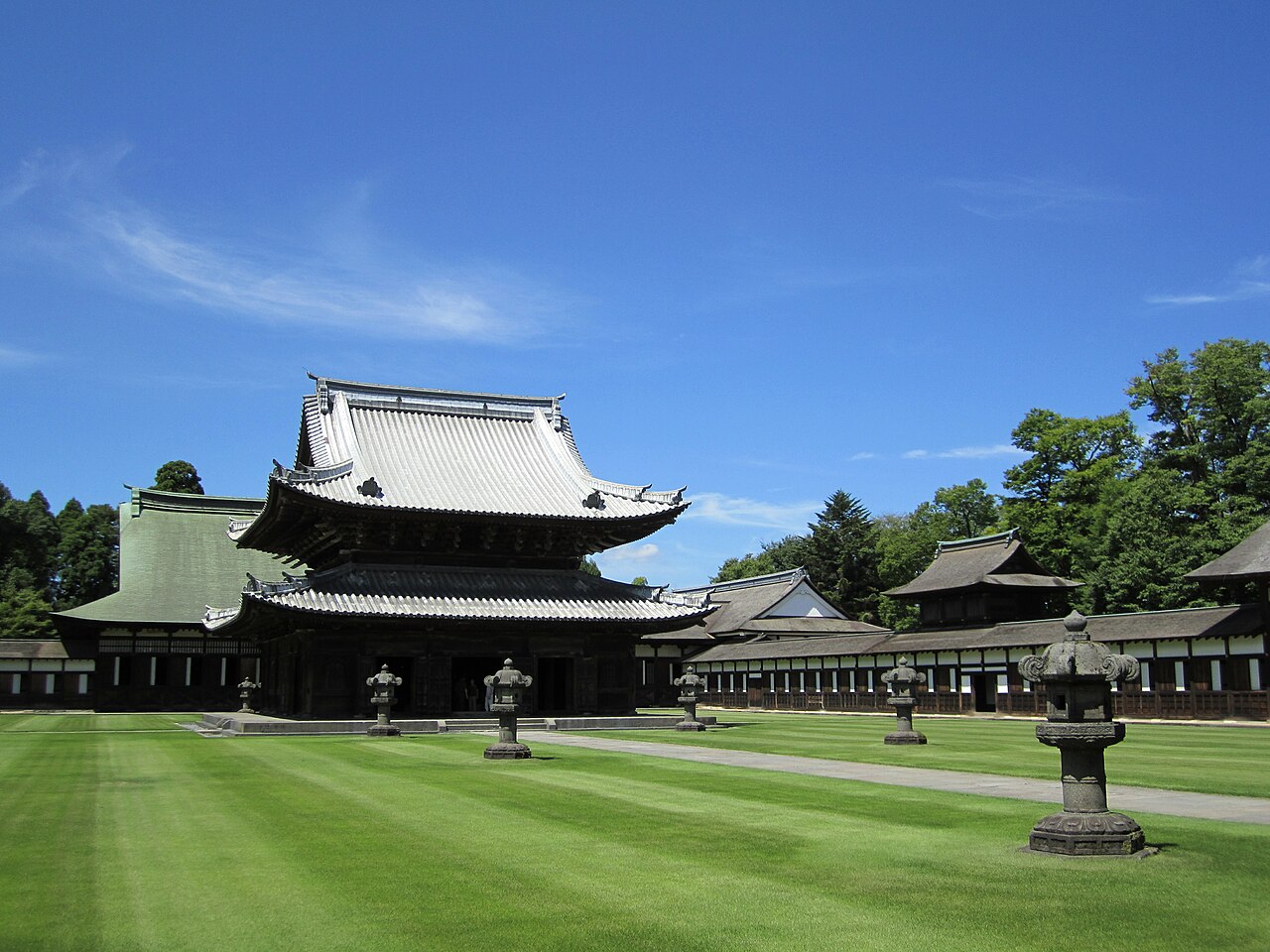
What sets Zuiryu-ji apart is its architecture and, above all, its layout. The temple is built in a strict, symmetrical arrangement modeled on Chinese Zen monastery design: the Sanmon gate, the Butsuden (Buddha hall), and the Hatto (Dharma hall) stand in a precise line along the central axis, with subsidiary buildings mirrored on either side and the whole complex linked by roofed corridors that form an enclosed rectangle. Visitors can walk almost the entire temple under cover, and the balanced, geometric composition — unusual in Japan, where temple layouts are often more organic — gives the place a calm, ordered majesty. Three of its structures, the Sanmon gate, the Butsuden, and the Hatto, are the designated National Treasures, while other buildings are Important Cultural Properties.
The Butsuden is a particular masterpiece, its lead-tiled roof and elegant proportions representing the refined tastes of the early Edo period, and the great Sanmon gate is one of the most impressive in the region. Inside, the halls house Zen imagery and the memorial to the Maeda lords whose patronage created the temple. The raked gravel courtyard and surrounding gardens complete a scene of disciplined serenity, and seasonal evening illuminations transform the corridors and gate into a glowing tableau.
Zuiryu-ji is closely tied to the history of Takaoka itself. The Maeda clan, one of the wealthiest and most powerful samurai families of the Edo period, developed the town as a center of casting and craftsmanship — a heritage still alive in Takaoka's famous bronze and copperware, including the great bronze Buddha nearby. A visit to the temple thus opens a window onto both the spiritual and economic history of the region.
The temple is conveniently located between Takaoka and Shin-Takaoka stations, an easy 15-minute walk from the shinkansen stop at Shin-Takaoka or a short ride from central Takaoka, making it a simple and worthwhile stop for travelers on the Hokuriku Shinkansen. Admission is modest, and the compact grounds can be appreciated in about an hour. For anyone interested in Zen architecture, samurai history, or simply a moment of ordered calm, Zuiryu-ji is Toyama's cultural treasure and one of the architectural highlights of the entire Hokuriku region.
A local's tip
Note the rare symmetrical layout — the Buddha hall, Dharma hall, and gate aligned and linked by roofed corridors, unique among Japan's Zen temples.
Best time to visit
Year-round; evening light-ups are held seasonally
Getting there
From Shin-Takaoka Station on the Hokuriku Shinkansen, walk about 15 minutes, or take a short bus or taxi from Takaoka Station.
Good to know
- Parking
- Restrooms
Plan the whole trip offline
Zuiryu-ji Temple is one of many places in the Real Japan app — with turn-by-turn directions, nearby spots and full offline maps you can use with no signal.