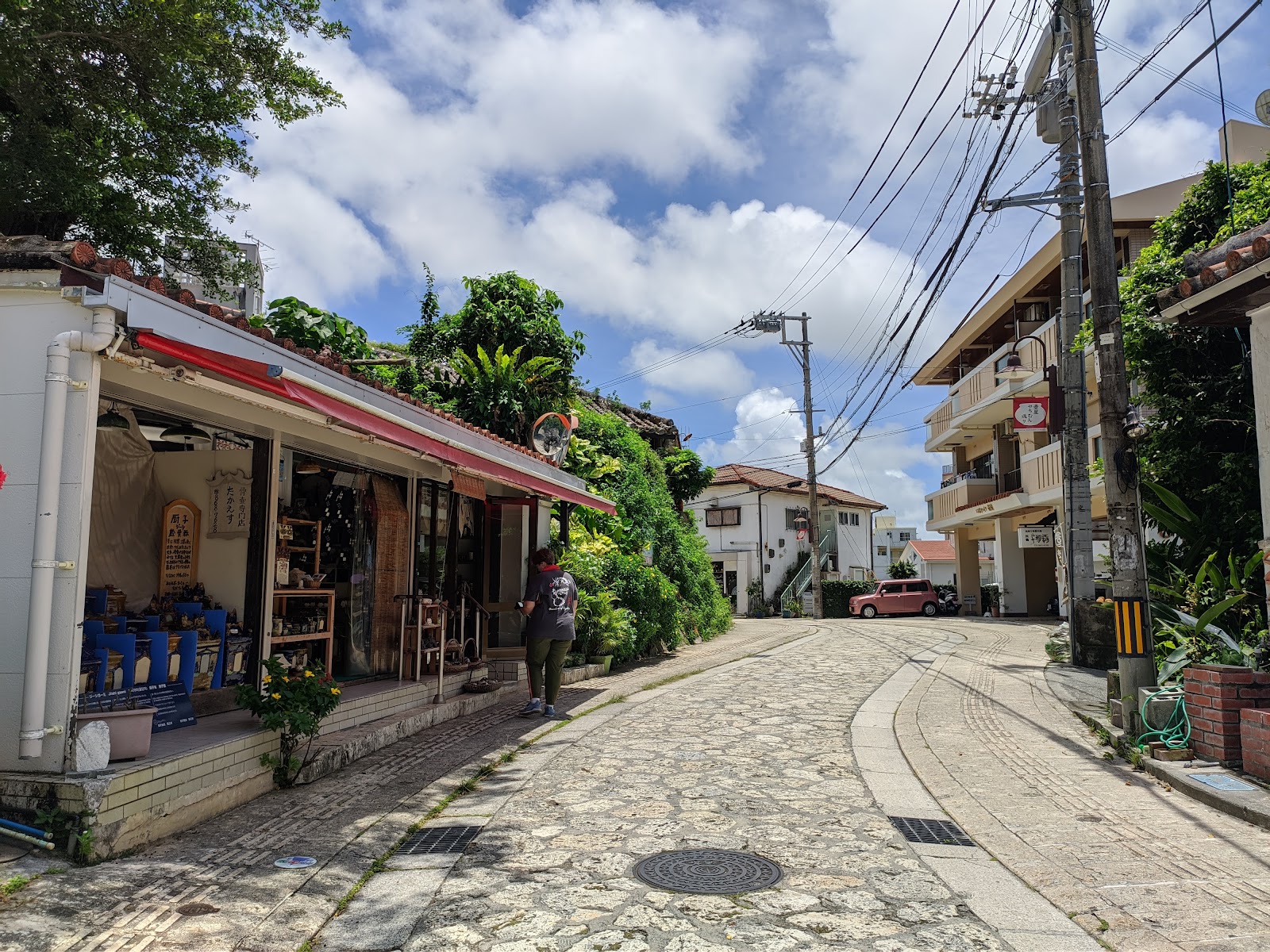
A historic pottery district in central Naha where Okinawan yachimun ceramics have been made for over three centuries.
Tsuboya Yachimun Street is the heart of Okinawa's pottery tradition, a charming stone-paved lane and its surrounding lanes in central Naha where the island's distinctive ceramics — known locally as yachimun — have been produced for more than three hundred years. Just a short walk from the bustle of Kokusai-dori and Makishi Market, it feels like a different, older world, and it is the best place in the prefecture to understand and buy authentic Okinawan pottery.
The district's story began in 1682, when the Ryukyu Kingdom consolidated scattered kilns into this single Tsuboya quarter to encourage the craft. Generations of potters settled here, and the neighbourhood grew into a dense community of workshops, kilns and merchant houses. Yachimun developed its own bold identity: thickly potted, generously glazed everyday wares — plates, bowls, sake flasks, teapots and the famous shisa lion-dog guardians — often decorated with vigorous brushwork in browns, greens and cobalt, warmer and earthier than mainland Japanese ceramics. The style influenced Japan's twentieth-century folk-craft (mingei) movement, whose leaders praised Tsuboya's honest, functional beauty.
Today the street is lined with galleries, studios and shops where you can browse and buy directly from makers, watch potters at the wheel, and pick up everything from a single rice bowl to a striking pair of roof shisa. Tucked among the workshops are historic remnants of the trade, most notably the Nanmin-gama, a preserved climbing kiln (noborigama) whose stepped brick chambers once fired great batches of pottery up the hillside; such kilns were largely relocated out of the city as it grew, making this survivor precious. The small Tsuboya Pottery Museum nearby traces the craft's history with displays of old wares and explanations of glazing and firing techniques.
Wandering the quarter is a pleasure in itself. The main street is paved with characteristic Ryukyuan stone, red-tiled roofs bristle with grinning shisa, and quiet side alleys reveal old walls, potters' homes and hidden cafes where you can rest with Okinawan sweets and coffee served, appropriately, in local ceramics. The pace is slow and the atmosphere authentically local, a welcome contrast to the souvenir-shop energy of nearby Kokusai-dori.
Because it sits in central Naha, Tsuboya is easy to reach on foot from the Yui Rail monorail at Makishi, and it pairs naturally with a walk through the covered arcades and the public market. Allow around an hour to an hour and a quarter to browse the galleries, admire the shisa and kilns, and perhaps carry home a hand-thrown souvenir with real provenance. For anyone interested in craft, culture or simply the older texture of the city, Tsuboya Yachimun Street is one of central Okinawa's most rewarding strolls.
A local's tip
Look for the pairs of shisa lion-dog guardians on the rooftops and gateposts — Tsuboya potters have made them for centuries — and duck down the stone-paved side lanes to find the old climbing kiln, the Nanmin-gama, preserved among the workshops.
Best time to visit
Daytime, when the workshops and galleries are open
Getting there
From Makishi Station on the Yui Rail monorail, walk south past Kokusai-dori and Makishi Public Market; the pottery street begins a short way beyond.
Good to know
- Cafes
- Museum
- Restrooms
Plan the whole trip offline
Tsuboya Yachimun Street is one of many places in the Real Japan app — with turn-by-turn directions, nearby spots and full offline maps you can use with no signal.