Japan's oldest public school for commoners, a serene 1670 Confucian academy ringed by a graceful curved stone wall deep in a Bizen valley.
Shizutani School (Kyu-Shizutani Gakko) is the oldest surviving public school in the world built for ordinary people, founded in 1670 by Ikeda Mitsumasa, the reform-minded daimyo of Okayama. Unlike the domain schools reserved for samurai, Shizutani was created to educate commoners in Confucian ethics and classical learning, an extraordinarily progressive idea for feudal Japan. It operated for more than two centuries and its ideals influenced the spread of public education across the country. Today the entire complex is designated a Special Historic Site, and its main lecture hall (Kodo) is a National Treasure.
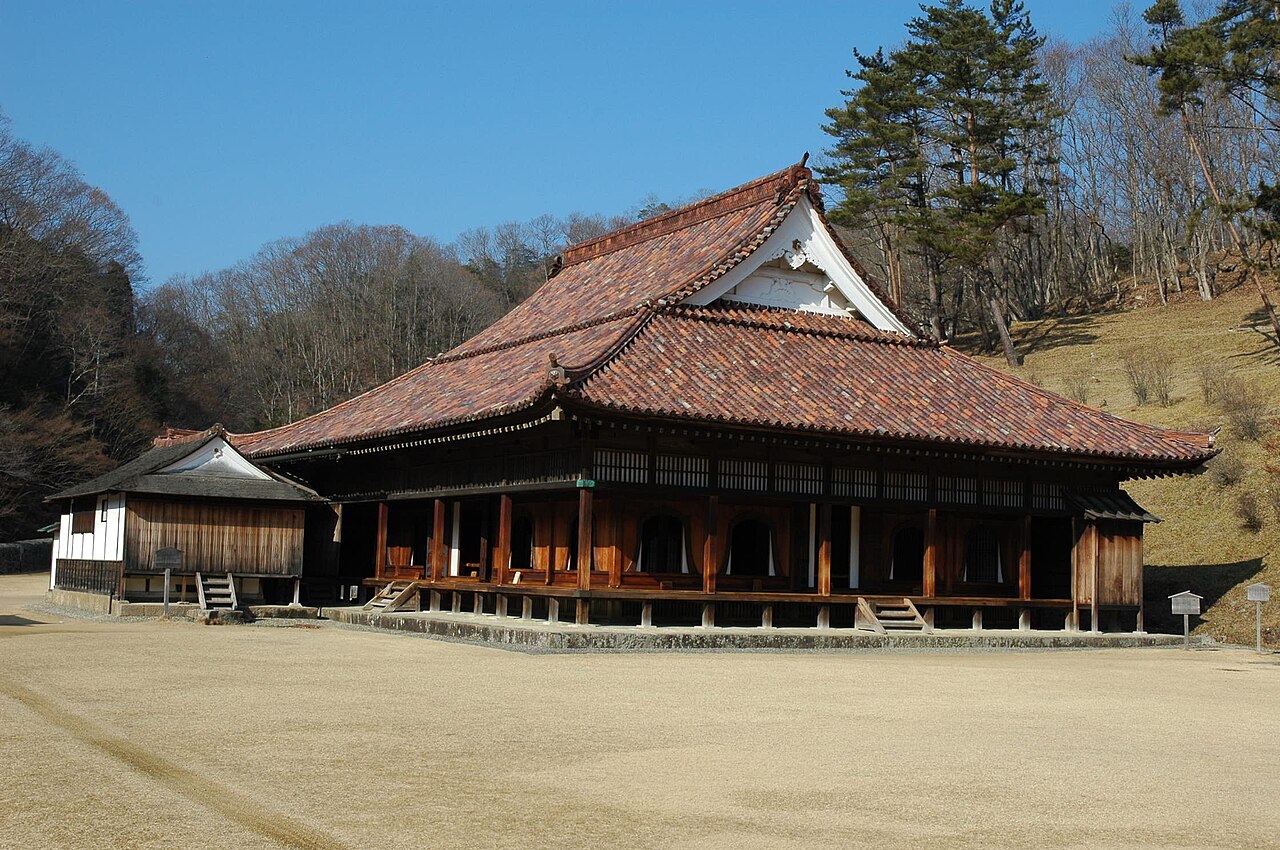
The school sits deliberately away from towns, tucked into a quiet wooded valley in Bizen so students could concentrate on study. The first thing visitors notice is the remarkable kamaboko-gata stone wall that undulates around the grounds like a gentle wave, built of fitted granite without mortar and still perfectly intact after 350 years. Inside stands the Kodo lecture hall, roofed with distinctive Bizen-ware tiles whose iron-rich clay has weathered to a deep russet sheen. Its floors of polished zelkova are so lustrous that the surrounding greenery reflects in them. Around it are the shrine to Confucius (Seibyo), the shrine honoring the founder, a study hall, and an archive.
A notable detail is the pair of great kaya trees planted in the Seibyo courtyard. Each autumn they blaze crimson and amber, framed against the black tiled roofs and the curving wall, creating one of Okayama's most photographed seasonal scenes; the grounds are illuminated on select November evenings. In spring, cherry and plum soften the austere lines of the architecture.
The visiting experience is calm and contemplative rather than flashy. You can walk the grounds, step into the reverent hush of the lecture hall, and read displays explaining the school's philosophy and its role in Japanese educational history. Because the site is compact and mostly level once you enter, it suits most visitors, though the approach involves a modest uphill walk from the parking area. Allow about an hour to 90 minutes.
Accessibility is the main challenge: the school is genuinely off the beaten path. The nearest rail access is Yoshinaga Station on the JR Ako Line, roughly 40 minutes east of Okayama Station. From Yoshinaga it is about 3 km to the school, a 10-minute taxi ride or a 40-minute walk; taxis are limited so booking ahead or arranging pickup helps. Drivers will find free parking. Because it lies within the ICOCA IC-card area and on a JR line, rail access is covered by the Japan Rail Pass, but the last leg from the station is not.
The best times to visit are the autumn foliage season, when the kaya trees peak, and spring for cherry and fresh green. Opening hours are generally 9:00 to 17:00 daily, with a small entrance fee around 400 yen. Combine a trip here with the nearby Bizen pottery town of Imbe and the Osafune sword museum, both a short hop back along the Ako Line, for a full day exploring Bizen's craft and cultural heritage.
A local's tip
Come in mid-to-late November when the two large kaya (Chinese pistache) trees inside the walled compound turn brilliant red and gold and are lit up in the evenings.
Best time to visit
Daytime
Getting there
From Okayama Station take the JR Ako Line east about 40 min to Yoshinaga Station, then a 10-min taxi (approx 3 km) or 40-min walk uphill into the valley. A community bus runs on limited days; a car is easiest.
Good to know
- Parking
- Restrooms
Plan the whole trip offline
Shizutani School is one of many places in the Real Japan app — with turn-by-turn directions, nearby spots and full offline maps you can use with no signal.