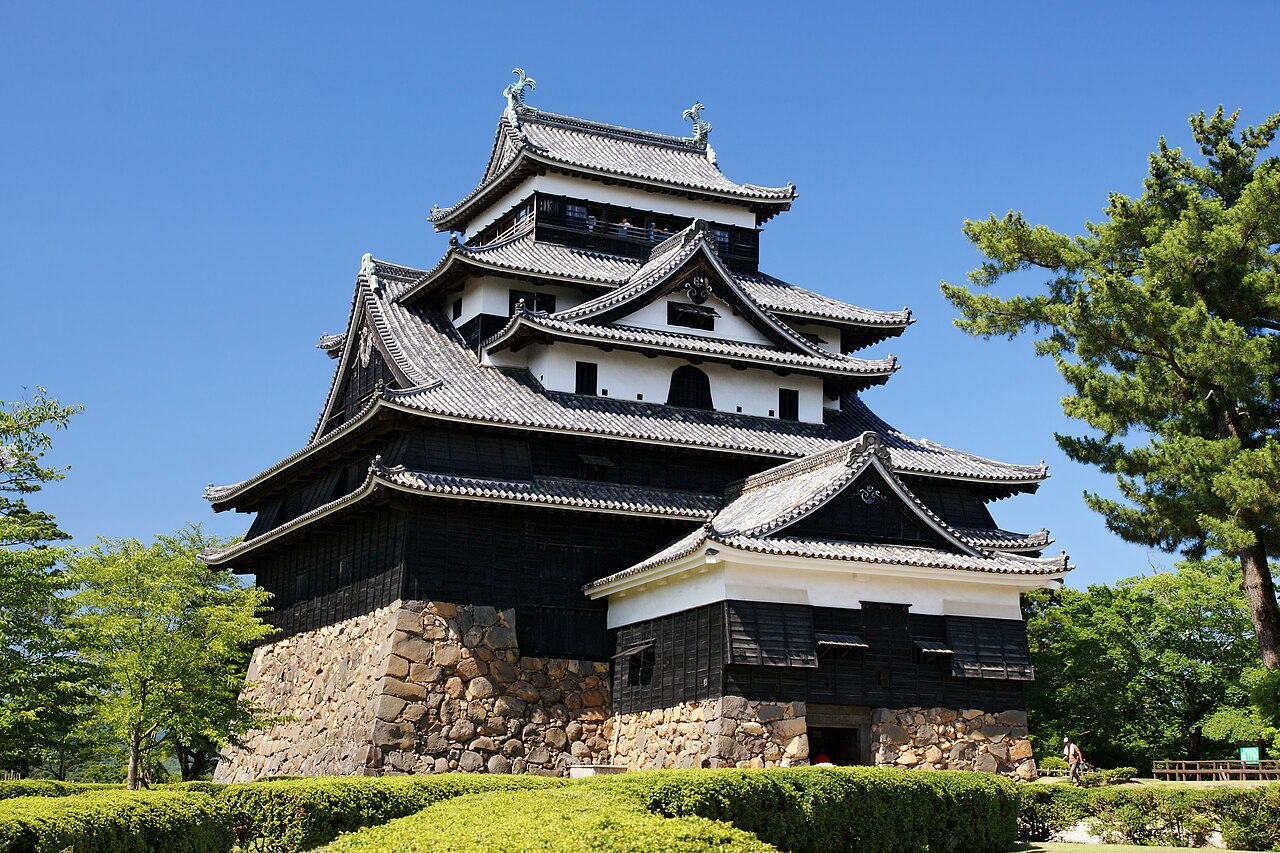
One of only twelve surviving original castle keeps in Japan and a designated National Treasure, wrapped in black wood above the moats of the old San'in castle town.
Matsue Castle rises above the city on a low hill called Kameda, its dark wooden walls earning it the nickname the "black castle" and a place among the most atmospheric fortresses in Japan. Completed in 1611 by the daimyo Horio Yoshiharu, it is one of only twelve Japanese castles whose original wooden keep still stands, and in 2015 it was elevated to the status of National Treasure, joining an elite handful that includes Himeji and Matsumoto.
Unlike the gleaming white plaster of Himeji, Matsue was built for defence in a cold northern province, and its sombre boarded exterior gives it a brooding, battle-ready character. The five-story keep looks smaller from outside than it is: inside are six levels, connected by steep original staircases of unpainted zelkova wood. As you climb you pass displays of samurai armour, old maps of the castle town and one of the largest surviving collections of period weaponry, before emerging onto the top-floor observation gallery. From here the whole "water city" spreads out below, with Lake Shinji shimmering to the west and the Sea of Japan visible on clear days.
The castle's survival is itself a story. During the Meiji era, when the government ordered most feudal castles demolished, Matsue's keep was scheduled to be torn down and sold for scrap. Local citizens and a former samurai raised the money to buy it back, saving the structure that had almost been lost forever. Much of the stonework of the base, the gnarled pines on the ramparts and the deep encircling moat remain from the Edo period.
The surrounding Jozan Park is one of Matsue's finest spots for the seasons: several hundred cherry trees bloom in April, making it one of the region's top hanami sites, while autumn brings fiery maple colour to the moat's edge. Shrines, a small history museum and a teahouse dot the grounds, and the northern side connects directly to the Shiomi Nawate samurai street.
One of the best ways to appreciate the fortress is from the water. The Horikawa sightseeing boats make a leisurely fifty-minute loop of the surviving moat, ducking under seventeen low bridges (the boat's roof lowers dramatically for the smallest ones) while a boatman narrates and often sings a local folk song.
Best visited in early morning light or during the seasonal illuminations, Matsue Castle is the anchor of any visit to Shimane. Give yourself at least ninety minutes to climb the keep, wander the moat and let the quiet, unrestored authenticity of a genuine Edo-period stronghold sink in — a rarer experience than the reconstructed concrete keeps found in most Japanese cities.
A local's tip
Ride the Horikawa pleasure boat around the surviving moat first, then climb the keep at opening time before the tour groups arrive.
Best time to visit
Autumn foliage or spring cherry blossom; early morning
Getting there
From Matsue Station take the Lakeline loop bus (about 10 minutes) to Otemae, or walk 25 minutes north across the Ohashi River. The main keep sits inside Jozan Park.
Good to know
- Wi-Fi
- Restrooms
- English signage
Plan the whole trip offline
Matsue Castle is one of many places in the Real Japan app — with turn-by-turn directions, nearby spots and full offline maps you can use with no signal.