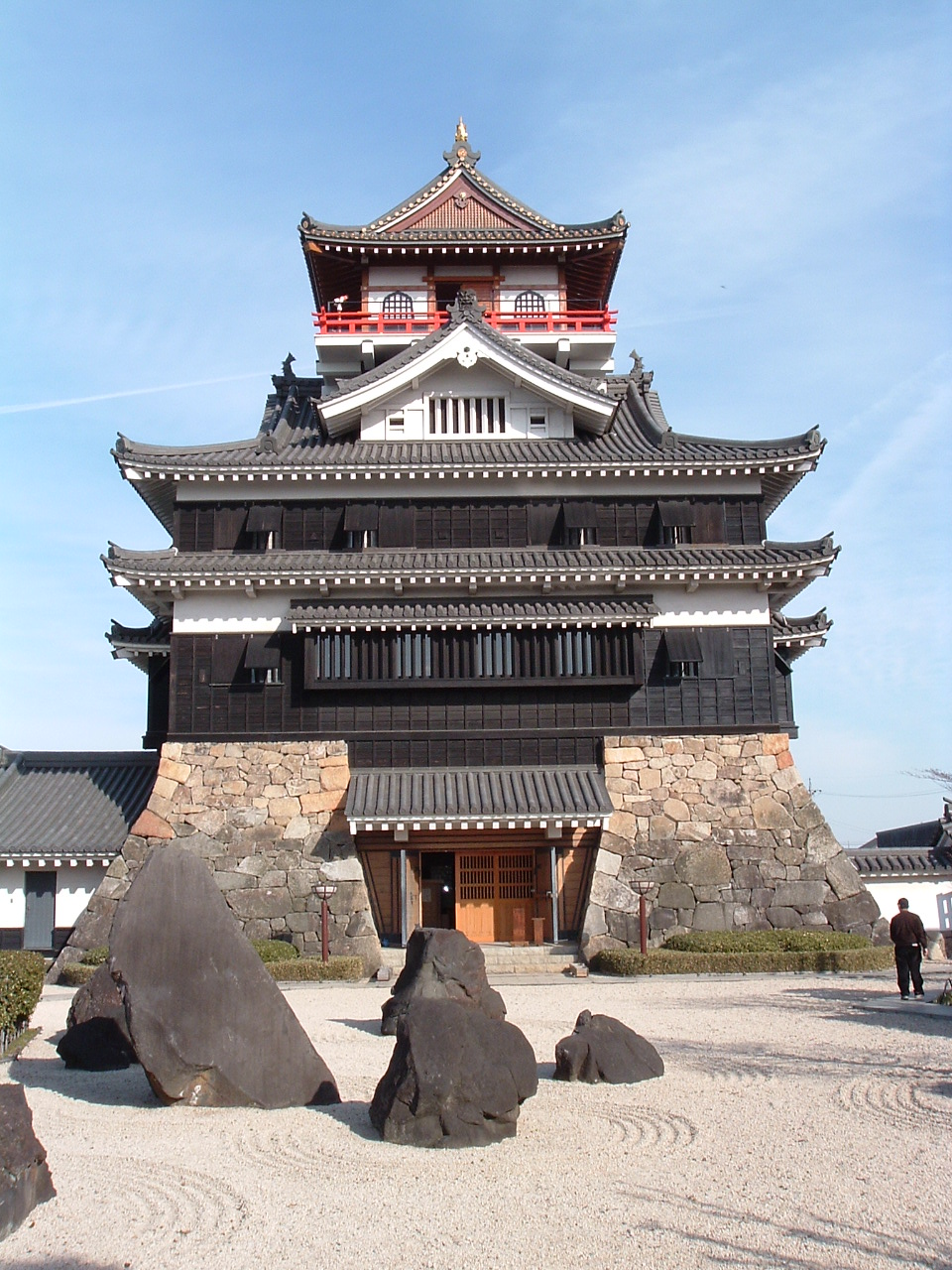
The reconstructed riverside castle of Oda Nobunaga's power base, cradle of Japan's unification.
Kiyosu Castle sits just outside Nagoya on the banks of the Gojo River and, though modest in size today, it occupies an outsized place in Japanese history. During the turbulent Sengoku (Warring States) period, Kiyosu was the seat from which the young warlord Oda Nobunaga launched his campaign to unify Japan. It was here, in 1560, that Nobunaga famously rode out to the Battle of Okehazama and defeated the much larger army of Imagawa Yoshimoto — a stunning upset that set him on the path to national dominance. Kiyosu remained a centre of power for decades and was the location of the pivotal 1582 Kiyosu Conference, at which Nobunaga's retainers, including Toyotomi Hideyoshi, decided the succession after his assassination.
The castle's later history explains why it feels small today. In the early 1600s the Tokugawa relocated the entire town, castle, temples and population a few kilometres southeast to found Nagoya, dismantling Kiyosu in a mass move known as the "Kiyosu koshi." Materials from the old castle, including a turret, were even reused at the new Nagoya Castle. As a result, nothing of the original fortress survives on site. The elegant three-storey keep visitors see now is a 1989 reconstruction, built in a picturesque style on the far bank of the river from where the historical castle actually stood.
What the modern castle lacks in authenticity it makes up for in atmosphere and views. A striking vermilion bridge, the Otebashi, arcs across the Gojo River to the keep, and the small but well-kept grounds include a garden and a statue of Nobunaga and his wife Nohime. Inside, the tower functions as a local history museum with displays on the Oda clan, Sengoku warfare and the founding of Nagoya, and its top-floor observation deck offers a wide panorama: the skyscrapers of Nagoya to the southeast, the Owari plain, and — a favourite with railfans — the Tokaido Shinkansen and conventional lines streaking past below. In spring the riverbanks bloom with cherry blossoms, making it the prettiest time to visit.
Kiyosu makes an easy and rewarding half-day trip from central Nagoya. It is only about ten minutes away by Meitetsu train to Shin-Kiyosu Station, followed by a pleasant fifteen-minute walk, and JR's Kiyosu Station offers an alternative approach. Admission to the keep is a very reasonable 300 yen, and the compact site can be seen in an hour or so, leaving time to stroll the riverside park.
For anyone interested in the age of the great unifiers — Nobunaga, Hideyoshi and Ieyasu — Kiyosu is a meaningful pilgrimage, the launch point of the drama that ended Japan's long civil wars. It pairs naturally with a visit to Nagoya Castle, the grander fortress the Tokugawa built after emptying Kiyosu, letting you trace in a single day the shift of power that created the modern city.
A local's tip
The current keep sits across the river from the true historical site — cross the vivid red Otebashi bridge for the classic photo, and climb the tower for a clear view of Nagoya's skyline and the Shinkansen speeding past.
Best time to visit
Spring, when the riverside cherry trees bloom around the castle
Getting there
From Nagoya take the Meitetsu Line to Shin-Kiyosu Station (about 10 minutes) and walk 15 minutes, or ride JR to Kiyosu Station; the castle stands beside the Gojo River.
Good to know
- Gift shop
- Restrooms
- English signage
Plan the whole trip offline
Kiyosu Castle is one of many places in the Real Japan app — with turn-by-turn directions, nearby spots and full offline maps you can use with no signal.