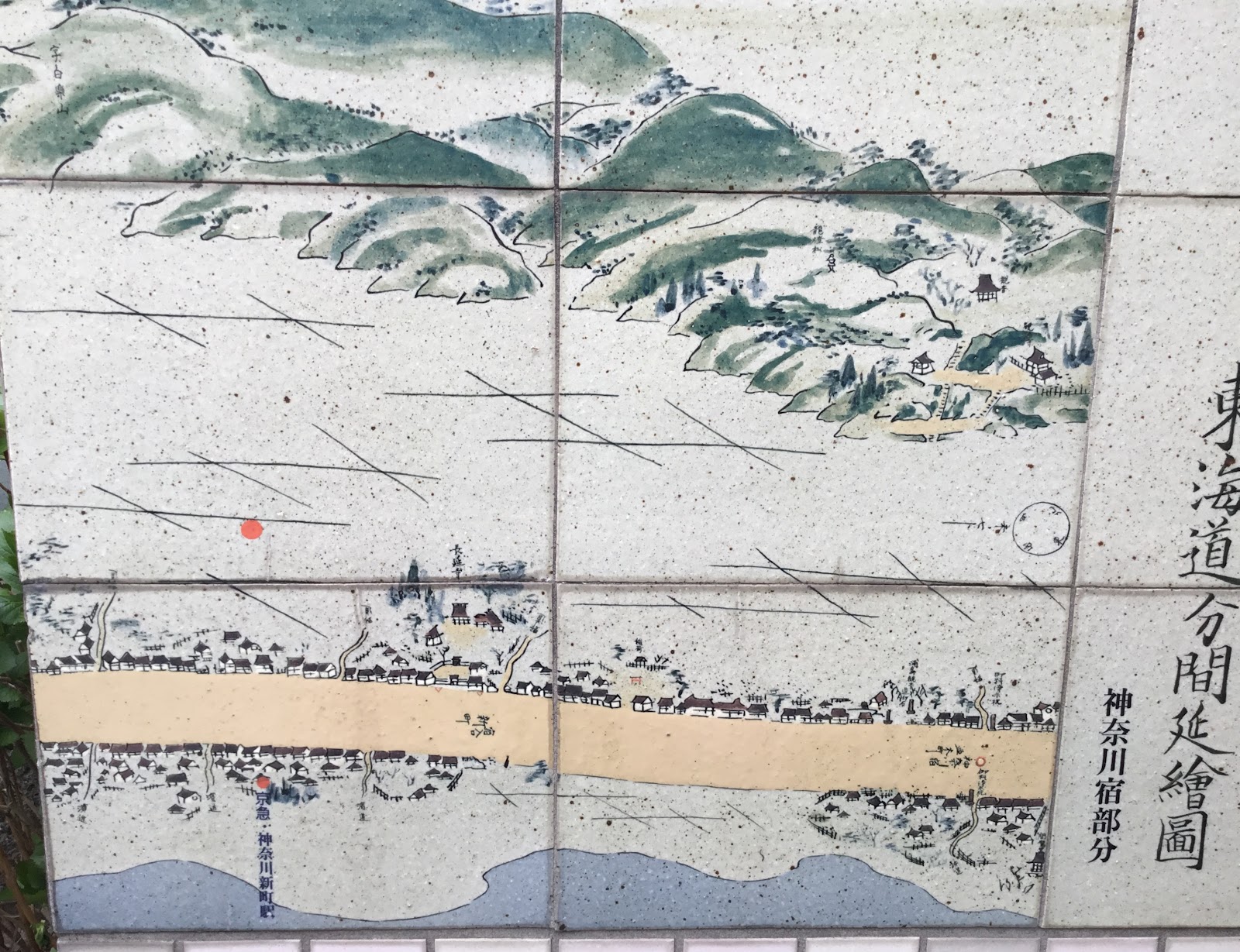
The old Tokaido highway post town north of central Yokohama, where Edo-era travellers rested and 1860s foreign consulates were quartered in its hillside temples.
Kanagawa-juku is a district steeped in a much older story than the famous harbourfront a few kilometres to the south. Long before Yokohama existed as an international port, this was one of the fifty-three post stations of the Tokaido, the great highway that connected Edo — modern Tokyo — with the imperial capital of Kyoto during the Edo period. As the third station out from Edo, Kanagawa-juku was a bustling waypoint where travellers, merchants, pilgrims and processions of feudal lords stopped to rest, change horses and find lodging. It even featured in Hiroshige's celebrated woodblock series depicting the stations of the Tokaido.
At its Edo-era height the town stretched along the highway crowded with inns, teahouses and shops, and its position on a hillside overlooking the bay gave it wide sea views that artists loved to capture. Rapid modernisation and, above all, the reclamation of the shoreline for docks and railways erased most of that literal landscape — the sea the old travellers gazed upon is now far away behind port infrastructure — but the district retains a surprising density of historical traces for those who know to look.
The most compelling layer of Kanagawa-juku's history belongs to the dramatic 1859-60 period when Yokohama opened to foreign trade. Because the nearby port was being hastily built, the hillside temples of Kanagawa-juku were commandeered to serve as the first foreign consulates and lodgings. Several of these temples still stand, and a signposted historical walking trail threads them together, with plaques explaining which nation occupied which hall. Walking the route, you pass from temple to temple through quiet residential streets, piecing together a moment when this old highway town briefly became the diplomatic front line of Japan's encounter with the West.
For visitors, Kanagawa-juku is a low-key, atmospheric stroll rather than a blockbuster attraction, best suited to travellers with an appetite for history who enjoy reading the past in an ordinary modern streetscape. The rewards are subtle: an old milestone, a temple gate that once flew a foreign flag, an information board overlaying the vanished Edo townscape on today's streets. Along the way are a few long-established shops and temples worth a pause.
Practically, the walk is flat to gently sloping and easily done in an hour or so. Temples generally welcome visitors during daylight hours, and the trail is free throughout. Because the district is compact and close to the city centre, it slots neatly into a broader Yokohama itinerary as a contemplative counterpoint to the busy harbour sights.
Access is straightforward: Kanagawa Station on the Keikyu Main Line and Higashi-Kanagawa Station on the JR Keihin-Tohoku Line both lie within the old post-town area, just north of central Yokohama. Bring curiosity and perhaps a printed map of the historical trail, and Kanagawa-juku will reward you with the quieter, deeper history beneath Yokohama's modern face.
A local's tip
Follow the signposted 'Kanagawa-juku Historical Trail,' which links the temples that served as foreign consulates in the 1860s — including the site where the American consulate was established.
Best time to visit
Daytime, following the marked historical walking trail
Getting there
Kanagawa Station on the Keikyu Main Line and Higashi-Kanagawa Station on the JR Keihin-Tohoku Line both sit within the old post-town area, a few minutes north of central Yokohama.
Good to know
- Wi-Fi
- Temples
- Restrooms
Plan the whole trip offline
Kanagawa-juku (Old Tokaido Post Town) is one of many places in the Real Japan app — with turn-by-turn directions, nearby spots and full offline maps you can use with no signal.