Hidden subshrine of Izumo Taisha with a thousand-year-old muku tree and the spot where ancient bronze and jade treasures were unearthed.
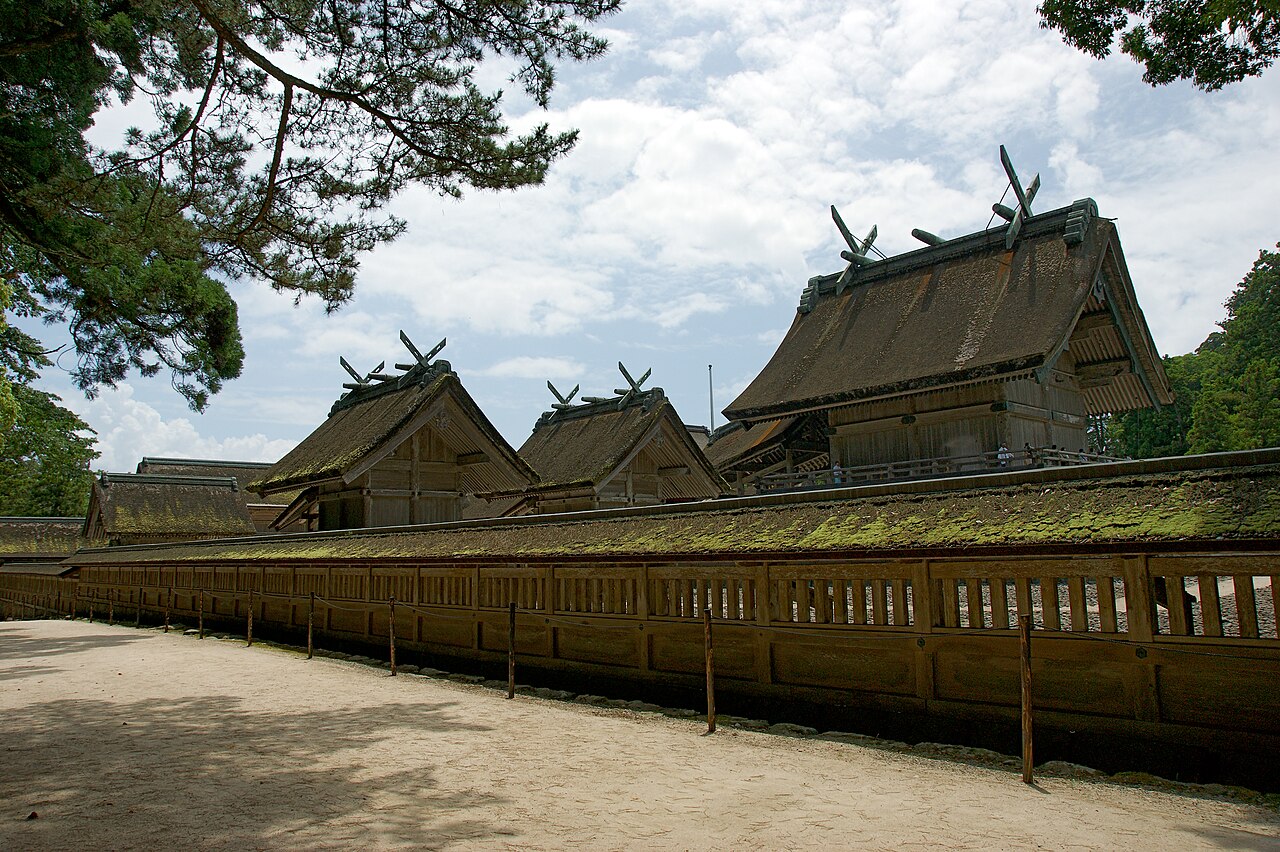
Kamimusubi-no-yashiro, whose formal name is Kamimusubi Inochinushi Shrine and which is known affectionately as Inochinushisha, is a small but deeply revered subshrine tucked into the wooded lanes just east of Izumo Taisha. Most visitors to the Grand Shrine never find it, yet for those who do it offers one of the most quietly powerful corners of the whole Kizuki district. It enshrines Kamimusubi-no-kami, one of the primordial creator deities of Japanese myth who appears at the very beginning of the Kojiki as a force of generation and life, and who in the Izumo tradition is credited with helping to revive and guide the great god Okuninushi.
The shrine is famous for two things. The first is the enormous muku tree, an Aphananthe aspera thought to be around a thousand years old, that towers over the little precinct. Gnarled, hollowed and buttressed with age, it is one of the celebrated great trees of Shimane and is itself an object of reverence, its presence lending the site the hush of an ancient grove. The second is a remarkable archaeological discovery: in 1665, when a stone was moved during major repairs to Izumo Taisha, a bronze spearhead and a curved jade magatama bead were unearthed at this spot. These finds, dating from a distant age, are preserved as important cultural properties and hint that this ground was held sacred long before the present shrine buildings.
Because its deity is a bringer of life and vitality, the shrine is quietly prayed to for health, for the safe growth of children and for renewal, and it has gained a reputation among knowledgeable pilgrims as a hidden power spot. The modest hall, the mossy stones and the great tree together create an intimacy that the grand halls of Izumo Taisha, for all their majesty, cannot match. There is no fee and rarely a crowd, and the whole visit takes only fifteen or twenty minutes, but it lingers in the memory.
The setting is easy and level, reached along peaceful residential lanes lined with pines and stone walls behind the Grand Shrine. It pairs naturally with a visit to Izumo Taisha itself and with the short walk out to Inasa-no-hama beach, and thoughtful travellers often string the three together into a half-day on foot. Spring greenery and autumn colour around the old tree are especially fine, though the shrine holds its atmosphere in every season.
To get here, ride the Ichibata Electric Railway Taisha Line to Izumo Taisha-mae Station, walk through the Grand Shrine grounds and continue past their eastern side for about ten to twelve minutes into Kizuki-higashi; the small shrine appears just off the path, marked by its towering tree. Standing beneath a tree that has watched over this ground for a millennium, beside earth that gave up treasures of a forgotten era, you touch a layer of Izumo far older and stranger than the guidebook sights nearby.
A local's tip
Greet the roughly thousand-year-old muku tree in front of the shrine, then look for the marker where a bronze spearhead and a jade magatama were dug up in the 1600s.
Best time to visit
Quiet weekday morning
Getting there
From Izumo Taisha-mae Station walk to Izumo Taisha and continue past its eastern edge for about 10-12 min into the Kizuki-higashi lanes; the shrine sits just off the pine-shaded paths behind the Grand Shrine.
Good to know
- Parking
Plan the whole trip offline
Kamimusubi-no-yashiro (Inochinushisha) is one of many places in the Real Japan app — with turn-by-turn directions, nearby spots and full offline maps you can use with no signal.