A serene samurai settlement near Satsumasendai with moss-covered stone walls and Kagoshima's last thatched samurai gate.
The Iriki Fumoto Samurai Village lies in the city of Satsumasendai and is one of the most atmospheric of the many fumoto, or samurai settlements, that the Satsuma domain scattered across its territory during the Edo period. Where Izumi is the largest and grandest, Iriki is prized for its intimacy and its almost timeless sense of age, its stone walls thick with moss and its layout still tracing the outline of a medieval fortress that predated the samurai houses themselves.
Iriki's history reaches back nearly 800 years, and the district uniquely layers two eras. Beneath the Edo-period samurai grid lie the winding contours of an older medieval fortification, so as you walk you move between the irregular, defensive curves of the medieval settlement and the more ordered lattice of the later samurai quarter. This overlap of periods gives Iriki a depth and complexity that rewards a slow, curious visit.
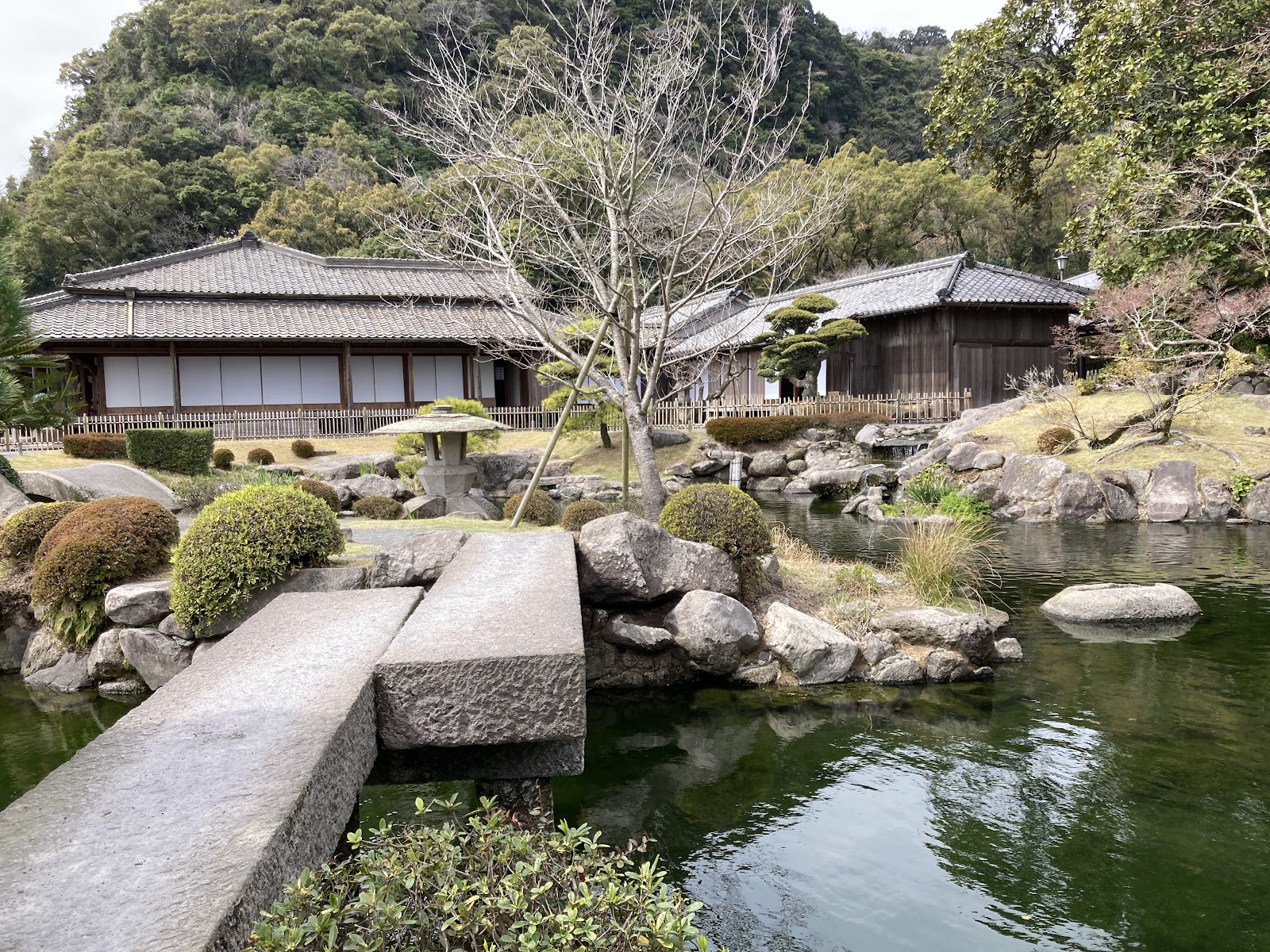
The defining feature of the village is its stonework. Mortarless walls of stacked stone, weathered and softened by centuries of moss, line the lanes and enclose the house plots, and their green-grey surfaces glow beautifully in soft light or after rain. Among the district's treasures is the only surviving thatched-roof gate to a samurai residence anywhere in Kagoshima Prefecture, a rare and evocative survival that anchors the historic streetscape and draws photographers and history enthusiasts alike.
Iriki remains a genuine, lived-in neighbourhood rather than a preserved museum, which lends it a quiet authenticity. There are no ticket gates on the streets and few crowds; you are free to wander the lanes, admire the walls and gardens, and absorb the deep tranquillity of a place where the rhythm of life has changed little in appearance for generations. Cherry and plum trees add colour in spring, fresh green fills the gardens in early summer, and autumn brings warm tones to the surrounding hills.
The fumoto system that produced Iriki was a distinctive feature of Satsuma governance. Rather than gathering its unusually large warrior class into one castle town, the domain settled samurai in fortified rural villages across its lands, both to defend the borders and to administer agriculture. This dispersal is why Kagoshima today has so many of these historic districts, and Iriki, with its ancient walls and singular thatched gate, is among the most rewarding to explore.
Because it is a working community, visitors are asked to be respectful, staying on the public lanes and treating residents' privacy with care. A visit of about an hour lets you take in the main streets, the thatched gate, and the finest stretches of wall, ideally at an unhurried pace with a camera in hand.
Reached in roughly thirty minutes by car from Sendai Station in Satsumasendai, Iriki is a little off the standard tourist trail, which is part of its charm. For travellers interested in samurai history who want something quieter and older-feeling than the more visited districts, Iriki delivers a genuinely moving encounter with the deep past of Satsuma, its mossy walls and lone thatched gate whispering of eight centuries of continuity.
A local's tip
Look for the only surviving thatched-roof samurai gate in Kagoshima Prefecture, and notice the moss-covered stone walls that give Iriki an even older feel than Izumi.
Best time to visit
Any season; fresh green in early summer
Getting there
From Sendai Station (Satsumasendai) on the Kyushu Shinkansen, it is about 30 minutes by car or taxi to the Iriki district.
Good to know
- Parking
- Restrooms
Plan the whole trip offline
Iriki Fumoto Samurai Village is one of many places in the Real Japan app — with turn-by-turn directions, nearby spots and full offline maps you can use with no signal.