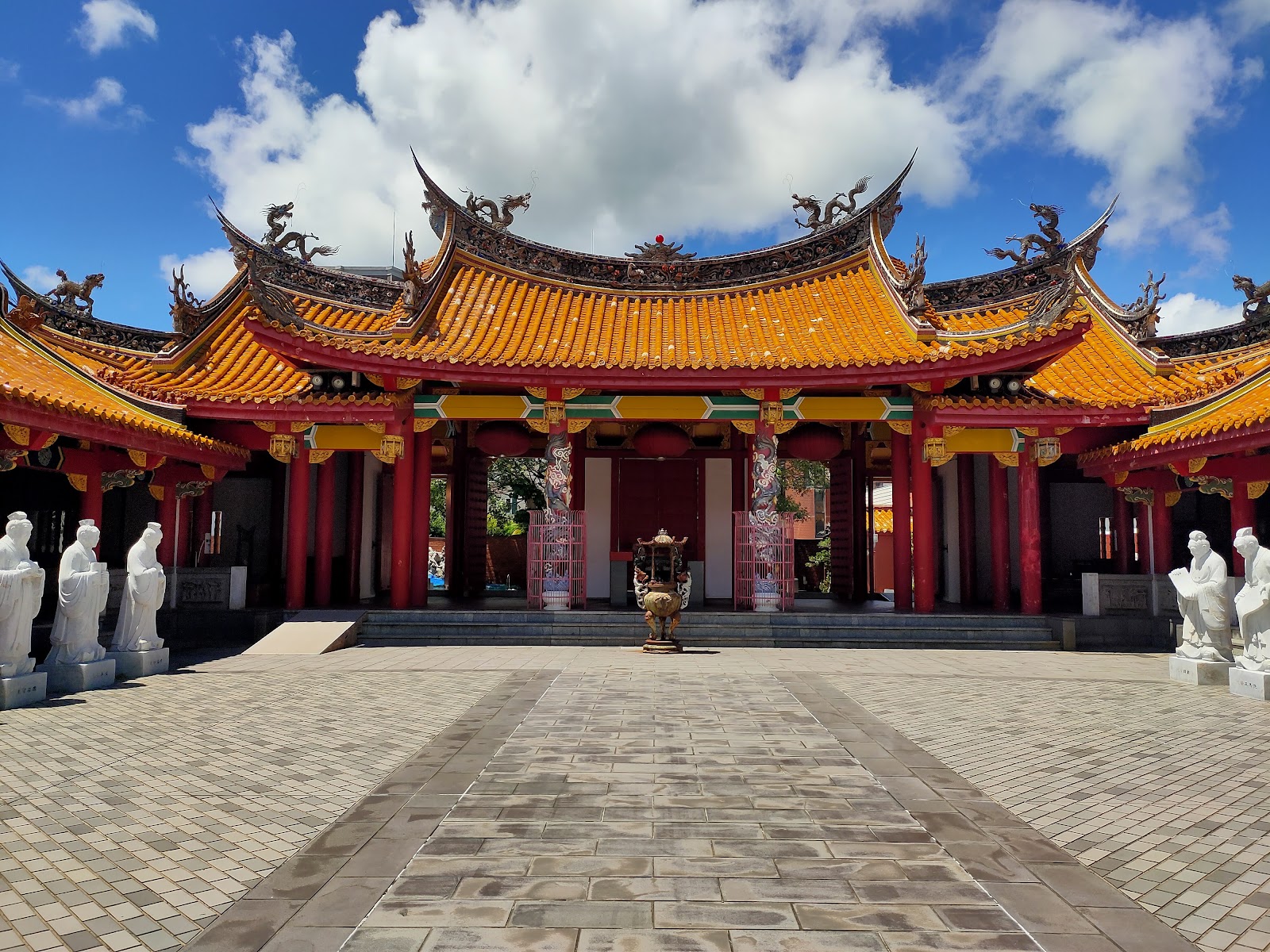
A vividly coloured Confucian shrine built by Nagasaki's Chinese community, the only one abroad constructed by Chinese hands.
The Confucius Shrine of Nagasaki, known in Japanese as Koshi-byo, is a dazzling burst of vermilion, gold and jade-green tile in the city's southern hills, and one of the most distinctive expressions of Nagasaki's centuries-old links with China. Built in 1893 by the local Chinese community with the support of the Qing government, it is said to be the only Confucian shrine outside China ever constructed by Chinese people themselves, and its architecture, ceremonies and treasures make it a vivid window into that heritage.
Nagasaki was for centuries Japan's principal gateway to the outside world. During the long period of national seclusion, it was one of the very few ports where foreign trade was permitted, and a substantial Chinese merchant community settled here, leaving a deep imprint on the city's food, festivals, temples and religion. The Confucius Shrine crowns this legacy. Dedicated to Confucius, the great philosopher whose teachings shaped East Asian thought and governance, it was raised so that the community could honour the sage in the proper manner, far from home.
Architecturally the shrine is a feast. Built in an authentic Chinese palatial style with materials brought from China, it blazes with colour: red-lacquered halls, yellow glazed roof tiles reserved in China for imperial and sacred buildings, intricate carved beams and a sweeping courtyard. That courtyard is lined with 72 life-size stone statues of Confucius's disciples, carved in China and shipped to Nagasaki, standing in solemn ranks that lend the space a striking, almost theatrical gravity. Dragons, phoenixes and other auspicious motifs adorn the roofs and walls, and the whole ensemble feels transported wholesale from the mainland.
Behind the shrine halls lies its greatest surprise: a museum, the Historical Museum of China, which displays rotating exhibitions of genuine antiquities lent by major institutions in Beijing, including the Palace Museum (the Forbidden City) and the National Museum of China. For visitors, this offers the rare chance to see authentic Chinese imperial artefacts, art and relics without leaving Japan, and it deepens the shrine's role as a bridge between the two cultures.
The shrine also remains a living centre of ceremony. Confucian rites are still performed here on important dates, and the community celebrates Chinese festivals with music and ritual, keeping the traditions alive rather than embalmed. Its location, near the foot of the Minamiyamate slopes below Glover Garden and close to Oura Church and the former foreign settlement, places it squarely on Nagasaki's international-heritage trail.
For visitors, an admission fee covers both the shrine and its museum, and daytime hours suit the bright, colour-saturated architecture, which photographs beautifully in strong light. Allow around forty-five minutes to see the halls, the ranks of disciple statues and the exhibits. To get there, take tram Line 5 to Ouratenshudo and walk about five minutes. Exuberant, authentic and unlike anything else in Japan, the Confucius Shrine is a highlight of Nagasaki's uniquely cosmopolitan character.
A local's tip
Do not miss the museum at the rear, which displays genuine treasures on loan from Beijing's Palace Museum and National Museum of China — a rare sight outside China.
Best time to visit
Daytime; vivid colours photograph well in bright light
Getting there
From central Nagasaki take tram Line 5 to Ouratenshudo, then walk about 5 minutes. The shrine sits near the foot of the Minamiyamate slopes below Glover Garden.
Good to know
- Museum
- Gift shop
- Restrooms
Plan the whole trip offline
Confucius Shrine (Koshi-byo) is one of many places in the Real Japan app — with turn-by-turn directions, nearby spots and full offline maps you can use with no signal.