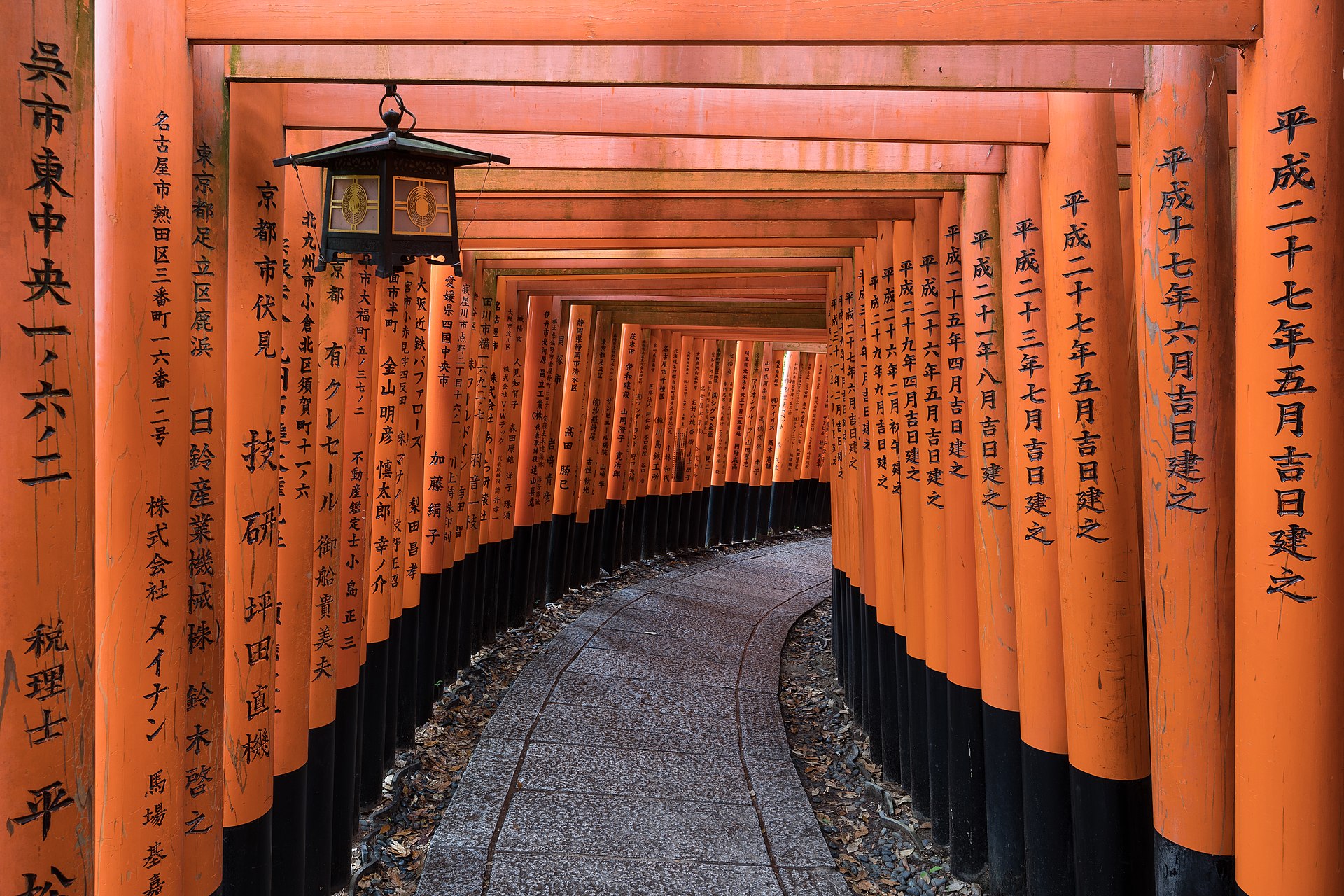
A Mountain Shrine Wrapped in Vermilion
Fushimi Inari Taisha is one of Kyoto’s most unforgettable sights: a seemingly endless tunnel of orange-red torii gates climbing through the wooded slopes of Mount Inari. At the foot of the mountain, worshippers pass beneath the imposing Romon gate and gather before the main shrine buildings. Beyond them, the path narrows, the city sounds fade, and the famous Senbon Torii—literally “thousands of torii”—unfolds into the forest.
The shrine is beautiful, but it is more than a photogenic walkway. Fushimi Inari is the head shrine of Inari worship in Japan, a tradition associated with rice, agriculture, prosperity, commerce, and household well-being. Small fox statues appear throughout the grounds because foxes are regarded as Inari’s messengers. Their stone faces may hold a key, jewel, scroll, or sheaf of rice, each suggesting a different aspect of the deity’s power.
Unlike many Kyoto attractions, Fushimi Inari is open at all hours, and there is no admission charge. That flexibility makes it easy to visit around another itinerary stop, but the mountain deserves more time than a quick photo at the first gate. Allow at least 90 minutes for the lower shrine and first torii tunnels; two to three hours gives you time to complete the mountain circuit at a comfortable pace.
History, Worship, and the Meaning of the Gates
Fushimi Inari’s origins are traditionally dated to 711, when Inari was enshrined on Mount Inari. The shrine was later moved to its present location in 816. Its influence grew alongside Kyoto’s development, and merchants and businesses began dedicating torii gates to express gratitude for success or to ask for continued prosperity.
Each gate is donated by an individual, family, company, or organisation. The donor’s name and date of dedication are recorded on the rear side, while the front faces the path. The gates vary in size and condition: some are broad and vivid, while others are smaller, weathered, and partly shaded by moss. Together they form a living record of ongoing devotion rather than a single historic installation.
At the main shrine, take a moment to observe the architecture and watch local worshippers. A standard visit involves a light bow before entering, cleansing your hands and mouth at the water pavilion, offering a coin, bowing twice, clapping twice, and bowing once more. You do not need to imitate every practice perfectly; quiet respect, keeping pathways clear, and following signs are the most important things.
What to See and Do on the Mountain
Begin at the large Romon gate and the worship hall below it. The lower precinct is lively, with fox imagery, offering boxes, ema prayer plaques, and stalls selling charms. The main Senbon Torii begins just behind the inner shrine. Here the gates stand close together, creating the iconic orange corridor. It is usually the busiest section, particularly in the morning and around sunset.
After the first tunnel, the route branches through a network of smaller shrines and stone markers. The path is clearly signed in Japanese and English, but it is also easy to wander onto a quieter side route. Keep following signs for “Mount Inari” or “summit” if you want the full climb. The surface changes from paved paths and steps to uneven stone, so shoes with reliable grip are worthwhile.
- Yotsutsuji intersection: After roughly 30 to 45 minutes of uphill walking, this viewpoint opens toward southern Kyoto. It is an excellent place to pause, especially if you do not want to continue to the summit.
- Upper shrines: Smaller sub-shrines, stone foxes, miniature torii, and flickering lanterns make the upper mountain feel more intimate than the entrance area.
- Mount Inari summit: The summit is about 233 metres above sea level. The view itself is limited by trees, but reaching the summit completes a peaceful circular walk and reveals the shrine’s devotional landscape.
- Mountain teahouses: A few simple eateries and drink stands appear along the route. Choices are limited and prices reflect the remote setting, so carry water and a small snack.
The complete loop is not technically difficult, but the continuous steps can be tiring in summer heat or after rain. You can turn around at any point without missing the essential experience. The descent follows the same general mountain route while offering different perspectives on the gates.
For navigation, the Real Japan app is useful on the ground: its offline maps and directions help you understand where you are on the mountain, while nearby-spot suggestions can point you toward less crowded shrines or a café after the walk. It is free on iOS and Android, which makes it a practical backup when mobile reception is inconsistent.
When to Go and How to Avoid the Crowds
Fushimi Inari is busy throughout the year, but the atmosphere changes dramatically with the time of day. Arrive before 8 a.m. for the best chance of walking through the lower torii with space around you. Early morning light filters between the gates and the shrine grounds feel more devotional than touristic. The mountain route becomes noticeably quieter beyond the first major torii tunnel, even when the entrance is crowded.
Late afternoon can also be rewarding. In summer, the forest provides shade, and the light becomes warm near sunset. Remember that the route is a mountain path with limited illumination in some areas; if you start late, leave enough time to descend safely before darkness. The shrine remains accessible at night, but a headlamp or phone light, sensible footwear, and extra caution are essential.
Spring brings mild walking weather and occasional cherry blossoms, while autumn adds colour to the wooded slopes, particularly in November. New Year is an especially important period for shrine visits, and Fushimi Inari can become extremely crowded. The first days of January, festival days, weekends, and public holidays all require patience. Summer is hot and humid, and mosquitoes may be present; bring water, sun protection, and insect repellent. Check the Real Japan app for current opening information at nearby attractions and suggested timing for combining Fushimi Inari with the rest of your Kyoto day.
Getting There, Eating Nearby, and Visiting Well
The nearest station is Inari Station on the JR Nara Line, directly opposite the shrine’s entrance. From Kyoto Station, local trains take only a few minutes, but rapid services may not stop at Inari, so check the service type before boarding. The shrine is also a short walk from Fushimi-Inari Station on the Keihan Main Line, which is convenient if you are travelling from central Kyoto, Gion, or along the Keihan corridor. Buses serve the broader area, but trains are generally more reliable when roads are congested.
Several streets near the stations sell snacks and casual meals. Look for inarizushi, sweet and savoury treats, grilled foods, noodles, and tea. Inarizushi is particularly fitting here: seasoned sushi rice is wrapped in a pouch of fried tofu, whose name connects it with Inari tradition. Eat in designated areas rather than while walking through the shrine, and dispose of rubbish carefully.
Fushimi Inari is an active place of worship, so avoid blocking gates or stairways for photographs. Do not climb on stone lanterns, touch sacred objects without permission, or use drones. Photography is welcome in many outdoor areas, but be considerate of people praying and of smaller side shrines where visitors may be seeking privacy. If you purchase an ema plaque or charm, follow the instructions for displaying or returning it.
Plan your day around your energy rather than treating the summit as a compulsory achievement. A thoughtful visit might begin with the main shrine, continue through the Senbon Torii, pause at Yotsutsuji, and then return for a meal in Fushimi. With offline directions and saved places in the Real Japan app, you can keep the route flexible and find your next stop without repeatedly unfolding a paper map. Fushimi Inari rewards both the first-time visitor who walks only the famous gates and the curious traveller who continues into the quieter forest, where Kyoto’s most recognisable shrine becomes a slower, more personal experience.