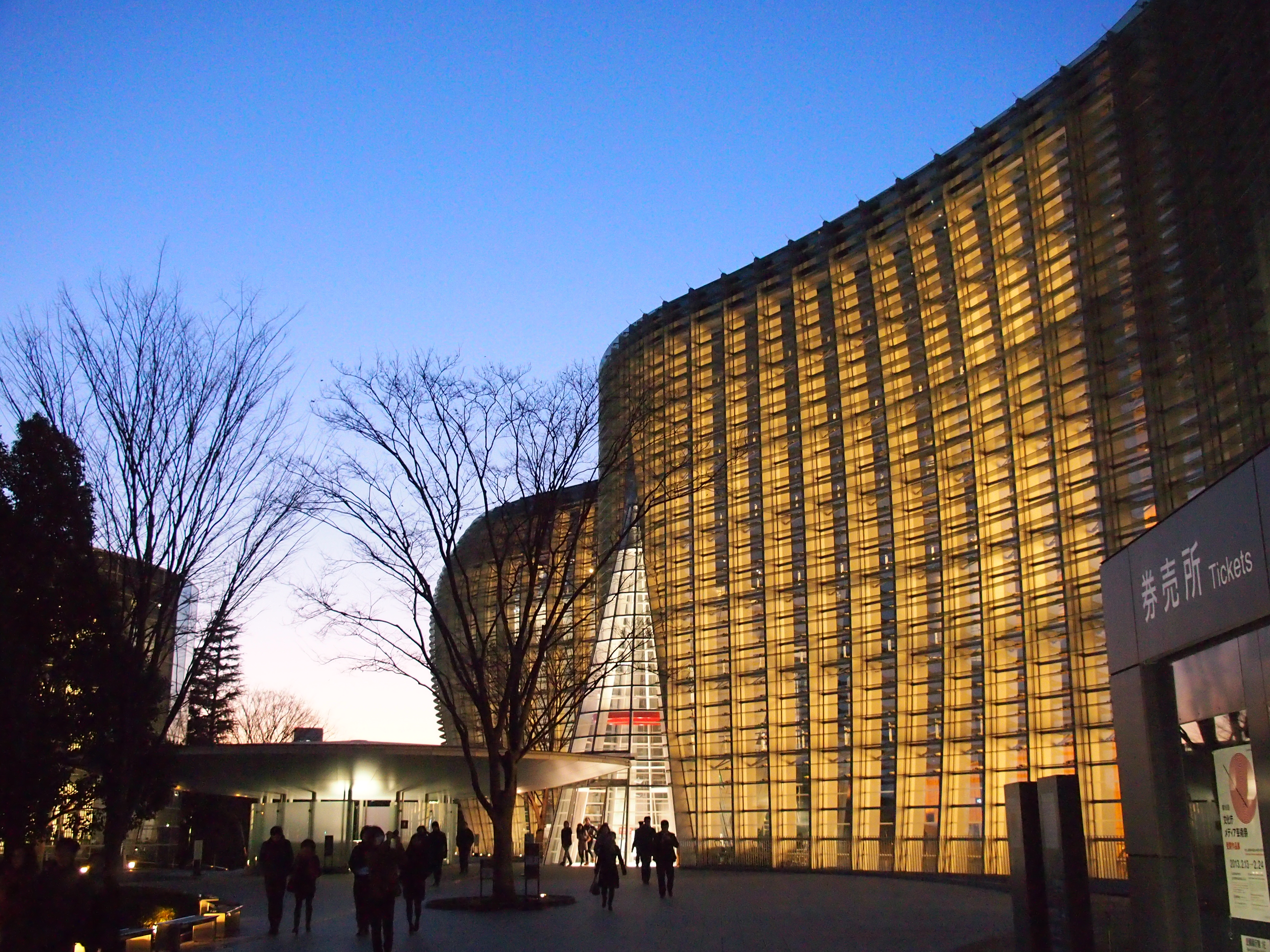
A vast, collection-free art center behind an undulating glass facade by Kisho Kurokawa, hosting Tokyo's biggest exhibitions.
The National Art Center, Tokyo is one of the most striking buildings in the city and a cornerstone of the Roppongi Art Triangle, the cluster of major museums that also includes the Mori and the Suntory. Opened in 2007, it is Japan's largest exhibition space, and it works on an unusual model: it holds no permanent collection of its own. Instead it is a kunsthalle, a grand set of column-free galleries hired out for a constantly changing roster of blockbuster exhibitions, major artist retrospectives and the huge annual salons of Japan's art associations. The result is that there is almost always something remarkable on, and the building itself is reason enough to visit.
That building is the last major work of Kisho Kurokawa, one of the founders of Japan's Metabolist architecture movement. Its signature is a vast undulating wall of glass that ripples across the entire street facade like a frozen wave, flooding the soaring atrium with light. Inside, two enormous inverted concrete cones rise from the floor, their flat tops serving as elevated platforms for a cafe and, at the summit, a restaurant run under the name of the legendary French chef Paul Bocuse. Walking the atrium's curving balconies, coffee in hand, is a genuine architectural pleasure, and crucially the atrium, the shop and the cafes are all free to enter; you only pay for the exhibition galleries themselves.
Because the content changes completely from show to show, the experience varies: on any given month you might find a sweeping survey of Impressionism on loan from Europe, a retrospective of a beloved manga artist, a design or fashion exhibition, or the sprawling members' shows of Japanese painting and calligraphy associations. Check the current programme before visiting to judge the appeal, and note that different concurrent exhibitions each carry their own ticket.
The visiting experience is airy and comfortable, with wide corridors, excellent natural light, bilingual signage on most major shows, and generous seating. It is fully wheelchair accessible with lifts throughout. The museum shop is one of the best in Tokyo for art books and design objects, and the cone-top cafes are a treat. Friday and Saturday evening opening until eight is a good way to avoid daytime crowds. The center closes on Tuesdays.
As an entirely indoor destination, it suits any season and pairs naturally with the nearby Mori Art Museum and Suntory Museum of Art for a full day of Roppongi culture. Weekday mornings are quietest for popular shows. Admission depends entirely on which exhibition you choose, and the building interior costs nothing at all. Getting there is exceptionally easy: the center connects directly to Exit 6 of Nogizaka Station on the Tokyo Metro Chiyoda Line, and Roppongi Station on the Hibiya and Oedo lines is a five-minute walk. These are subway lines not covered by the Japan Rail Pass, so allow a small IC-card fare.
A local's tip
Even without an exhibition ticket, the swooping glass-wave facade and the giant inverted-cone cafe by three-star chef Paul Bocuse are free to enter and photograph, one of Tokyo's best free architecture stops.
Best time to visit
Weekday mornings
Getting there
Directly connected to Exit 6 of Nogizaka Station on the Tokyo Metro Chiyoda Line. From Roppongi Station on the Hibiya or Oedo lines it is a 5-minute walk.
Good to know
- Cafe
- Restrooms
- Restaurant
- Wheelchair
- Museum Shop
Plan the whole trip offline
The National Art Center, Tokyo is one of many places in the Real Japan app — with turn-by-turn directions, nearby spots and full offline maps you can use with no signal.