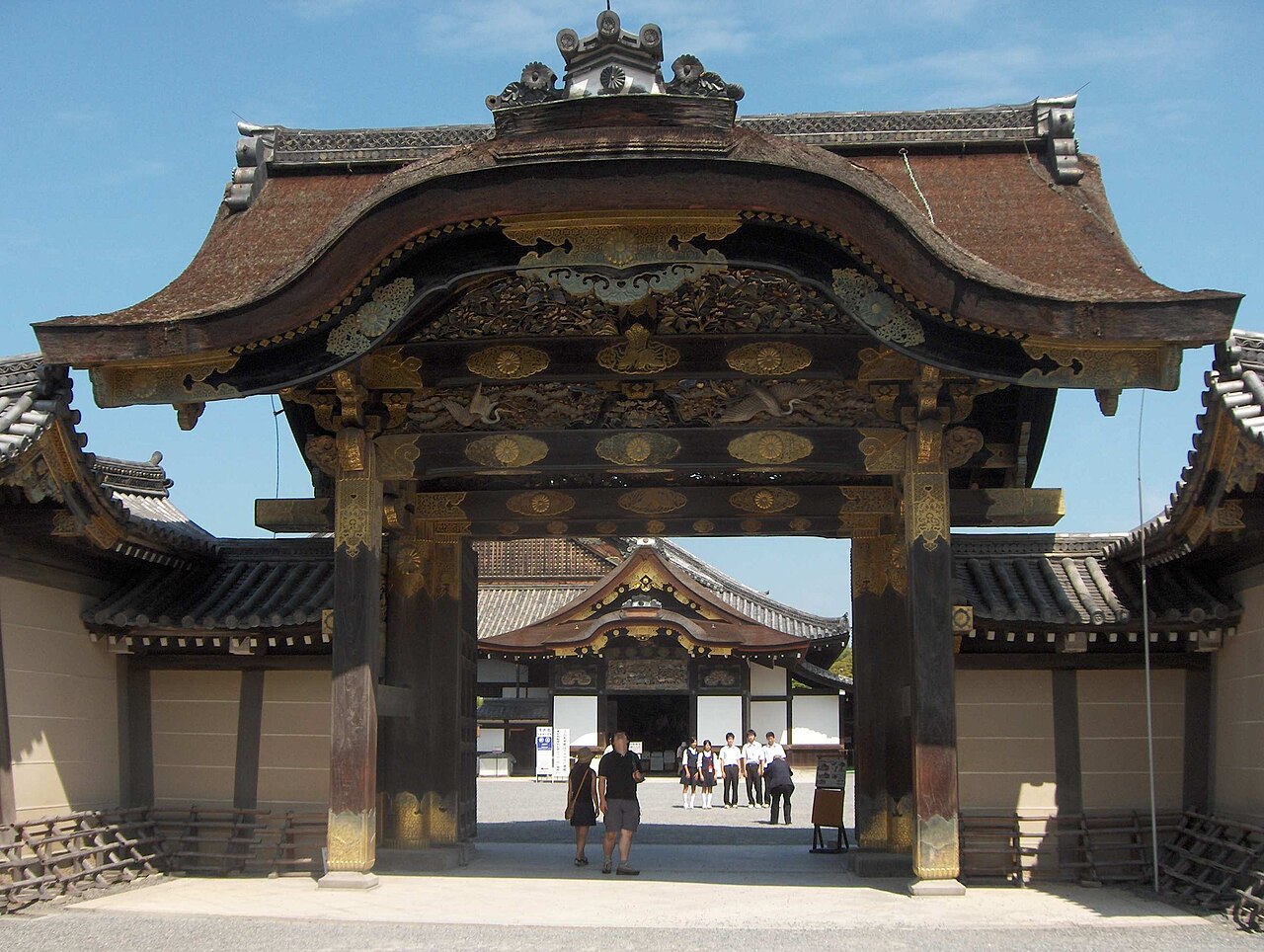
The Tokugawa shoguns' Kyoto stronghold, famous for its nightingale floors and lavish Ninomaru Palace.
Nijo Castle (Nijo-jo) is the great flatland castle of Kyoto and one of the most complete surviving symbols of Tokugawa power. It was built in 1603 on the orders of Tokugawa Ieyasu, the first shogun of the Edo period, as his official Kyoto residence, and completed under his grandson Iemitsu in 1626. For more than two and a half centuries it stood as the visible seat of the shogunate in the imperial capital, and it was here in 1867 that the fifteenth and last shogun, Tokugawa Yoshinobu, formally returned governing authority to the Emperor Meiji, ending nearly 700 years of samurai rule. In 1994 the castle was inscribed as part of the UNESCO World Heritage listing of Historic Monuments of Ancient Kyoto.
The grounds are ringed by stone walls and a moat, entered through the ornate Karamon gate, its gilded carvings of cranes, pine and tigers restored to full brilliance. Beyond it stands the Ninomaru Palace, the castle's masterpiece: five connected buildings of some thirty-three rooms, floored with over 800 tatami mats and decorated with gold-leaf sliding screens painted by artists of the Kano school. The audience halls are arranged so that a visiting daimyo's rank determined how close he could approach the shogun, a spatial theatre of authority. Most famous of all are the uguisubari, the nightingale floors, whose nails and clamps were set so that footsteps produce a chirping squeak, an early warning system against assassins.
Surrounding the palace are two contrasting gardens. The Ninomaru garden, designed by the celebrated landscape master Kobori Enshu, arranges craggy stones and a pond with three islands around the audience halls. The inner Honmaru enclosure once held a five-storey keep, destroyed by lightning in 1750 and never rebuilt; visitors can climb the surviving stone base for a view across the compound. In spring the castle's cherry orchards, with hundreds of trees of many varieties, make it one of Kyoto's finest hanami spots, extended into the evening during the spring light-up.
The visiting experience is unusually relaxed for such a monument: paths are broad and largely flat, and the walk from Karamon gate through the palace and gardens takes around two hours at an easy pace. The Ninomaru Palace interior is a designated National Treasure, so photography inside is not permitted and visitors remove their shoes. An audio guide and multilingual signage explain each hall. Early morning, just after the 08:45 opening, offers the quietest experience and the softest light on the gold screens; autumn brings fiery maples to the outer gardens.
Getting there is simple. The Tozai subway line stops at Nijojo-mae Station directly outside the eastern gate, a two-minute walk. From Kyoto Station, city buses 9, 50 and 101 reach Nijojo-mae in about twenty minutes. Combining the castle with the nearby Kyoto Imperial Palace makes a satisfying half-day tracing the two poles of old Japanese power, the shogun and the emperor.
A local's tip
Walk the Ninomaru Palace corridors slowly and listen for the deliberate squeak of the nightingale floors, engineered to warn of intruders.
Best time to visit
Early morning; cherry blossom season in early April
Getting there
Take the Tozai subway line to Nijojo-mae Station, exit right beside the eastern gate. From Kyoto Station, take city bus 9, 50 or 101 to Nijojo-mae (about 20 minutes).
Good to know
- Wi-Fi
- Gift Shop
- Restrooms
- Wheelchair
Plan the whole trip offline
Nijo Castle is one of many places in the Real Japan app — with turn-by-turn directions, nearby spots and full offline maps you can use with no signal.