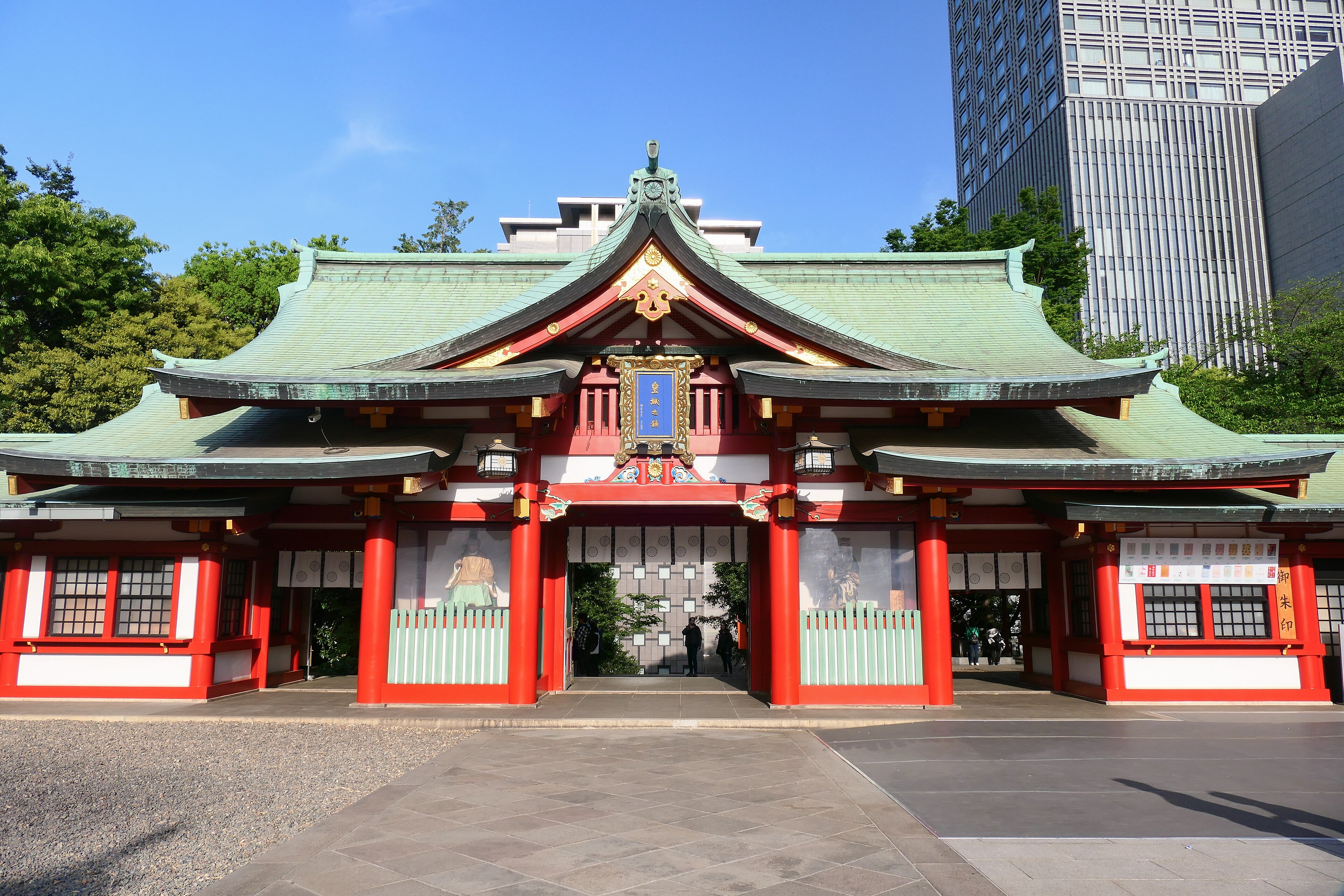
The shogun's protective shrine in Nagatacho, ringed by skyscrapers and a hidden red torii staircase.
Hie Shrine occupies a wooded hill in Nagatachō, the political heart of Tokyo, surrounded by the headquarters of government and gleaming office towers — an island of Shinto calm a few minutes from the National Diet. Founded in the 15th century by the warrior-poet Ōta Dōkan, who built the first Edo Castle, it rose to prominence when the Tokugawa shōguns adopted it as a guardian shrine protecting the castle and, by extension, the entire city.
The shrine venerates Ōyamakui-no-Kami, a mountain deity associated with protection, and has long been prayed to for warding off misfortune, safe childbirth and success. Its most distinctive emblem is the monkey (masaru), regarded as the god's messenger; you will see paired monkey statues — one cradling a baby — flanking the hall, and the word masaru puns happily on "warding off evil" and "winning," making the shrine popular with those seeking good luck and safe pregnancy.
The present buildings are postwar reconstructions, the originals having been destroyed in the 1945 air raids, but they faithfully reproduce the earlier gongen style in bright vermilion and copper-green. The wide upper plaza feels serene despite the city pressing in on all sides, and the contrast of ancient rooflines against glass skyscrapers is a defining Tokyo image.
Hie Shrine's signature photo spot is its eastern approach: a steep staircase roofed by a tunnel of closely spaced red torii gates climbing the hillside from the Akasaka side. Far less crowded than the main entrance, it offers the vermilion-corridor effect of Kyoto's Fushimi Inari in the middle of downtown Tokyo. The grand main gate (from the Sannō-dōri side) and its guardian monkeys are the more formal approach, and — usefully for a hilltop shrine — an escalator runs up the west flank for those who cannot manage the steps, making Hie one of the more accessible sanctuaries in the city.
Every other year, in mid-June of even-numbered years, the shrine stages the Sannō Matsuri, one of the three great festivals of Edo alongside Kanda and Fukagawa. A vast procession of mikoshi, court costumes and decorated floats winds several kilometres through central Tokyo, recreating a pageant the shōguns themselves once viewed — a rare chance to see feudal ceremony play out among the ministries.
The visiting experience is quiet, free and quick, ideal for travellers staying in the Akasaka, Roppongi or Nagatachō hotels. A small shop sells the shrine's monkey-motif charms, and cherry trees soften the plaza in early April. Getting there is effortless: Tameike-Sannō Station on the Ginza and Namboku lines sits three minutes away, while Akasaka and Kokkai-gijidōmae stations are close alternatives. Combine a visit with a walk past the Diet Building and the moats of the Imperial Palace for a compact tour of political and spiritual Tokyo.
A local's tip
Skip the main steps and enter via the east side's tunnel of red torii gates — a quieter, photogenic climb that most tourists miss entirely.
Best time to visit
Mid-June in even years for the Sanno Matsuri
Getting there
From Tameike-Sanno Station (exit 7) it is a 3-minute walk; from Akasaka Station, climb the striking red torii staircase on the shrine's east side.
Good to know
- Escalator
- Restrooms
- Souvenir shop
Plan the whole trip offline
Hie Shrine is one of many places in the Real Japan app — with turn-by-turn directions, nearby spots and full offline maps you can use with no signal.