The world's most famous digital art museum, reborn in Azabudai Hills as a borderless maze of light, water and flowers.
teamLab Borderless is the Mori Building Digital Art Museum created by the international art collective teamLab, and it is one of Tokyo's defining 21st-century attractions. After closing its original Odaiba home, it reopened in February 2024 inside the gleaming Azabudai Hills complex in Minato, where it occupies a labyrinth of darkened halls filled with projected, ever-changing digital artworks.
The concept behind Borderless is exactly what the name promises: the artworks are not confined to single rooms or frames. Digital butterflies flutter from one gallery into the next, waterfalls of light cascade down walls and pool across the floor, and fields of virtual flowers bloom and scatter in response to where visitors stand. Because the pieces move between spaces and react to human presence, no two visits are ever the same. There is deliberately no set route and no map - you wander, follow a stream of projected koi around a corner, and discover the next world by chance.
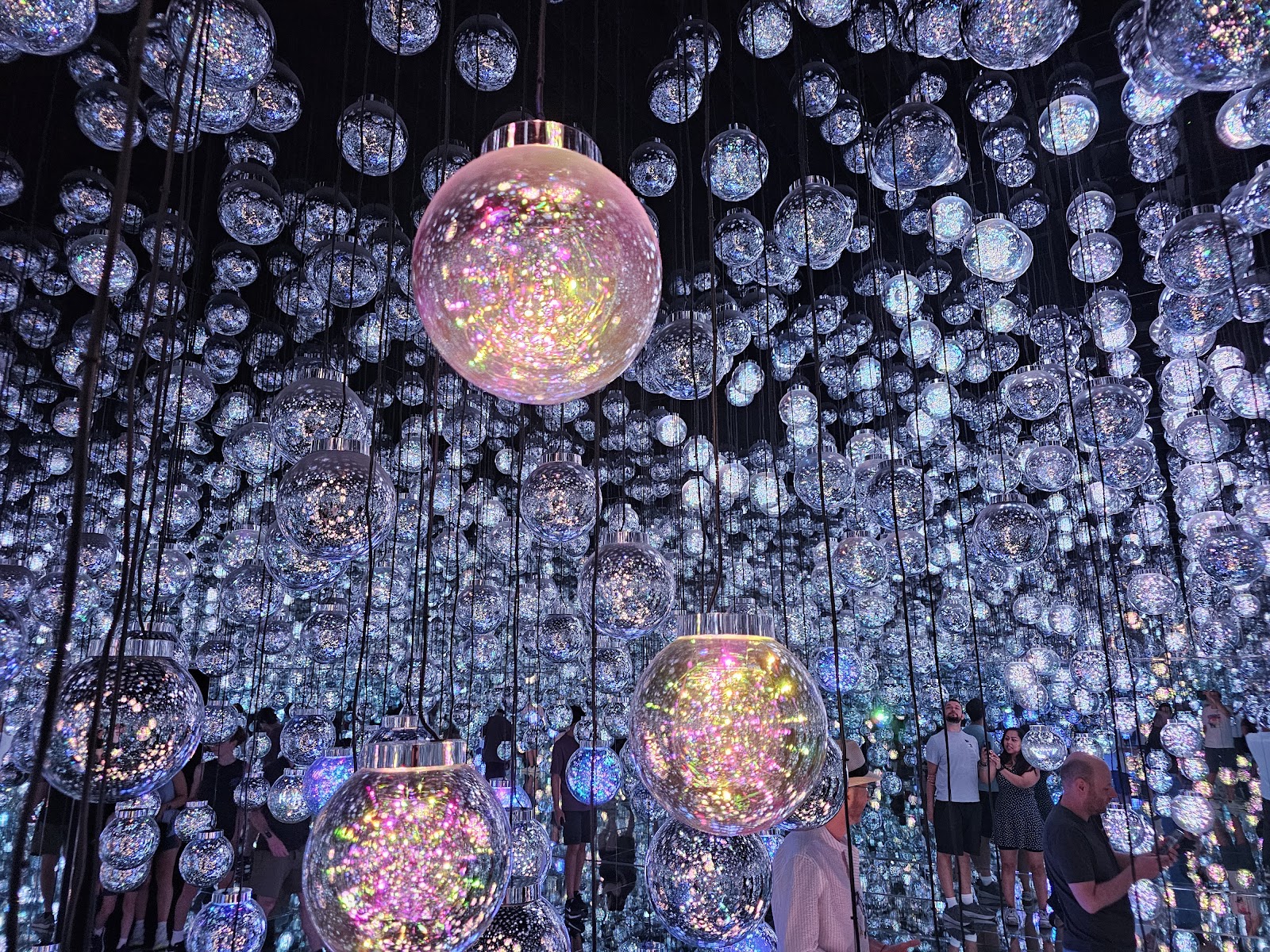
Among the most beloved installations are the 'Forest of Lamps,' a mirrored room hung with Murano-style glass lamps that light up in rippling chains of colour; 'Bubble Universe,' a compact but dazzling sphere of lights and mirrors; and the 'Universe of Water Particles,' a towering digital waterfall. In the 'EN TEA HOUSE' a real cup of tea is served, and a digital flower blossoms inside the liquid as you drink, dispersing when you lift the cup. Children gravitate to the 'Athletics Forest,' a set of interactive, physically active works designed to blur art and play.
The experience is as much about atmosphere as about any single piece. Soft ambient music, shifting colour, mirrored floors and the drifting crowd combine into something closer to a dream than a traditional gallery. It is famously one of the most photographed places in Japan, and the mirrored infinity effects make even a casual phone snapshot look extraordinary - though many visitors put the camera away for long stretches simply to absorb it.
Practical planning matters here. Tickets are sold for timed entry slots and regularly sell out days in advance, so buy online before your trip rather than turning up on the day. Wear comfortable shoes and, if you can, avoid mirrored-floor sensitivities by choosing trousers over short skirts. Allow at least two hours; many people stay far longer. The venue is fully indoors and climate-controlled, making it an ideal rainy-day or peak-summer refuge.
Getting there is easy: from Kamiyacho Station on the Hibiya Line it is a two-to-three-minute walk to Azabudai Hills, then a lift down to basement level B1 where the entrance sits immediately on your left. Roppongi-Itchome Station on the Namboku Line connects via an underground passage, so you never need to surface in bad weather. Combine a visit with the wider Azabudai Hills development - Japan's tallest skyscraper, gardens and restaurants - for a full half-day of contemporary Tokyo at its most futuristic.
A local's tip
There is no fixed route and no map on purpose - let yourself get lost, and don't miss the tiny mirrored 'Bubble Universe' and the tea house where a flower blooms in your cup.
Best time to visit
Weekday afternoons; book timed tickets well ahead
Getting there
From Kamiyacho Station (Hibiya Line) exit 5, walk 2-3 minutes to Azabudai Hills Garden Plaza B, then take elevator D to floor B1. Also reachable from Roppongi-Itchome Station (Namboku Line) via underground passage.
Good to know
- Cafe
- Wi-Fi
- Cashless
- Restrooms
Plan the whole trip offline
teamLab Borderless is one of many places in the Real Japan app — with turn-by-turn directions, nearby spots and full offline maps you can use with no signal.