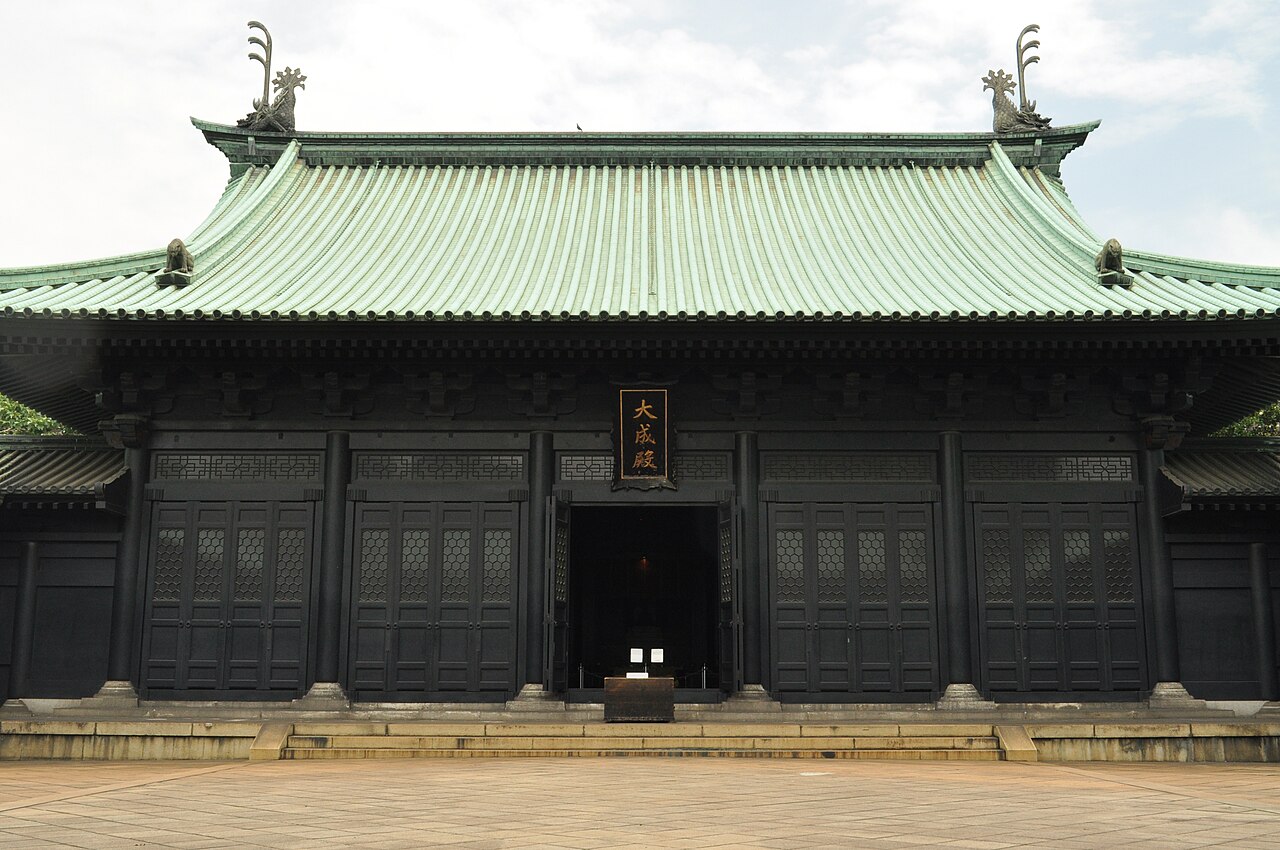
A striking black-lacquered Confucian temple that was the Tokugawa shogunate's elite academy and birthplace of modern Japanese education.
Tucked on a wooded rise above the Kanda River, Yushima Seido is one of Tokyo's most historically important yet least crowded sites. It is a Confucian temple, not a Buddhist or Shinto one, and its severe black-lacquered halls set it apart from anything else in the city. The complex traces its origins to 1690, when the fifth shogun Tokugawa Tsunayoshi, a devoted student of Confucian thought, moved a private academy here and built a shrine to Confucius on the hillside of Yushima.
What grew around that shrine shaped the intellectual life of Edo Japan. In 1797 the shogunate established the Shoheizaka Gakumonjo here — often called the Shoheiko — the official academy where samurai officials were trained in the Neo-Confucian curriculum that underpinned Tokugawa governance. For decades this was the closest thing Japan had to a national university, and its influence rippled outward through every domain that sent students to study. After the Meiji Restoration the site became a cradle of the modern school system: the forerunners of the University of Tsukuba and Ochanomizu University were founded here, and for a time the grounds even housed the first incarnation of the Tokyo National Museum and Japan's first library.
The buildings you see today are largely faithful reconstructions in ferro-concrete, rebuilt after the Great Kanto Earthquake of 1923 destroyed the original wooden halls. The centrepiece is the Taiseiden, the Hall of Accomplishment, a dark, imposing structure that enshrines Confucius and his principal disciples. Its roof is guarded by bronze mythical beasts — a pair of horned kihen and fish-tailed kicho believed to ward off fire. In the forecourt stands the world's largest bronze statue of Confucius, a gift from a Taipei civic group in 1975, standing over four metres tall. The approach passes through the Nyutokumon gate and up worn stone steps shaded by old ginkgo and camphor trees.
Visiting is quiet and contemplative, and refreshingly free. The grounds are open daily, while the interior of the Taiseiden is generally accessible only on weekends and holidays. Because the academy was dedicated to learning, it has become a favourite of students who come to pray for success in entrance examinations — visit in late winter, before exam season, and you will see racks of wooden ema plaques inscribed with the names of schools hoped for. The site sits on a slope with steps, but the main courtyard is easy to reach and the atmosphere rewards a slow wander.
Come on a weekday morning for near-solitude among the dark halls, or in autumn when the ginkgos turn gold against the black timber. The temple is a four-minute walk from JR Ochanomizu Station: leave by the Hijiribashi exit, cross the Sage's Bridge over the Kanda River, and the entrance appears on your right. It pairs naturally with a stroll to nearby Kanda Myojin shrine and the bookshops of Jimbocho.
A local's tip
Look up at the roof of the Taiseiden hall for the pair of bronze mythical guardian beasts (kihen and kicho) — they are said to protect the building from fire.
Best time to visit
Weekday mornings; visit near exam season to see students praying for success
Getting there
A 4-minute walk from the Hijiribashi exit of JR Ochanomizu Station; cross the Hijiribashi bridge and the black gate is on your right.
Good to know
- Shop
- Restrooms
Plan the whole trip offline
Yushima Seido is one of many places in the Real Japan app — with turn-by-turn directions, nearby spots and full offline maps you can use with no signal.