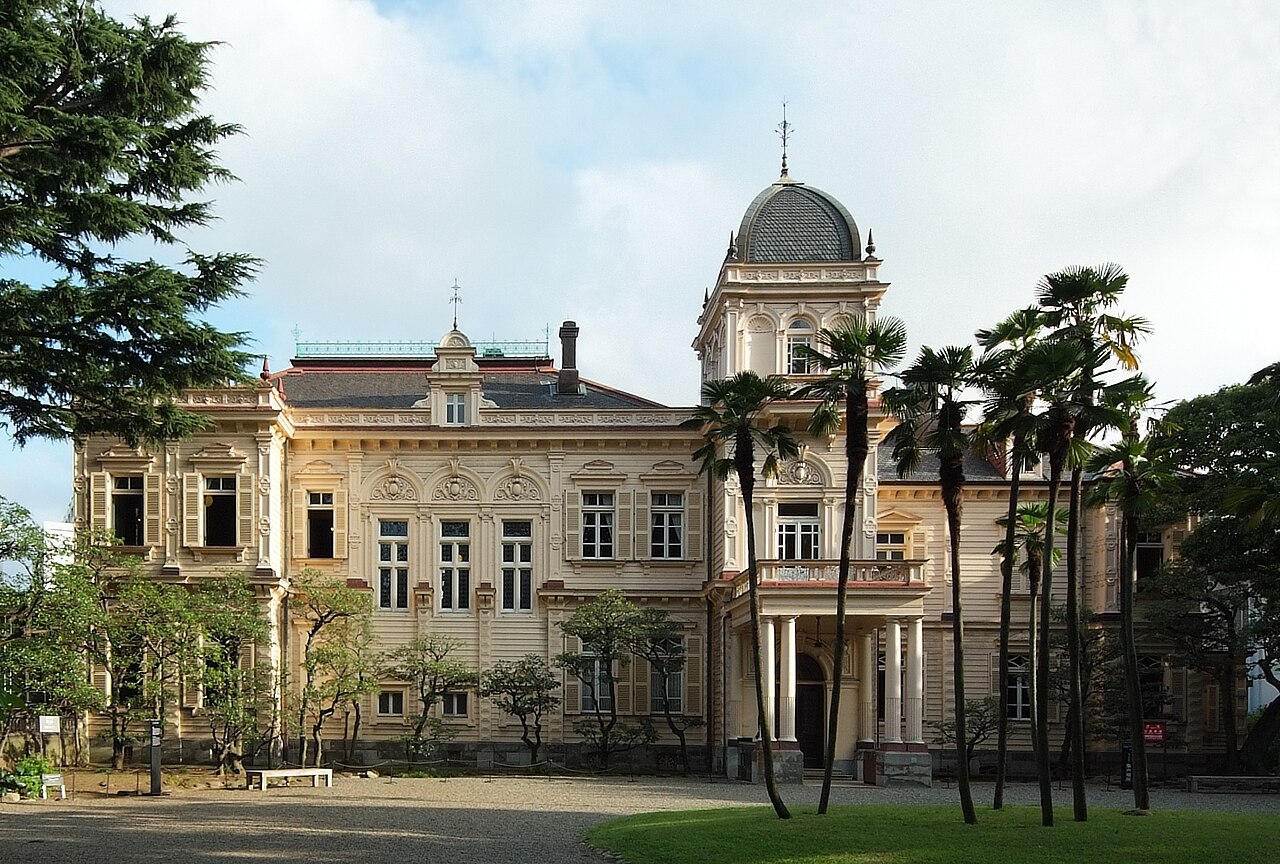
A grand Meiji-era mansion blending a British architect's Western design with a traditional Japanese wing, built for the Mitsubishi founding family.
The Former Iwasaki Estate is one of the finest surviving examples of the hybrid Meiji-era architecture that flourished as Japan reinvented itself in the late nineteenth century. Completed in 1896, it was the residence of Iwasaki Hisaya, the third president of Mitsubishi and son of the conglomerate's founder. At its height the estate covered a vast area with some twenty buildings; today three remain, preserved as an Important Cultural Property and opened to the public as a museum garden.
The star of the estate is the Western-style mansion, designed by the British architect Josiah Conder, the so-called father of modern Japanese architecture, who trained a generation of Japanese designers and shaped the look of Meiji Tokyo. The two-storey house is a romantic confection of Jacobean and Renaissance motifs, with a columned veranda, intricately carved woodwork, hand-tooled leather wall coverings, and Islamic-influenced decorative flourishes that reflect Conder's eclectic tastes. Walking its parquet floors in stockinged feet, you pass through rooms that once hosted the business and political elite of a rapidly modernising nation.
What makes the estate especially revealing is its dual character. Attached to the grand Western mansion is a large traditional Japanese-style residential wing, where the family actually lived day to day — a vivid illustration of how the Meiji upper class navigated between imported Western formality and Japanese domestic life. Behind the house stands a third rare building: a Swiss-chalet-style billiard house, its log-cabin exterior utterly unlike anything else nearby, connected to the main mansion by an underground passage so guests could move between the two in any weather.
The surrounding garden, once a sweeping lawn in the English manner dotted with specimen trees, has shrunk from its original scale but still offers a green, restful setting that shows how the wealthy of the era blended Western landscaping with Japanese planting. In autumn the maples and ginkgos give the grounds warm colour.
Visiting is a calm, indoor-and-outdoor experience that suits a slower pace. There is a modest entry fee of 400 yen, and you remove your shoes to explore the mansion interiors. A small tea service in the Japanese wing lets you rest with matcha overlooking the garden. The main mansion has stairs to the upper floor, and the traditional wing involves stepping up onto tatami, so it is only partly step-free, but the ground-floor rooms and garden are easy to enjoy for most visitors. Photography is allowed outside but restricted indoors.
Come on a weekday morning, when you can wander the echoing rooms almost alone and appreciate the craftsmanship without a crowd. Autumn is the loveliest season for the garden. The estate is a three-minute walk from Yushima Station on the Chiyoda Line, tucked in a quiet residential pocket between Ueno and Ochanomizu, and pairs well with Yushima Seido and Ueno Park for a day of Meiji and Edo history.
A local's tip
Don't skip the separate Japanese-style wing and the billiard house behind the mansion — the Swiss-chalet-style billiard room is a rare survivor and connected to the main house by an underground passage.
Best time to visit
Weekday mornings to avoid crowds in the mansion
Getting there
A 3-minute walk from Yushima Station (exit 1) on the Chiyoda Line, or about 10 minutes from Ueno-Hirokoji / Yushima area.
Good to know
- Shop
- Restrooms
- Tea service
Plan the whole trip offline
Kyu-Iwasaki-tei Gardens (Former Iwasaki Estate) is one of many places in the Real Japan app — with turn-by-turn directions, nearby spots and full offline maps you can use with no signal.