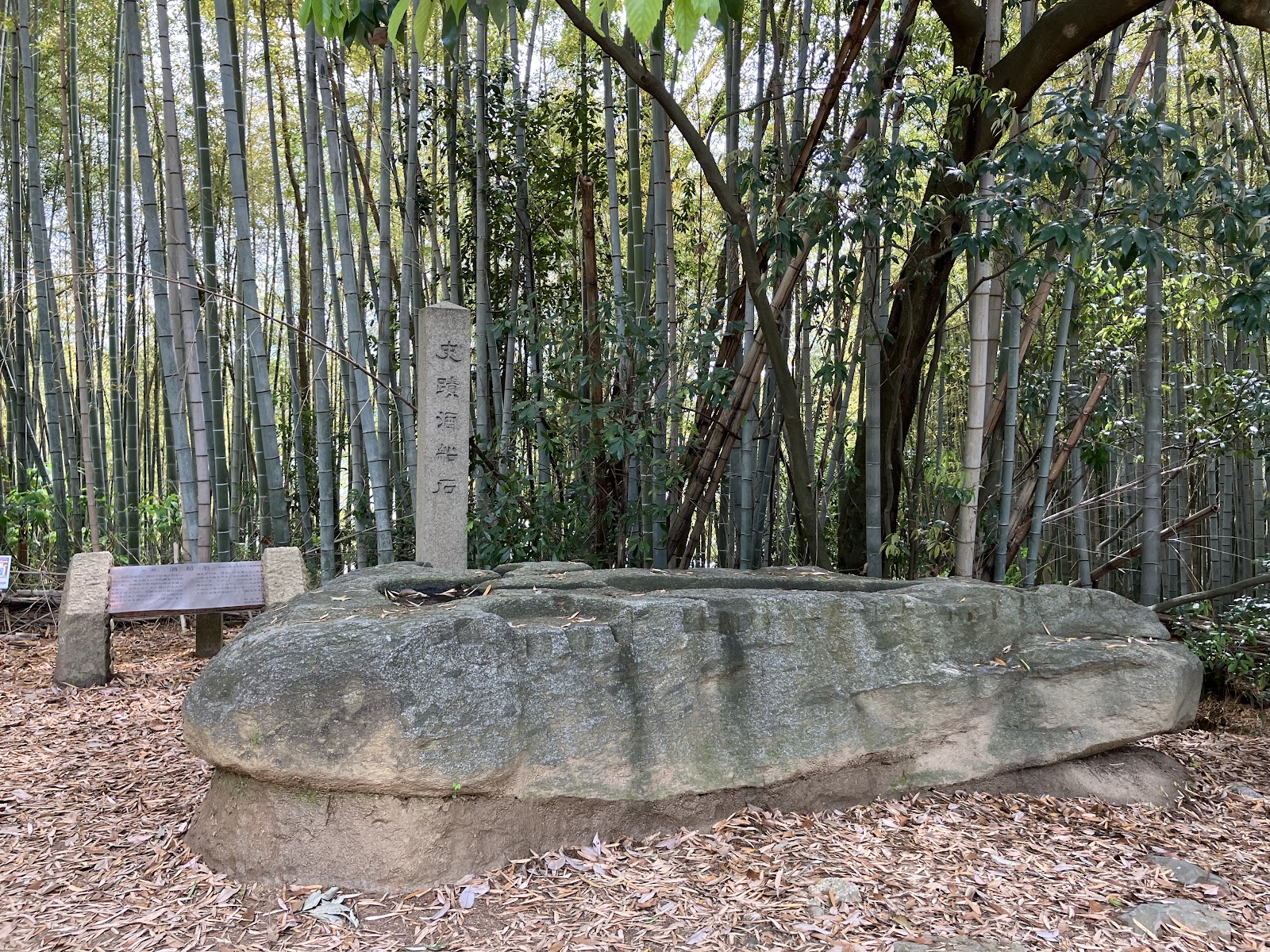
An enigmatic Asuka-period carved stone laced with channels and hollows whose purpose still baffles archaeologists.
Among the rice fields and low hills of Asuka lies one of Japan's most intriguing archaeological puzzles: the Sakafuneishi, a large flat stone carved with a network of shallow basins and connecting channels whose true purpose has never been established. It is the most famous of a whole family of mysterious carved stones scattered through the ancient landscape of Asuka, and it draws visitors precisely because it resists easy explanation.
The name Sakafuneishi means 'sake boat stone,' reflecting one old theory that the grooves and hollows were used to press or ferment rice wine. But that is only one of many ideas. Other scholars have proposed that it functioned as part of an elaborate garden waterworks, channelling liquid through its carved troughs in a display of hydraulic ingenuity; some suggest it was a water clock or measuring device; others believe it served a ritual or ceremonial role, perhaps connected with the elaborate court practices of the 7th century when Asuka was the seat of imperial power. Excavations in the surrounding area have revealed evidence of sophisticated stone-lined water channels and what may have been an ornamental garden or ritual precinct, deepening the intrigue rather than resolving it.
What is certain is the craftsmanship. The stone is a substantial slab of hard rock, and its surface is worked with precise circular and oval depressions linked by straight cut channels, clearly the product of skilled hands and a deliberate design. Standing beside it, you can trace how liquid might have flowed from hollow to hollow, and the sense of looking at an object whose logic has been lost to time is genuinely compelling. It is a reminder that the Asuka court, for all its documented temples and tombs, still guards secrets.
The Sakafuneishi is one of several 'mystery stones' that make cycling around Asuka such a distinctive pleasure. Not far away sit the Kameishi, a huge boulder carved to resemble a turtle's face; the Saruishi, grotesque monkey-like stone figures near an imperial tomb; and various other worked stones whose meanings are equally uncertain. Together they give Asuka an air of quiet enchantment quite unlike anywhere else in Japan, blending serious archaeology with a folk-tale strangeness.
Because the site is modest — a single carved stone on a terraced hillside — it is best treated as one stop on a longer exploration rather than a destination in itself. The joy is in the journey between monuments, freewheeling along quiet lanes between paddies and villages, with the hills of Yamato all around.
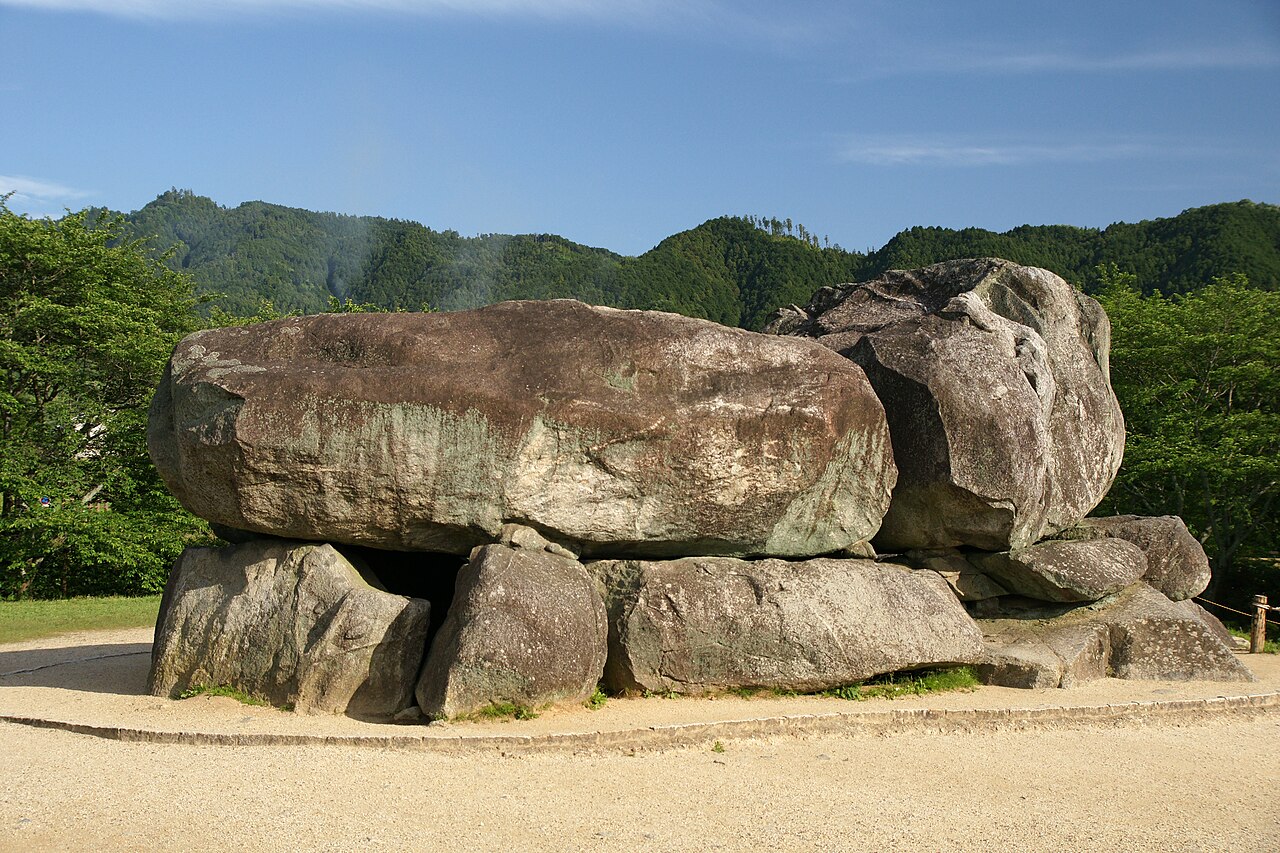
Getting there: rent a bicycle at Asuka Station on the Kintetsu Yoshino Line — the standard and by far the best way to see Asuka — and ride about 30 minutes to the eastern side of the village where the Sakafuneishi sits among the fields. There is no admission charge. Fold it into a loop taking in Ishibutai, the painted tombs and the other carved stones, and let Asuka's gentle mystery work on you.
A local's tip
Nobody knows for certain what these carved stones were for — sake press, water clock, ritual altar? Part of the fun is standing over the grooves and forming your own theory. The nearby 'turtle stone' Kameishi is another Asuka enigma worth cycling to.
Best time to visit
Any clear day; combine with an Asuka cycling loop
Getting there
Best reached by rental bicycle from Asuka Station, about 30 minutes; the carved stones sit on a low hillside terrace among the fields of eastern Asuka.
Good to know
- Restrooms
- Bicycle rental at station
Plan the whole trip offline
Sakafuneishi Ruins is one of many places in the Real Japan app — with turn-by-turn directions, nearby spots and full offline maps you can use with no signal.