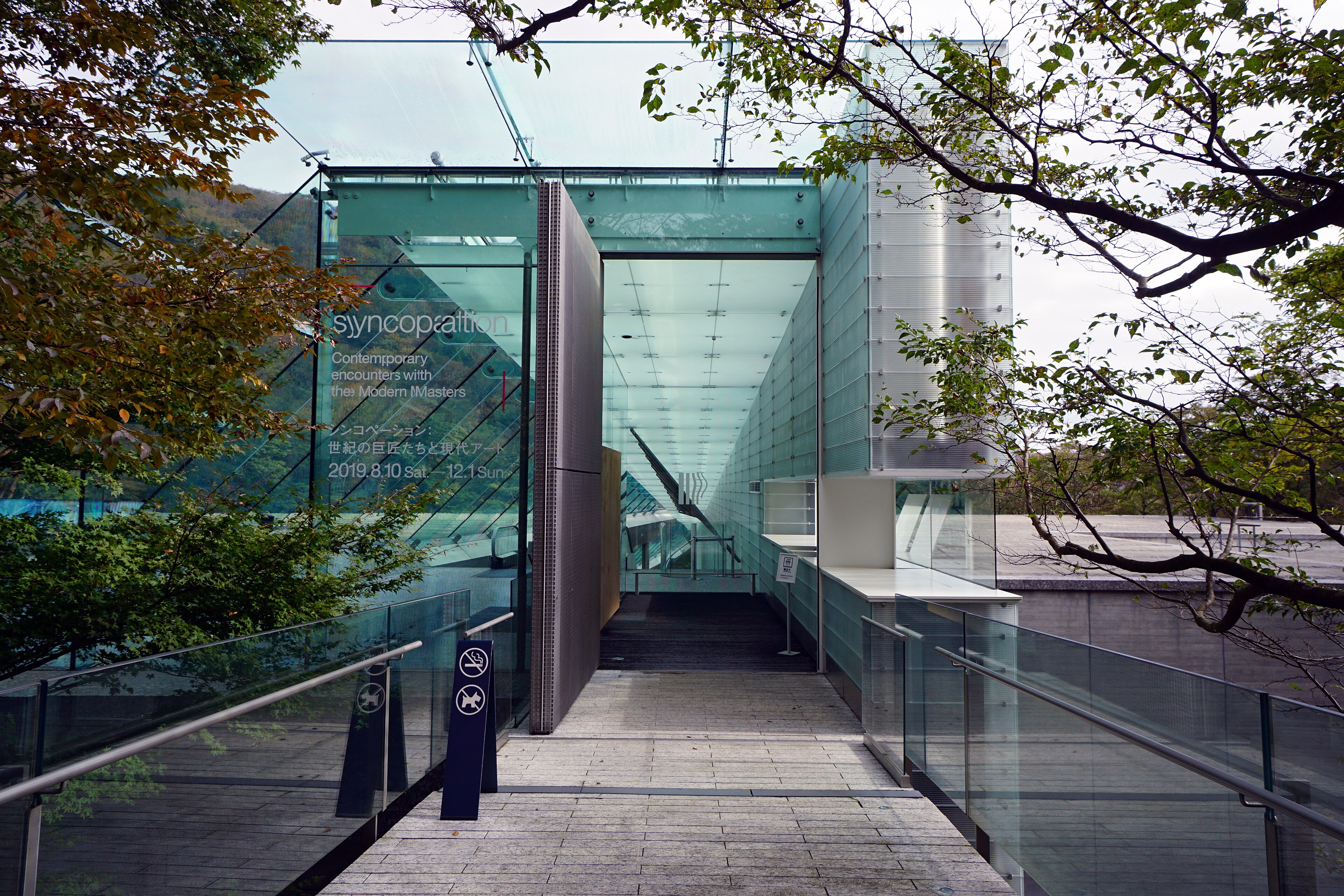
Hakone's flagship art museum, hiding a world-class Impressionist collection inside a glass pavilion sunk into the forest.
The Pola Museum of Art is the most celebrated of Hakone's many museums, and for good reason. Opened in September 2002 deep inside Fuji-Hakone-Izu National Park, it houses the collection amassed over decades by Suzuki Tsuneshi, the second-generation head of the Pola cosmetics group. With more than 10,000 works, it holds one of Japan's finest private hoards of French Impressionist and post-Impressionist painting.
The galleries read like a greatest-hits of European modernism: Monet's water lilies, Renoir's luminous portraits, Van Gogh, Cézanne, Gauguin, Picasso and a deep seam of the École de Paris. Alongside them hang Japanese Western-style (yōga) paintings and Nihonga, plus a quietly fascinating collection of antique glass, ceramics and the ornate cosmetic containers that built the Pola fortune. Exhibitions rotate through the year, so the walls change but the quality never dips.
The building itself is a masterpiece. Designed by Nikken Sekkei, it was deliberately sunk into a hollow so that no part rises above the surrounding treeline, preserving the protected forest. You enter at ground level and descend through a soaring glass atrium where daylight pours down onto pale stone, blurring the line between gallery and woodland. The architecture won awards precisely because it refuses to shout over the nature around it.
One of the museum's best-kept secrets is free to everyone: the 670-metre Nature Trail that loops through the beech and fir forest on the grounds, dotted with a handful of outdoor sculptures. In late autumn the maples flush scarlet; in early summer the new green is dazzling. It turns a museum visit into a half-day in the hills.
The visiting experience is unhurried and comfortable. The wide corridors and gentle ramps make it fully accessible for wheelchairs and strollers, the lighting is calibrated for the art, and there is a genuinely good restaurant plus a cafe with forest views for lunch or coffee. A well-stocked shop sells prints and design objects.
The best time to come is a weekday morning, when you can stand alone in front of a Monet before the tour buses arrive from Gōra. Autumn is the signature season, when the forest framing the glass walls turns gold and red, but the collection makes it a rewarding stop in any weather — a rainy Hakone afternoon is transformed here.
Getting there is straightforward. From Gōra Station, the terminus of the Hakone Tozan mountain railway, hop on the Hakone Tozan Bus on the Shisseikaen route for about 13 minutes and get off at 'Pola Bijutsukan', which drops you at the door; a free shuttle also runs from Gōra. Note that Hakone is served by the Odakyu and Hakone Tozan network, not JR, so a Japan Rail Pass does not cover the final legs — the Hakone Freepass is the smarter buy. Give yourself at least two hours inside, more if you walk the trail.
A local's tip
Buy a combined ticket or arrive before 10:00 to beat the tour groups, then walk the free 670 m Nature Trail behind the museum through old-growth beech forest.
Best time to visit
Weekday morning; late autumn for the surrounding forest
Getting there
From Gōra Station take the Hakone Tozan Bus (Shisseikaen line) about 13 minutes to the 'Pola Bijutsukan' stop, right at the entrance. A free shuttle also runs from Gōra. By car it is roughly 20 minutes from Hakone-Yumoto.
Good to know
- Cafe
- Shop
- Wi-Fi
- Restrooms
- Restaurant
Plan the whole trip offline
Pola Museum of Art is one of many places in the Real Japan app — with turn-by-turn directions, nearby spots and full offline maps you can use with no signal.