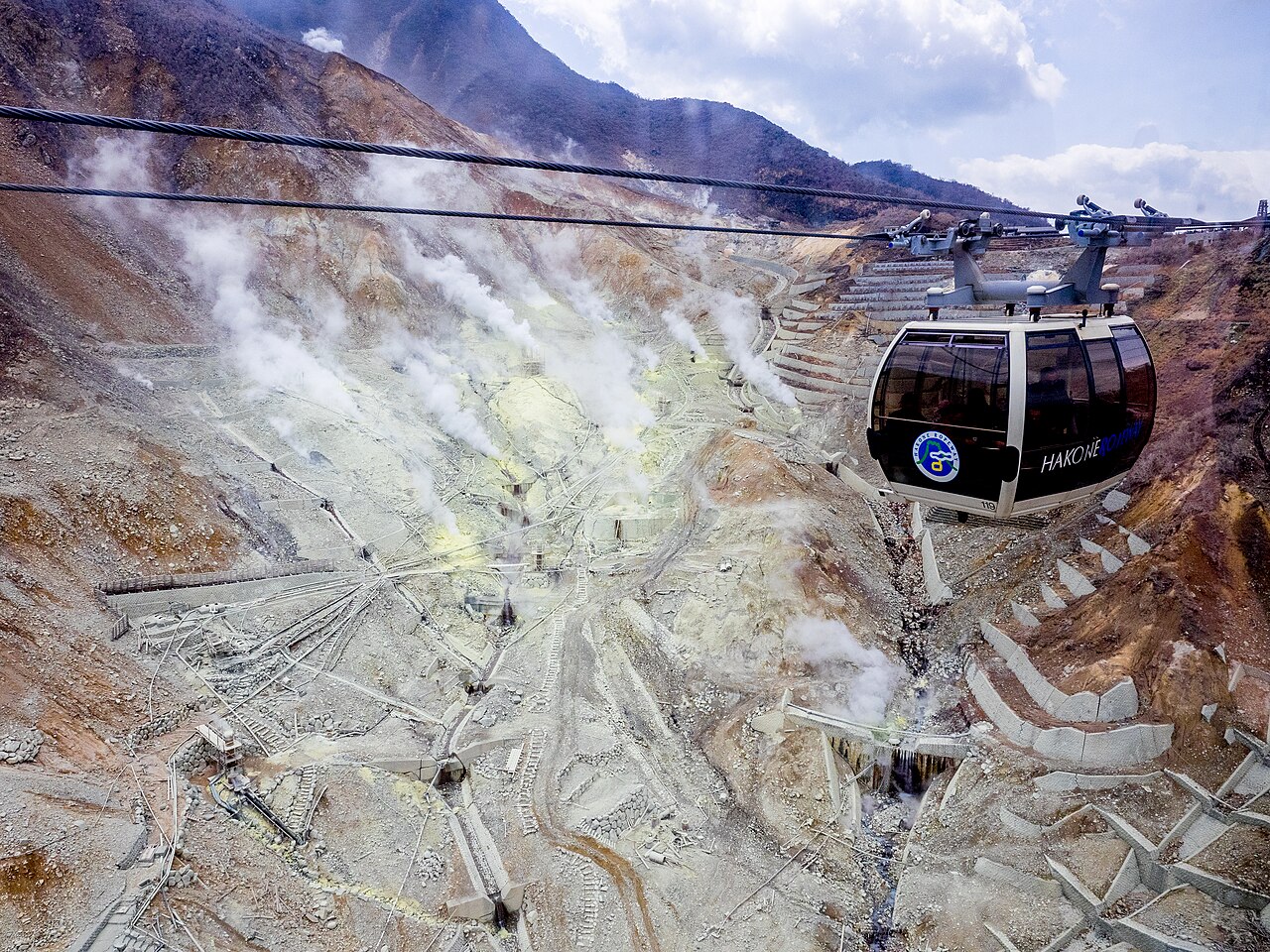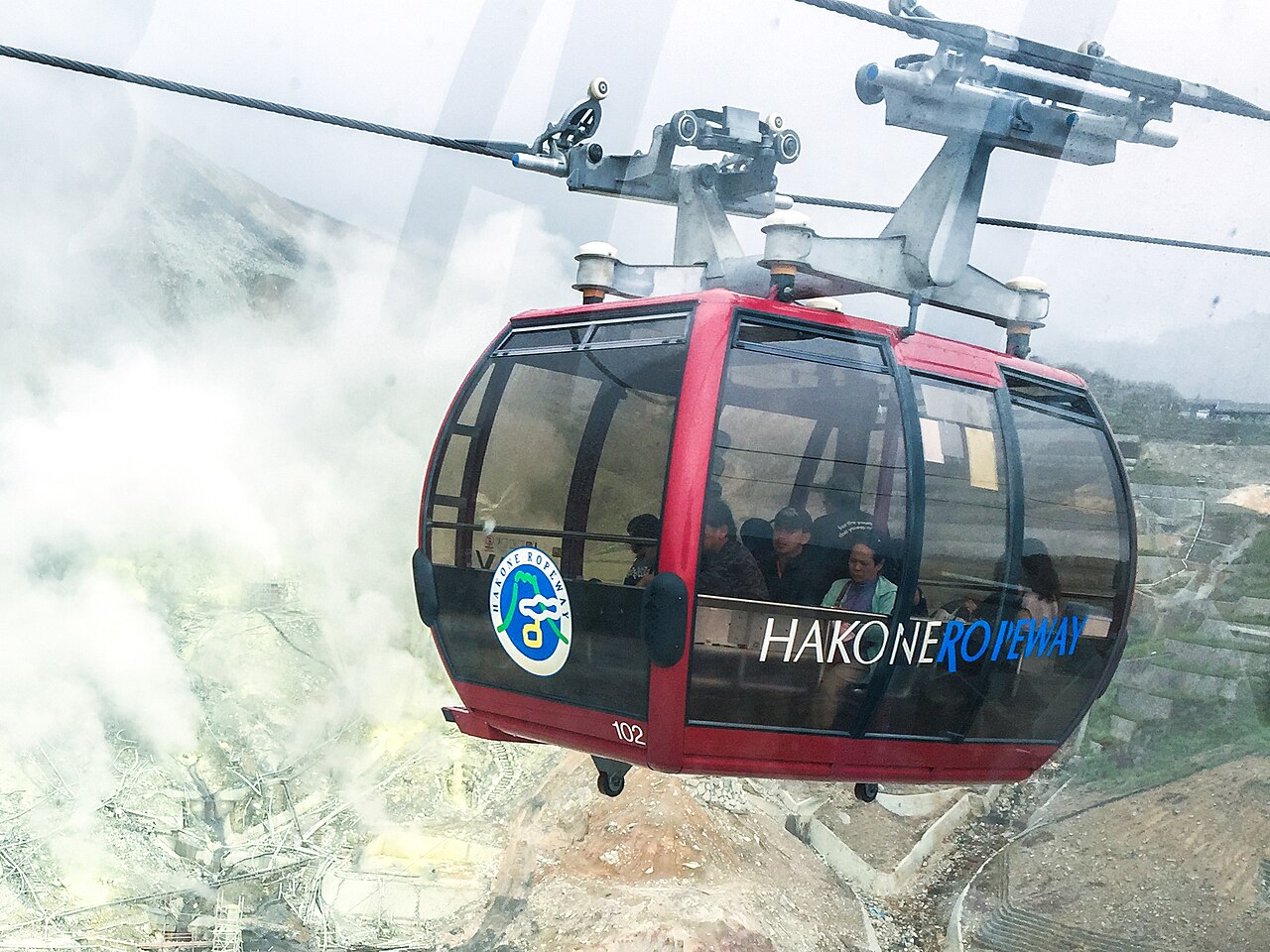
An aerial cableway gliding over the steaming Owakudani vents with Mount Fuji and Lake Ashi in view.
The Hakone Ropeway is not a fixed lookout but a moving viewpoint — a four-kilometre aerial cableway that carries passengers high above the volcanic landscape between Sounzan and Togendai on the shore of Lake Ashi. As the gondolas rise from Sounzan they crest a ridge and reveal, quite suddenly, the smoking crater of Owakudani directly below, with plumes of sulphurous steam pouring from the mountainside and, on clear days, Mount Fuji floating serenely on the horizon beyond. It is one of the most memorable rides in Japan and a highlight of the classic Hakone sightseeing loop.
The ropeway opened in 1960 and was extensively modernised in the 2000s with Swiss-built gondolas that run in a continuous loop, arriving every minute so that queues move quickly. The journey is split into legs, with a midway stop at Owakudani Station where most riders disembark to walk among the fumaroles and buy the valley's famous black eggs before continuing. From the cabins the perspective is extraordinary: the ground falls away to reveal the raw, grey volcanic basin, the forested slopes of the caldera, and the deep blue of Lake Ashi opening up as the line descends toward Togendai.
The views shift constantly as the gondola climbs and drops. On the Sounzan-to-Owakudani section the drama is the volcano itself, the steam vents hissing directly beneath the cable. On the Owakudani-to-Togendai section the scene softens into a grand panorama of the lake, and this is where Mount Fuji is most likely to appear, rising above the western ridges in perfect symmetry. Photographers angle for the moment when the steaming foreground and the snow-capped mountain sit in the same frame — a uniquely Hakone image that captures both the violence and the beauty of the landscape.
Because the ropeway is exposed to the elements, its operation depends heavily on weather and on volcanic gas levels at Owakudani. High winds can suspend service, and during periods of volcanic unrest the central section may close, with a replacement bus running instead. On a fine, calm morning, however, the ride is smooth and unforgettable. Autumn wraps the slopes in fiery foliage viewed from above, while winter offers the clearest, sharpest views of Fuji across the lake. As always, the mountain is most reliably visible early in the day before cloud gathers.
The ropeway is fully covered by the Hakone Freepass, which makes it the connecting link in the region's grand circuit: train from Hakone-Yumoto to Gora, cable car up to Sounzan, ropeway over Owakudani to Togendai, and then a cruise across Lake Ashi to Moto-Hakone. Riding the whole line one way takes around forty minutes without stops, but most visitors allow longer to break the journey at Owakudani. For the best experience, board early, sit facing the direction of travel, and keep a camera ready for the instant the crater — and Fuji — come into view.
A local's tip
Sit facing forward on the Owakudani-to-Togendai leg for the best combined view of the steaming vents and Mount Fuji.
Best time to visit
Clear mornings
Getting there
From Hakone-Yumoto take the Hakone Tozan Railway to Gora, transfer to the cable car up to Sounzan, then board the ropeway toward Owakudani and Togendai.
Good to know
- Shops
- Restrooms
Plan the whole trip offline
Hakone Ropeway is one of many places in the Real Japan app — with turn-by-turn directions, nearby spots and full offline maps you can use with no signal.