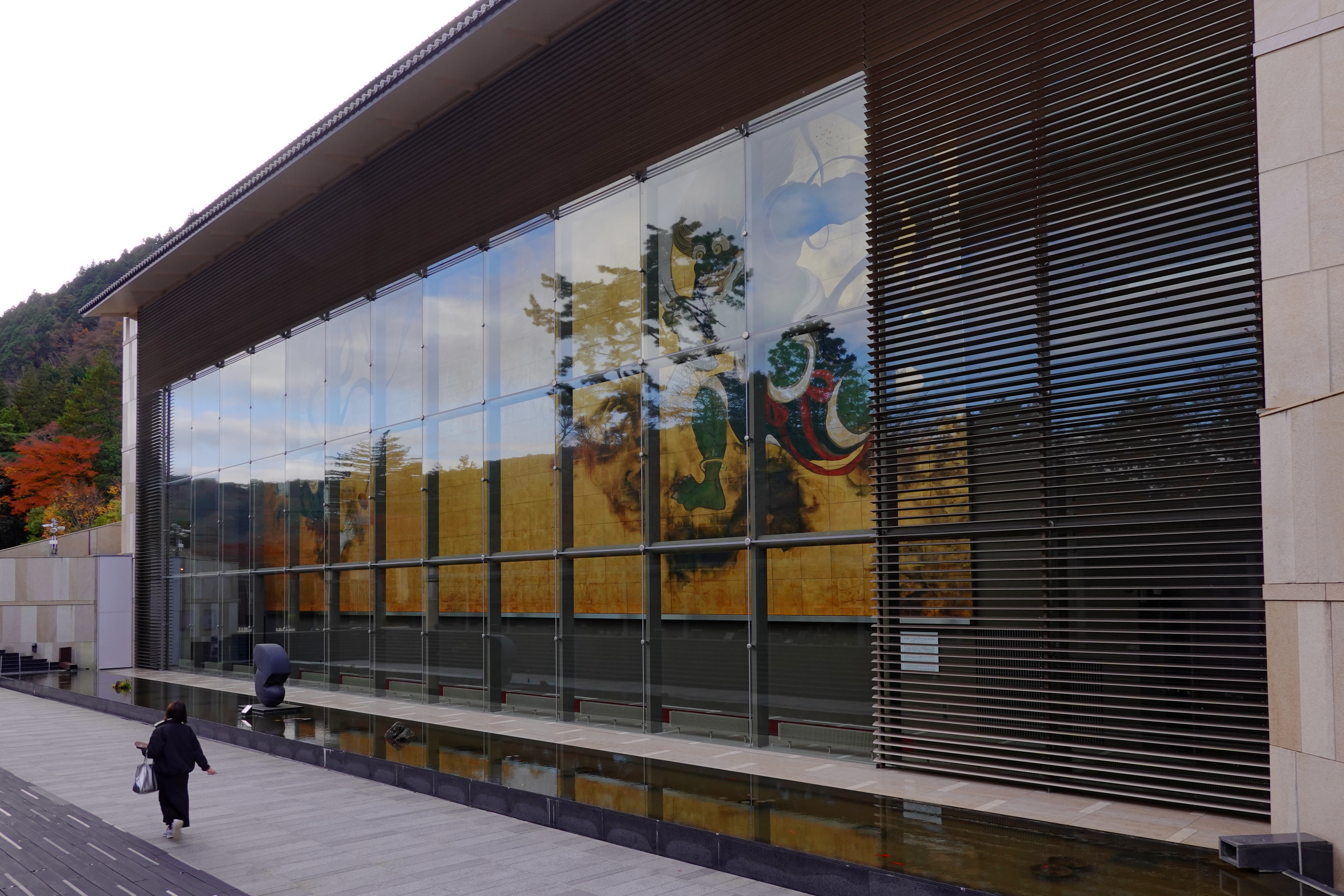
Five floors of East Asian art behind a colossal Fūjin-Raijin mural, with a garden and hot-spring footbath.
The Okada Museum of Art is Hakone's grandest and most ambitious museum, opened in October 2013 by Okada Kazuo, the entertainment-industry magnate. Set in the Kowakudani hot-spring valley, it packs roughly 450 works of East Asian art across five spacious floors, making it one of the largest private art museums in the region.
The collection ranges across Japan, China and Korea and spans millennia — from ancient bronzes and Buddhist sculpture to Chinese and Korean ceramics, gilded folding screens, hanging scrolls, lacquerware and a strong run of Edo-period Japanese painting including works associated with the great ukiyo-e and Rinpa traditions. Because the holdings are so broad, the museum arranges them thematically floor by floor, so a single visit walks you through the sweep of East Asian aesthetics rather than one narrow genre.
The first thing every visitor sees, however, is outside and free: a monumental Fūjin-Raijin (Wind God and Thunder God) mural by contemporary artist Fukui Kōtarō, some 12 metres tall and 30 metres wide, painted across the facade above a long, open-air footbath. You can sit, dip your feet in the naturally hot spring water and gaze up at the gods for a small footbath fee, even without entering the galleries — an experience unique to this museum.
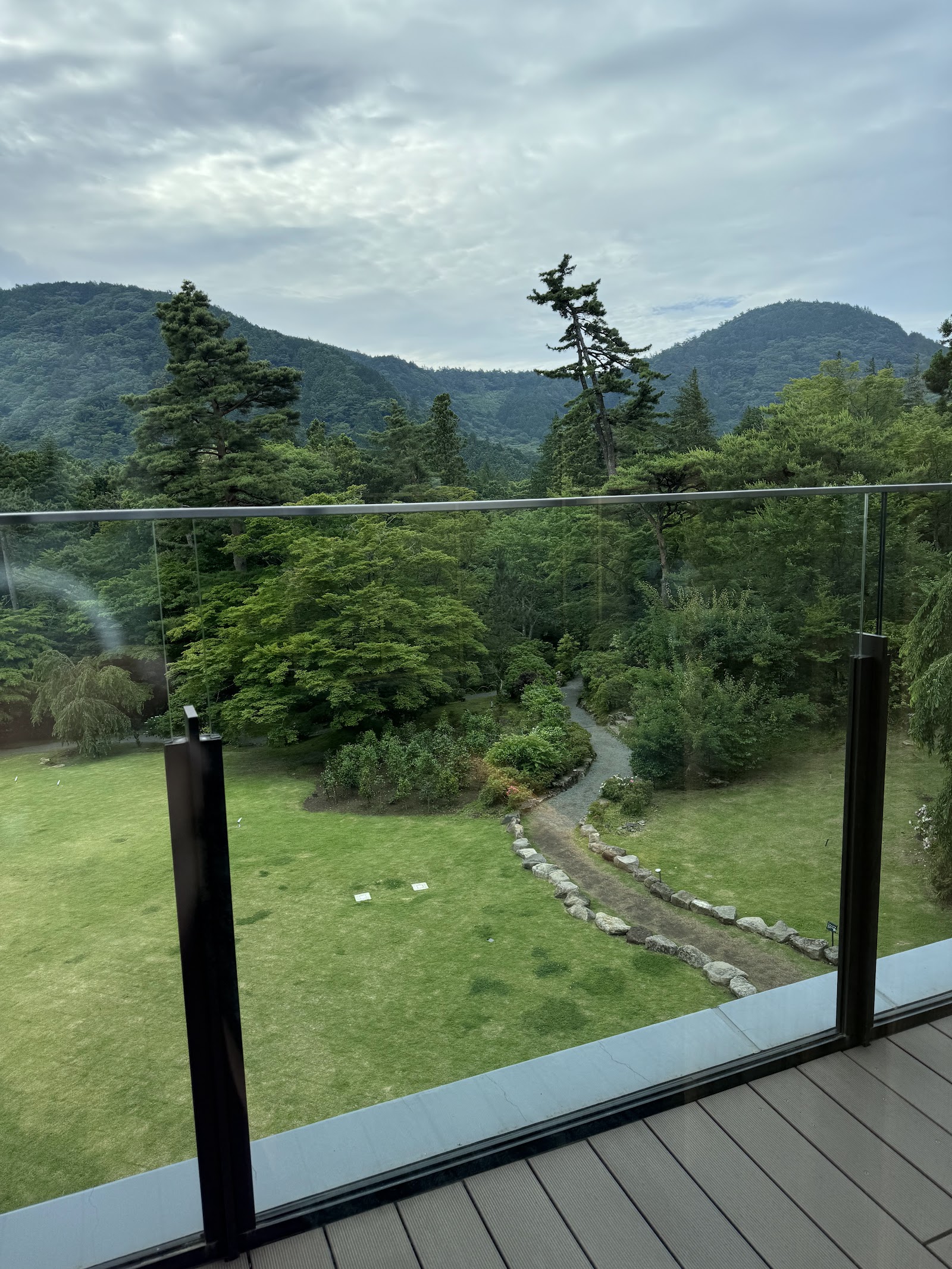
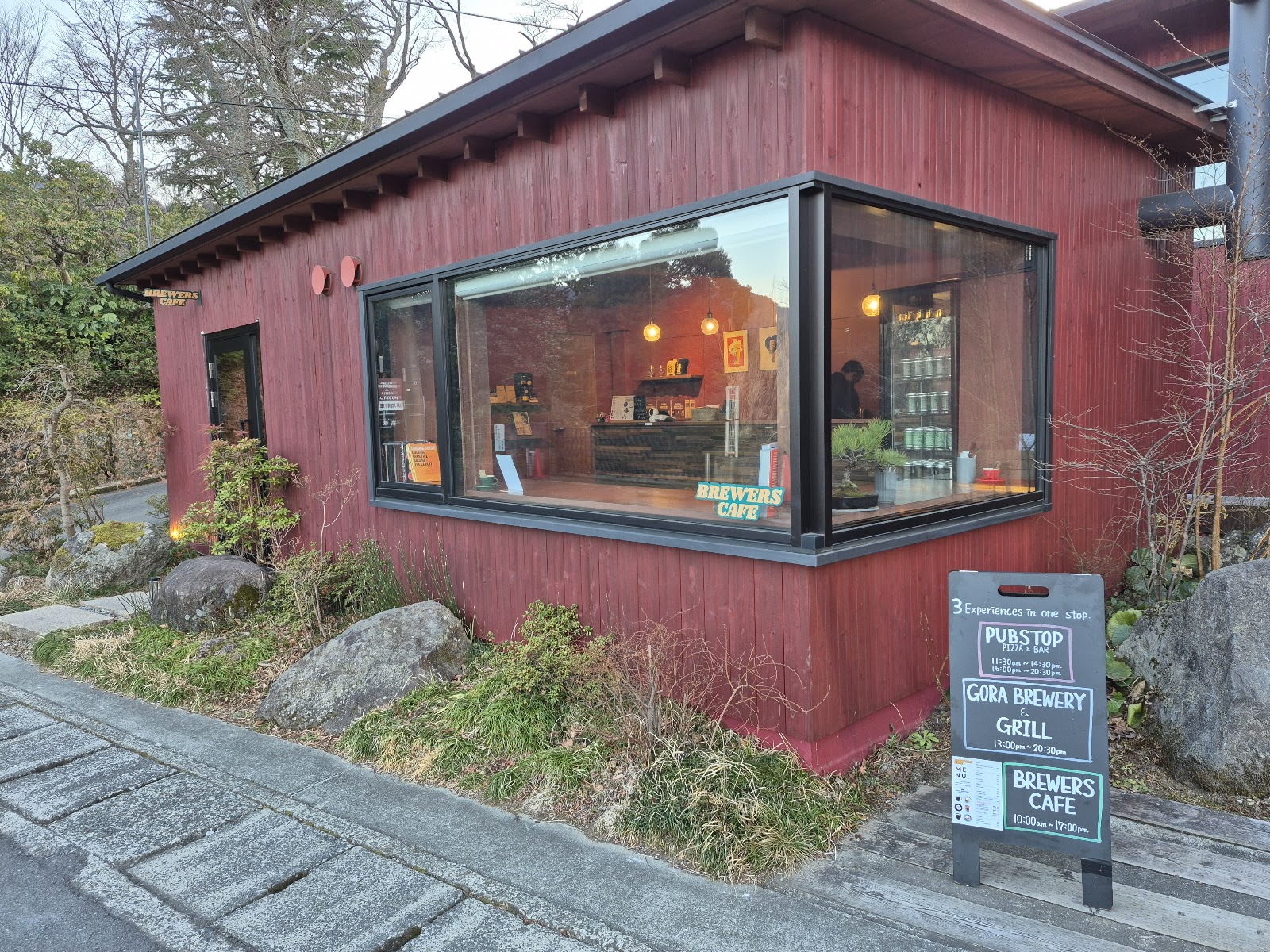
Inside, the presentation is deliberately museum-grade: controlled lighting, generous circulation space and detailed English labelling that makes the sometimes-unfamiliar East Asian works approachable for foreign visitors. The building is fully accessible with lifts between floors. Beyond the galleries lies a landscaped Japanese garden with a stream, seasonal planting and the upscale Kaikatei restaurant set in a traditional building, plus a café — turning the visit into an easy half-day.
The experience is calm and contemplative. Because the collection is indoors and climate-controlled, the Okada is one of the best rainy-day or mid-winter options in Hakone, yet it is equally rewarding when the garden's cherry trees bloom in spring or the maples colour in autumn. Photography rules are stricter than at some Hakone museums, so the mural and garden are where cameras come out.
Allow at least two hours; art lovers easily spend longer. The gift shop is a cut above, with quality reproductions and craft objects.
Getting there is simple. From Hakone-Yumoto or Gōra, take the Hakone Tozan Bus or Izuhakone Bus heading toward Moto-Hakone and Hakone-machi and get off at the 'Kowakuen' stop, which sits directly in front of the entrance; the ride is roughly 15 minutes from Yumoto. Hakone's transport runs on the Odakyu and Hakone Tozan network rather than JR, so a Japan Rail Pass will not cover the buses here — a Hakone Freepass is the economical choice for a day of museum-hopping.
A local's tip
You can soak your feet in the free-to-view outdoor footbath cafe under the giant Fūjin-Raijin mural without buying a museum ticket — a great photo stop even if you are short on time.
Best time to visit
Morning; any season (indoor)
Getting there
Take the Hakone Tozan Bus or Izuhakone Bus toward Moto-Hakone/Hakone-machi and alight at 'Kowakuen', directly in front. It is about 15 minutes from Hakone-Yumoto or a short ride from Gōra.
Good to know
- Cafe
- Shop
- Garden
- Footbath
- Restrooms
- Restaurant
Plan the whole trip offline
Okada Museum of Art is one of many places in the Real Japan app — with turn-by-turn directions, nearby spots and full offline maps you can use with no signal.