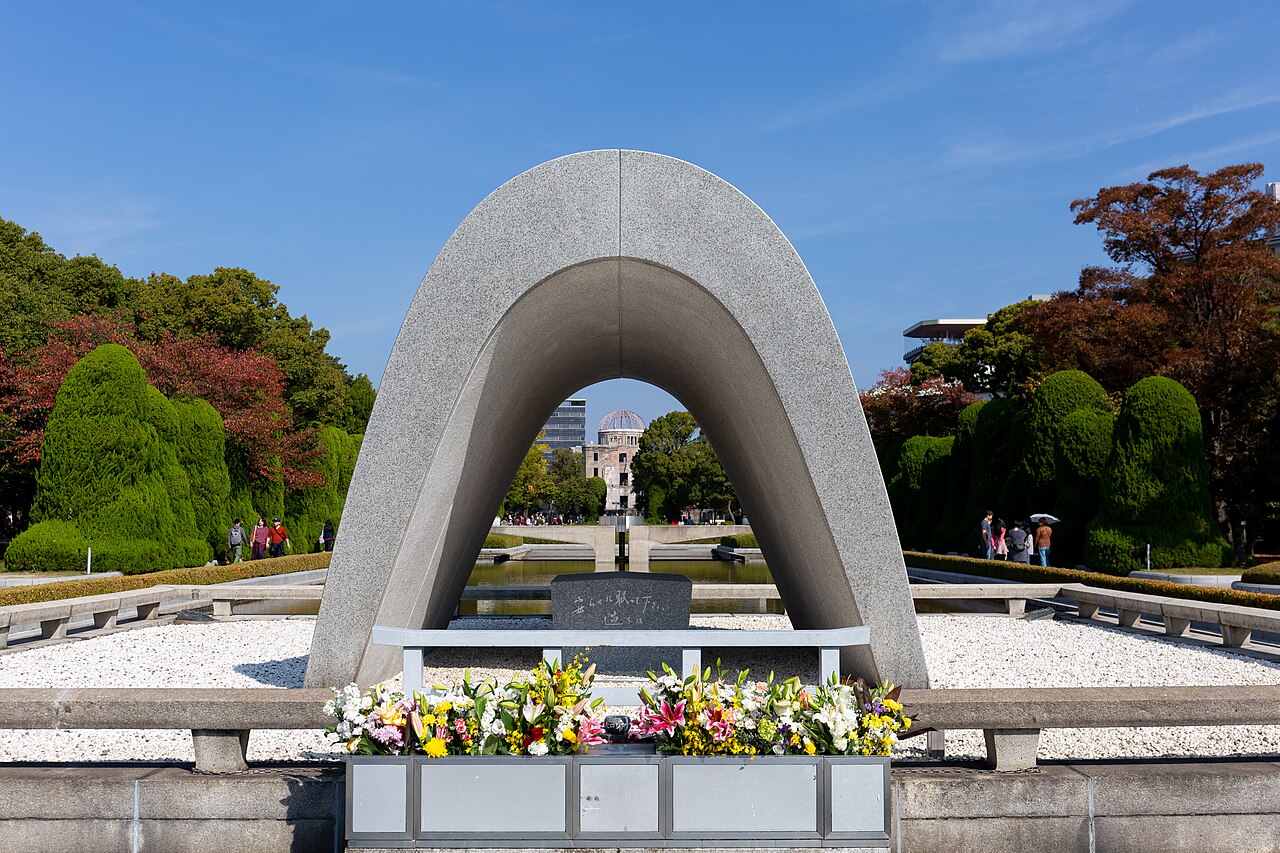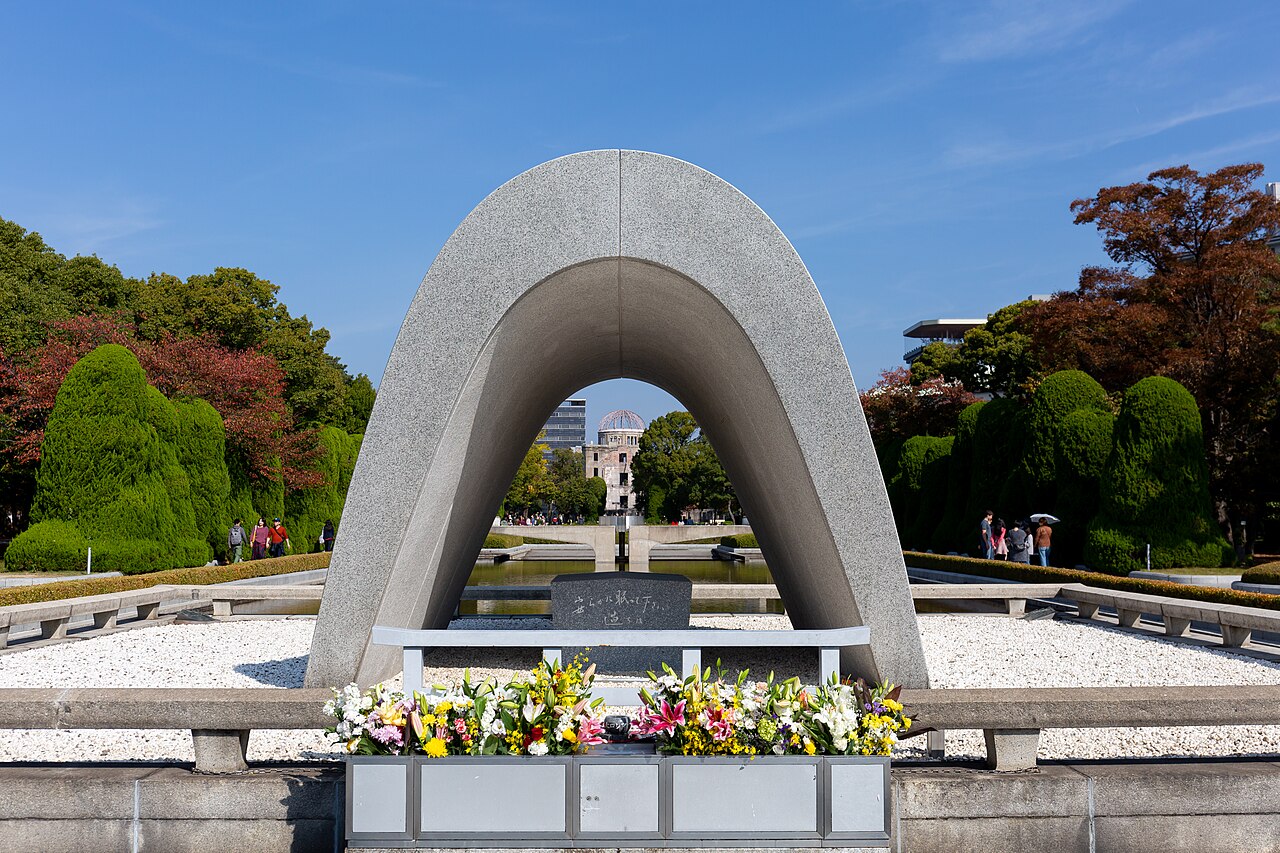
The saddle-shaped arch at the heart of the Peace Park, sheltering the register of every known atomic-bomb victim.
The Memorial Cenotaph, formally the Cenotaph for the Atomic Bomb Victims, stands at the exact centre of the Hiroshima Peace Memorial Park and is the emotional core of the entire site. Designed by the architect Kenzo Tange and unveiled in 1952, it takes the form of a smooth, saddle-shaped concrete arch. The shape was inspired by the haniwa clay house models placed in ancient Japanese tombs, evoking a shelter for the souls of the dead. Beneath the arch sits a stone chest that holds the register of the deceased, a set of volumes updated every year on 6 August to add the names of those who have since died from the after-effects of radiation. The list now records well over three hundred thousand people.
The monument carries a short, famous and deliberately ambiguous inscription that translates roughly as, Let all the souls here rest in peace, for we shall not repeat the evil. The Japanese omits any subject, so it does not say who must not repeat the evil, a grammatical openness that was a matter of public controversy in the 1950s and that Hiroshima has always defended: the pledge, the city says, belongs to all humanity, not to any single nation. Reading the inscription while standing before the arch is, for many visitors, the moment the scale of the loss becomes real.
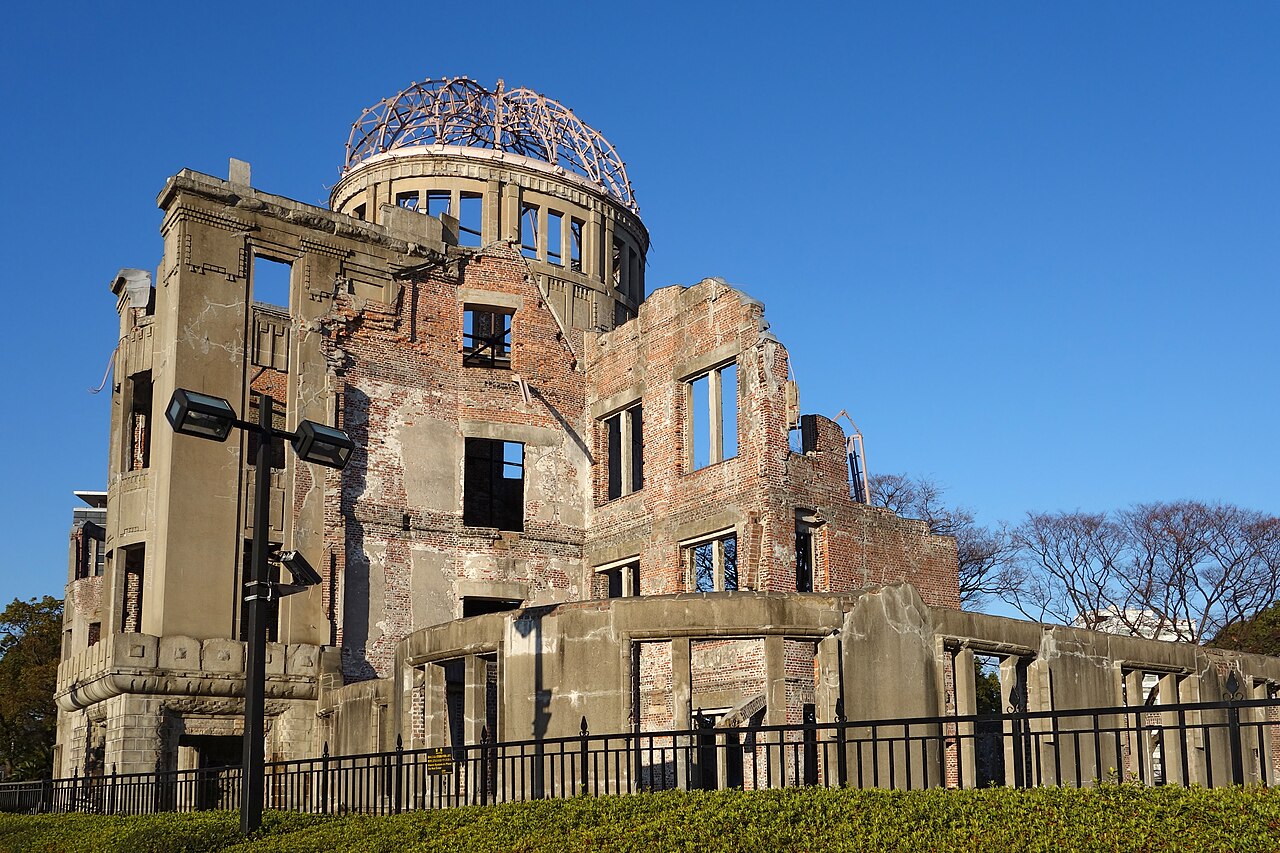
What makes the Cenotaph more than a tomb is its place in Tange's grand design. He set it precisely on the park's central axis so that a person standing before it looks straight through the arch to the eternal Flame of Peace a short distance beyond, and past that, across the Motoyasu River, to the ruined Atomic Bomb Dome. The three monuments, tomb, flame and ruin, are meant to be read as a single line connecting the dead, the living vow and the physical evidence of the blast. Getting low to frame all three through the arch is the definitive Hiroshima photograph, and it is a genuinely powerful sightline rather than a mere tourist trick.
The Cenotaph is the focus of the annual Peace Memorial Ceremony each 6 August, when wreaths are laid, the register is renewed and, at 8:15 in the morning, the city observes a minute of silence at the moment of detonation. On ordinary days it is a place of quiet reflection, where visitors bow, offer flowers or simply stand.
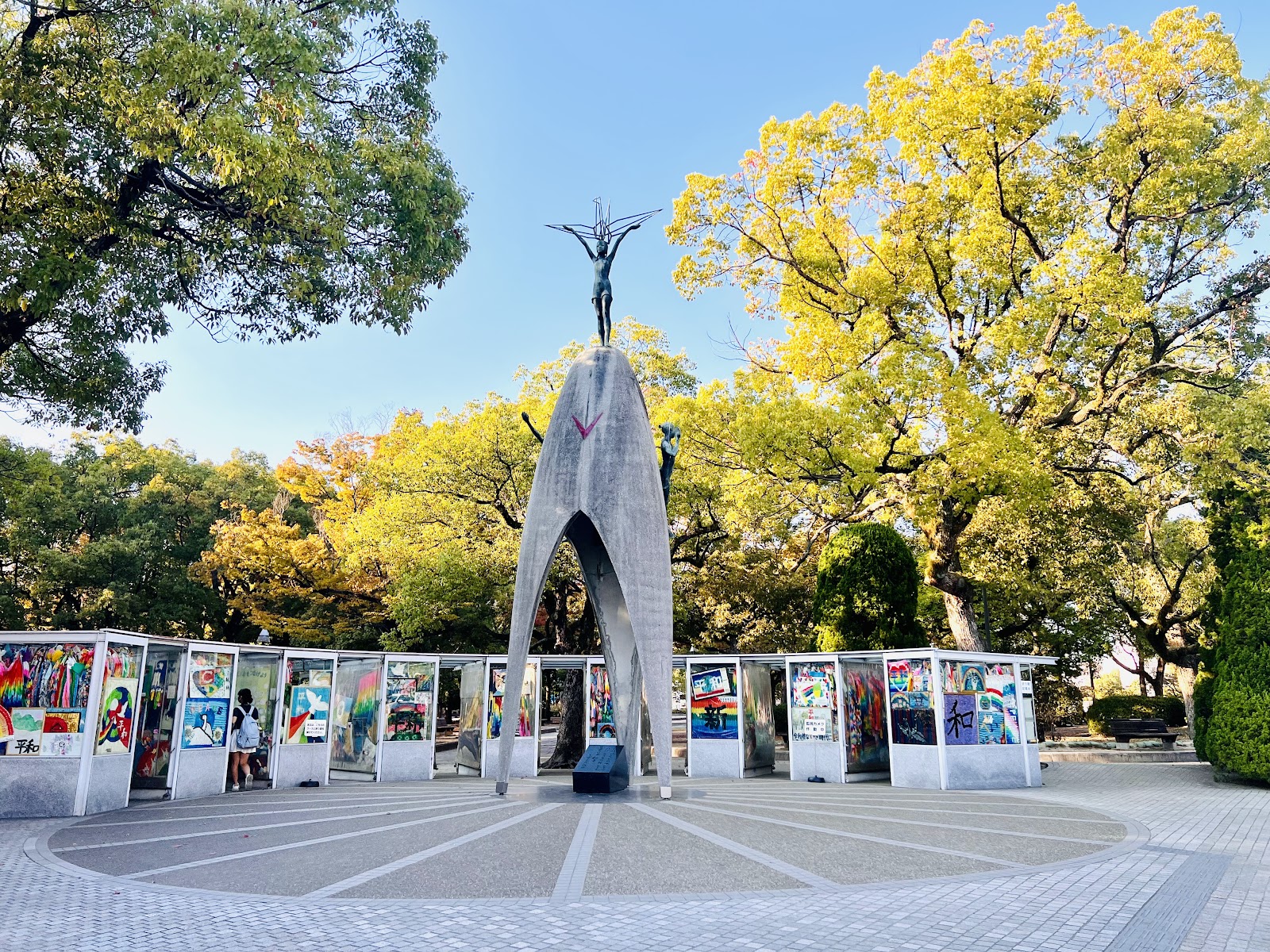
Access is free, open at all hours, and completely step-free, sitting on the flat, paved central promenade of the park just a few minutes' walk from the Genbaku Dome-mae tram stop. It takes only a short pause to visit, but it is the pivot around which a walk through the whole Peace Park turns, linking the Dome to the north with the Children's Peace Monument and the Peace Memorial Museum to the south.
A local's tip
Crouch slightly and look through the arch: the Flame of Peace and the Atomic Bomb Dome line up perfectly, exactly as the architect intended.
Best time to visit
Any time; especially still at dawn
Getting there
Within the Peace Memorial Park, a few minutes' walk from the Genbaku Dome-mae tram stop, on the central north-south axis.
Good to know
- Wi-Fi
- Restrooms
Plan the whole trip offline
Memorial Cenotaph for the A-Bomb Victims is one of many places in the Real Japan app — with turn-by-turn directions, nearby spots and full offline maps you can use with no signal.