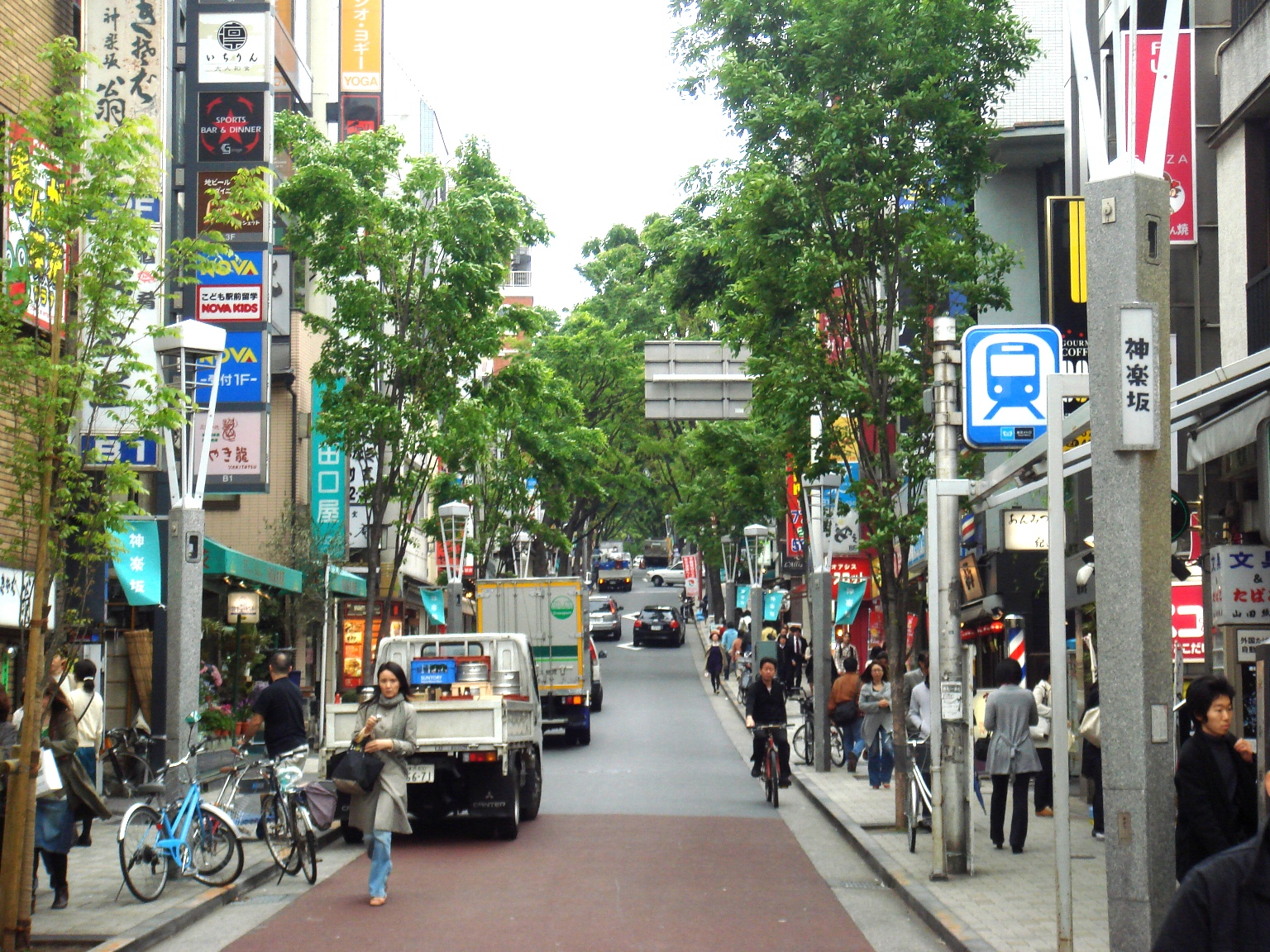
A charming hillside quarter of cobbled geisha alleys, hidden ryotei and French bistros near Iidabashi.
Kagurazaka is one of Tokyo's most atmospheric and least touristy districts, a sloping hillside neighbourhood that has quietly preserved the flavour of old Tokyo while acquiring an unexpected French accent. Climbing gently from Iidabashi toward Ushigome, its central slope and the maze of stone-paved alleys branching off it reward the kind of slow, curious wandering that most of the city, with its scale and speed, does not.
The district's roots lie in the Edo and Meiji periods, when it flourished as a hanamachi, a geisha entertainment quarter. That heritage survives in the discreet black wooden fences, lantern-lit stone lanes, and exclusive ryotei, traditional restaurants where geisha still occasionally entertain behind closed doors. Alleys such as Hyogo-yokocho and Kakurenbo-yokocho ('hide-and-seek alley', named for how easily one gets pleasantly lost) are the district's soul: narrow, curving, cobbled passages where the modern city seems to fall away entirely. Cats doze on doorsteps, and the only sound is footsteps on stone.
What makes Kagurazaka distinctive is its layering. Onto this old-Tokyo base has settled a thriving community of French residents and restaurateurs, drawn historically by the nearby Institut Francais. As a result the neighbourhood is dotted with excellent French bistros, patisseries, and wine bars sitting cheek by jowl with centuries-old sweet shops, tea houses, and the beautiful Bishamonten Zenkoku-ji temple that anchors the main slope. This blend of refined Japanese tradition and understated European charm gives Kagurazaka a character found nowhere else in the city, and its restaurant scene, spanning kaiseki, sushi, French, and cosy izakaya, is regarded as one of Tokyo's best-kept dining secrets.
A highlight is simply the mood after dark. As evening falls, lanterns and the glow of restaurant entrances light the cobbles, the slope fills with a genteel, unhurried crowd, and the alleys take on a cinematic quality. Twice-yearly festivals, including a lively summer Awa-odori dance procession, briefly fill the main street with crowds, but for most of the year Kagurazaka's pleasure is its calm.
Accessibility is straightforward, though the defining feature is a hill: the main street is a moderate incline and the side alleys are cobbled and occasionally stepped, so comfortable shoes help. There is no admission to the district, and exploring costs nothing beyond whatever you choose to eat or drink.
The best time to visit is early evening, when the lanterns come on and the restaurants open, ideally arriving in daylight to see the alleys first and staying as dusk transforms them. Spring and autumn bring the most comfortable weather for walking the slope.
Getting there is easy. Iidabashi Station, at the foot of the hill, is served by the JR Chuo-Sobu Line and three subway lines, the Tozai, Yurakucho, and Toei Oedo, making it reachable from across the city. Kagurazaka Station on the Tozai Line sits at the top of the slope, so many visitors ride to one and walk down to the other.
A local's tip
Leave the main slope and duck into the cobbled side alleys (yokocho) like Hyogo-yokocho; the black-fenced ryotei and hidden French bistros there are the real Kagurazaka, missed by most visitors.
Best time to visit
Evening, when lanterns light the cobbled backstreets
Getting there
Kagurazaka's main slope climbs from Iidabashi Station (JR Chuo-Sobu, Tozai, Yurakucho and Oedo lines). Kagurazaka Station on the Tozai Line sits at the top of the hill.
Good to know
- Wi-Fi
- Cashless
- Restrooms
Plan the whole trip offline
Kagurazaka is one of many places in the Real Japan app — with turn-by-turn directions, nearby spots and full offline maps you can use with no signal.