Japan's first state-built Buddhist temple, founded by Prince Shotoku in 593, laid out in a rare pure symmetrical style.
Shitenno-ji is widely regarded as the oldest officially administered Buddhist temple in Japan, founded in 593 by Prince Shotoku, the statesman most responsible for planting Buddhism in Japanese soil. According to tradition, the young prince vowed that if the pro-Buddhist Soga clan prevailed in their war against the anti-Buddhist Mononobe, he would build a temple to the Four Heavenly Kings (Shitenno) who guard the cardinal directions. His side won, and the temple that rose in what is now central Osaka became a template for Japanese religious architecture.
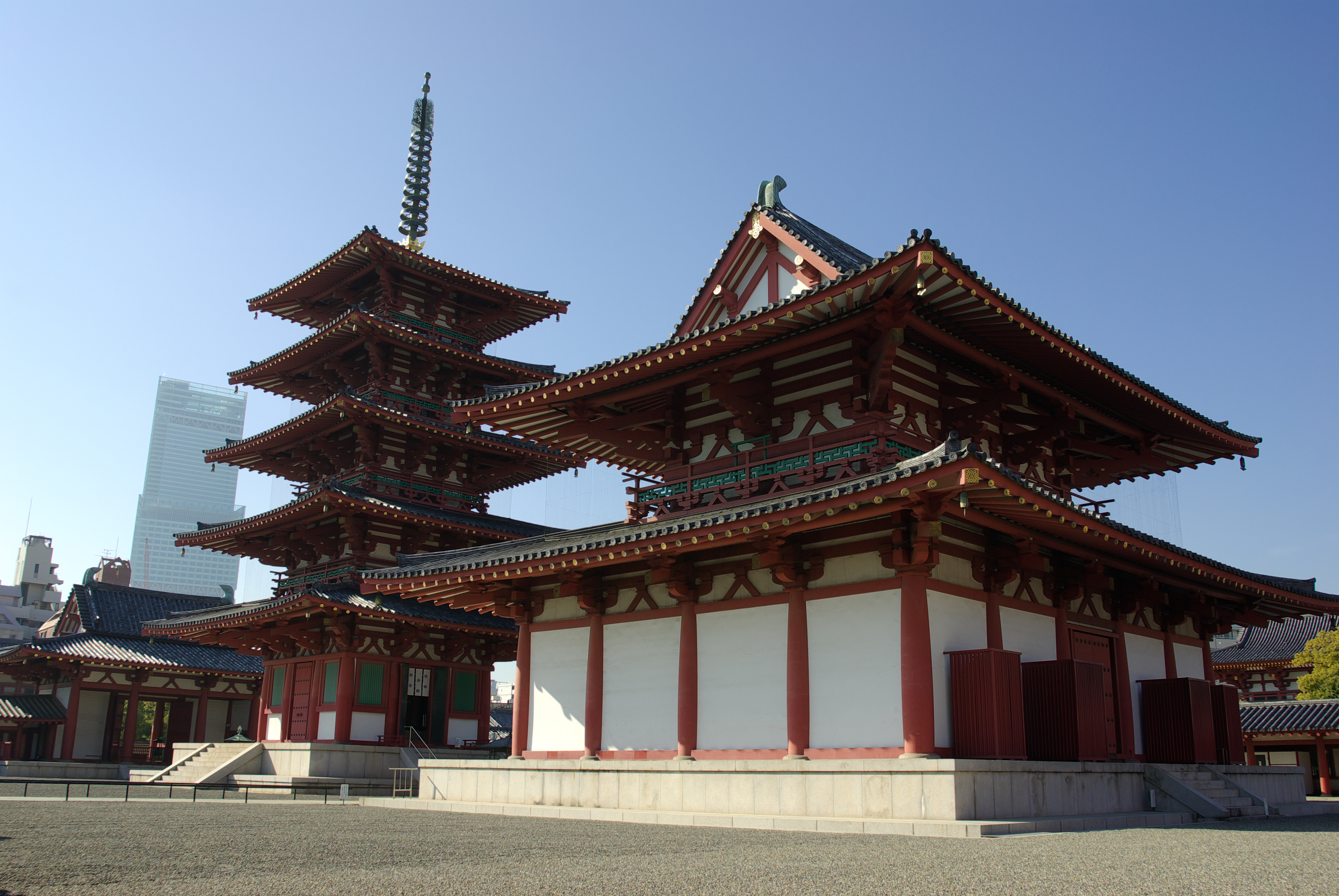
The layout is the temple's greatest treasure. Shitenno-ji preserves the Shitenno-ji-style garan, the oldest temple plan in Japan: a five-story pagoda, the Main Hall (Kondo) and the Lecture Hall arranged in a dead-straight line, all wrapped by a roofed corridor and entered through the Chumon gate. It is austere, geometric and continental, echoing the temples of Baekje-era Korea, whose carpenters Prince Shotoku invited to build it. One of those construction lineages founded Kongo Gumi, which operated as the world's oldest continuously running company until 2006.
War and fire have destroyed the buildings many times; the present concrete reconstructions date mostly to 1963 and faithfully copy the sixth-century originals. That does little to dim the atmosphere. Climbing the five-story pagoda's steep internal stairs rewards you with a view over the precinct and the surrounding city, and the Rokuji-do hall, Gokuraku-jodo garden and the turtle-filled pond reward a slower wander.
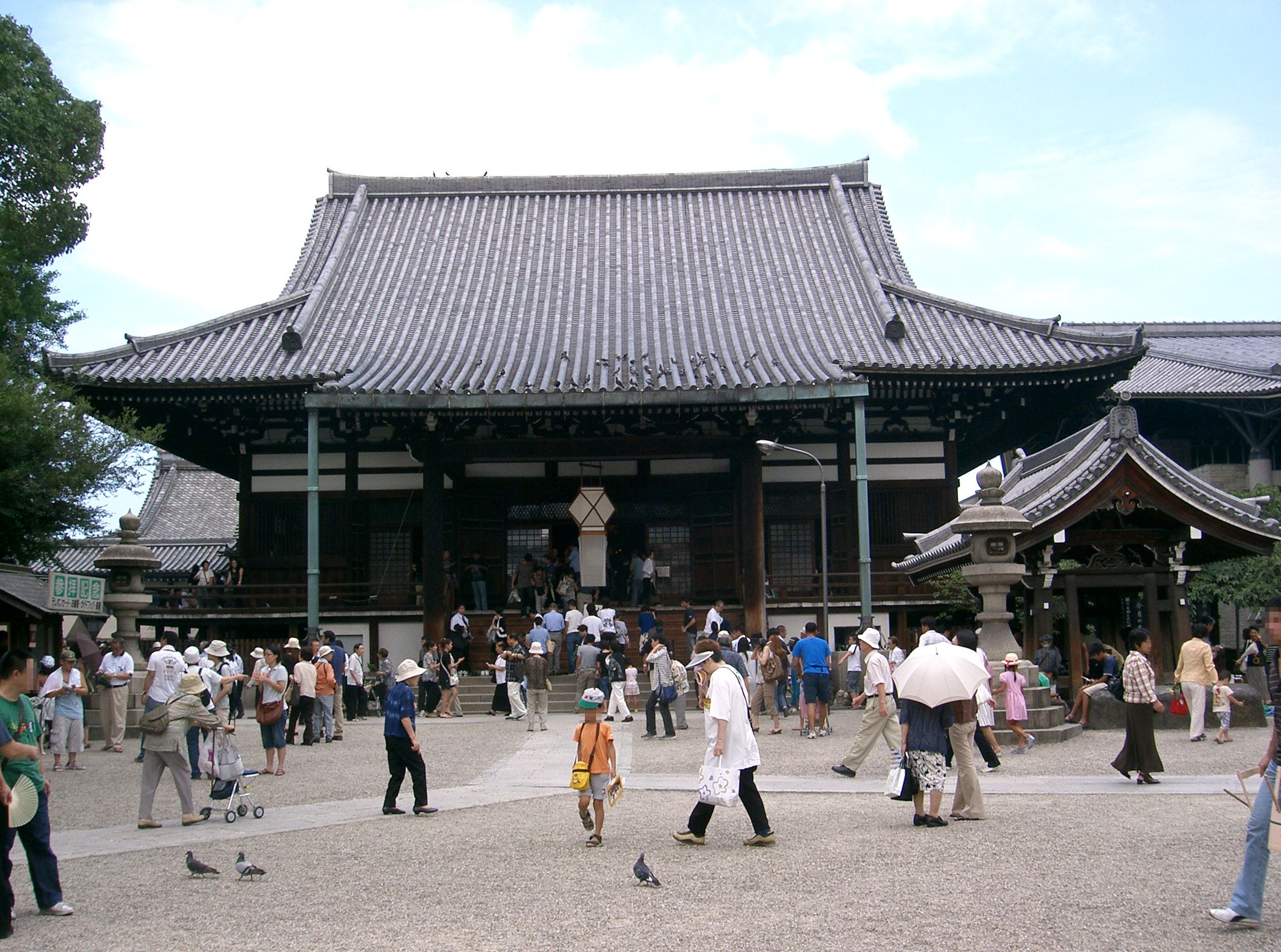
The single best fact to carry with you is that this temple has been a working center of faith for over fourteen centuries, older than almost any wooden structure on earth even if its timber has been renewed. It has always been a people's temple as much as a state one, and that shows most vividly on the 21st of each month, when one of Osaka's largest flea markets sprawls across the grounds. Vendors sell antiques, old kimono, tools, potted plants, takoyaki and taiyaki, and the crowd is a warm cross-section of the city.
Access is easy and the ground-level precinct is largely flat and stroller- and wheelchair-friendly, though the pagoda interior involves stairs and the paid central hall has a modest fee. Photograph the pagoda against the corridor's vermilion pillars in the low light of early morning, when tour groups are thin and the symmetry of the garan reads most clearly. Spring brings cherry blossoms to the grounds; any time of year, arriving near opening at 8:30 gives you the quiet the place deserves.
Getting there is simple: Shitennoji-mae Yuhigaoka Station on the Tanimachi subway line sits five minutes north of the west gate, and Tennoji Station, a major transport hub, is a twelve-minute walk south. Give yourself at least an hour and a quarter, more if you visit on market day or pair it with nearby Isshin-ji and Tennoji Park.
A local's tip
Come on the 21st of the month, when a huge temple flea market fills the grounds with antiques, plants, kimono and street food.
Best time to visit
Early morning; the 21st of any month for the flea market
Getting there
From Shitennoji-mae Yuhigaoka Station (Tanimachi Line) take exit 4 and walk about 5 minutes south. Also roughly 12 minutes on foot from Tennoji Station, a major JR and Metro hub.
Good to know
- Wi-Fi
- Gift shop
- Restrooms
Plan the whole trip offline
Shitenno-ji is one of many places in the Real Japan app — with turn-by-turn directions, nearby spots and full offline maps you can use with no signal.