A refined Taisho-era strolling garden, once the Sumitomo family's private grounds, hidden inside Tennoji Park.
Keitakuen is a small but exquisite Japanese strolling garden tucked into the northern corner of Tennoji Park, a pocket of deliberate calm just minutes from the roaring transit hub of Tennoji. Built in the Taisho era on the former site of the main residence of the Sumitomo family, one of Osaka's great merchant houses and the founders of a business empire that endures today, the garden was later donated to the city and is now a designated cultural property of Osaka.
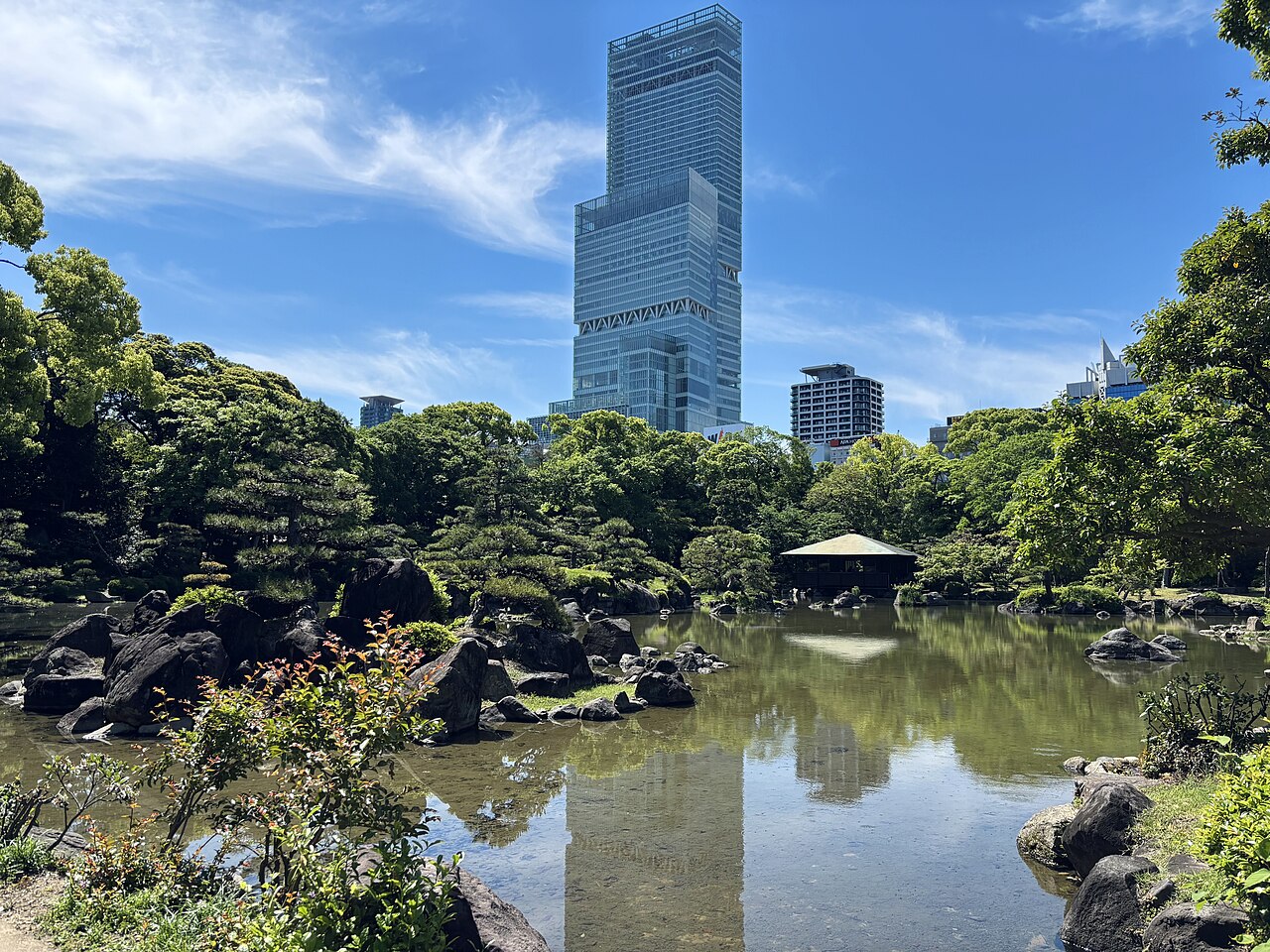
The garden is a chisen-kaiyu, a pond-centred stroll garden, arranged around a large central spring-fed pond that visitors circle on a winding path. It is widely attributed to the influential Kyoto garden designer Ogawa Jihei VII, known as Ueji, whose naturalistic style shaped many of the finest gardens of the age. Every turn of the path is composed as a fresh picture: the pond mirrors the surrounding trees, carefully placed stones and lanterns punctuate the banks, and a forested backdrop screens out the city so completely that the towers of Tennoji seem to vanish.
Although compact, Keitakuen rewards slow, attentive walking. The design uses the principle of borrowed and hidden scenery, revealing and concealing views as you move so that the garden feels far larger than its footprint. Autumn is its signature season, when the maples flush deep red and gold and reflect in the still water; late spring's vivid new greenery is a quieter but equally lovely alternative, and even winter has a spare beauty here.
The visiting experience is one of contemplative retreat rather than spectacle. The circuit takes only 30 to 45 minutes, the path is mostly gentle and largely accessible, and benches invite you to pause by the water. Because it sits within Tennoji Park, it pairs naturally with the adjacent Osaka City Museum of Fine Arts, the Tennoji Zoo, the ancient Chausuyama burial mound and the views from the nearby Abeno Harukas skyscraper.
The best time to visit is autumn, roughly mid to late November, for the maple color, or the fresh green of April and May. A weekday morning offers the greatest tranquillity, before school groups and afternoon visitors arrive. Keep in mind the garden's Monday closure, a common trip-up for travellers.
Getting there could hardly be easier. Tennoji Station is one of southern Osaka's principal interchanges, served by the JR Osaka Loop Line, which is covered by the Japan Rail Pass, and by the Midosuji and Tanimachi subway lines. From the station it is about an eight-minute walk into Tennoji Park, where Keitakuen is signposted near the fine arts museum. The very modest admission makes it one of the best-value garden experiences in the city.
A local's tip
This is a rare pocket of stillness a few steps from one of Osaka's busiest hubs; visit on a weekday morning and you may have the pond path almost to yourself. Note it closes on Mondays, when many visitors are caught out.
Best time to visit
Autumn for maples; late spring for fresh greenery
Getting there
From Tennoji Station, served by the JR Osaka Loop Line and the Midosuji and Tanimachi subway lines, walk about 8 minutes into Tennoji Park; Keitakuen is signposted near the Osaka City Museum of Fine Arts.
Good to know
- Benches
- Restrooms
Plan the whole trip offline
Keitakuen Garden is one of many places in the Real Japan app — with turn-by-turn directions, nearby spots and full offline maps you can use with no signal.