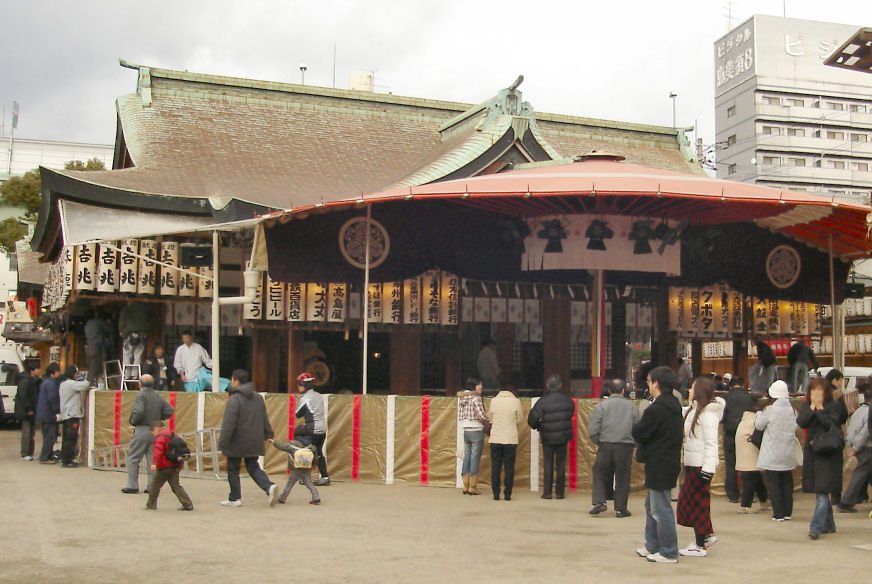
The shrine of Ebisu, god of commerce, whose January festival draws a million merchants praying for a prosperous year.
Imamiya Ebisu Shrine is the beating heart of Osaka's identity as a merchant city, dedicated to Ebisu, the ever-smiling god of commerce, fishermen and good fortune, usually depicted cradling a sea bream and a fishing rod. In a city that has always prided itself on trade and the making of money, few places are as culturally central, and for three days each January this ordinarily modest shrine becomes one of the busiest religious sites in the country.
The shrine's origins are traditionally traced to the year 600, during the reign of Empress Suiko, and it is closely linked to the founding of nearby Shitenno-ji, having reportedly served as a guardian shrine on its western side. Alongside Ebisu himself, known here as Kotoshironushi, the shrine enshrines Amaterasu, Susanoo and other deities. But it is Ebisu, patron of honest trade and abundant catches, who defines the place and its most famous event.
That event is Toka Ebisu, held every January 9 through 11 and one of the great spectacles of the Osaka calendar. Roughly a million people pour through the shrine over the three days to pray for business prosperity in the coming year. The signature ritual is the buying of a fukusasa, a lucky branch of bamboo, which visitors carry to the shrine's kirime maidens to be adorned with small auspicious charms, miniature gold coins, rice bales, sea bream and other tokens of wealth. The result is taken home or to the shop and displayed for the year to invite fortune. The atmosphere is jubilant, crowded and quintessentially Osakan, a festival explicitly about the frank pursuit of prosperity.
A particularly charming custom belongs to the shrine's rear hall. Ebisu is said in local belief to be hard of hearing, so worshippers who have prayed at the front go around to the back of the main building to knock or tap on a board, making sure the god has actually heard their wishes. It is a small, endearing ritual that captures the warm, unpretentious relationship Osakans have with their gods.
Outside the festival, Imamiya Ebisu is a quiet neighborhood shrine, quickly visited, its grounds compact and level and easy for all. The real reason to time a visit is Toka Ebisu, when the shrine, the approach and the surrounding streets fill with stalls, music, decorated bamboo and an electric sense of collective hope for the year ahead. Restrooms and a charm stall are on site, with far more services during the festival.
Getting there could hardly be easier: Imamiya-Ebisu Station on the Nankai Koya Line sits directly beside the shrine, and Ebisucho Station on the Sakaisuji subway is a two-minute walk. The shrine also pairs naturally with the retro Shinsekai district and Tsutenkaku tower just to the south. Allow half an hour on an ordinary day, and far longer, plus patience for crowds, if you come for Toka Ebisu in January.
A local's tip
During Toka Ebisu, buy a lucky bamboo branch (fukusasa) and have the shrine maidens decorate it with charms for prosperity in the year ahead.
Best time to visit
January 9-11 for the Toka Ebisu festival
Getting there
Imamiya-Ebisu Station on the Nankai Koya Line sits right beside the shrine; Ebisucho Station on the Sakaisuji subway is a 2-minute walk.
Good to know
- Restrooms
- Charm stall
Plan the whole trip offline
Imamiya Ebisu Shrine is one of many places in the Real Japan app — with turn-by-turn directions, nearby spots and full offline maps you can use with no signal.