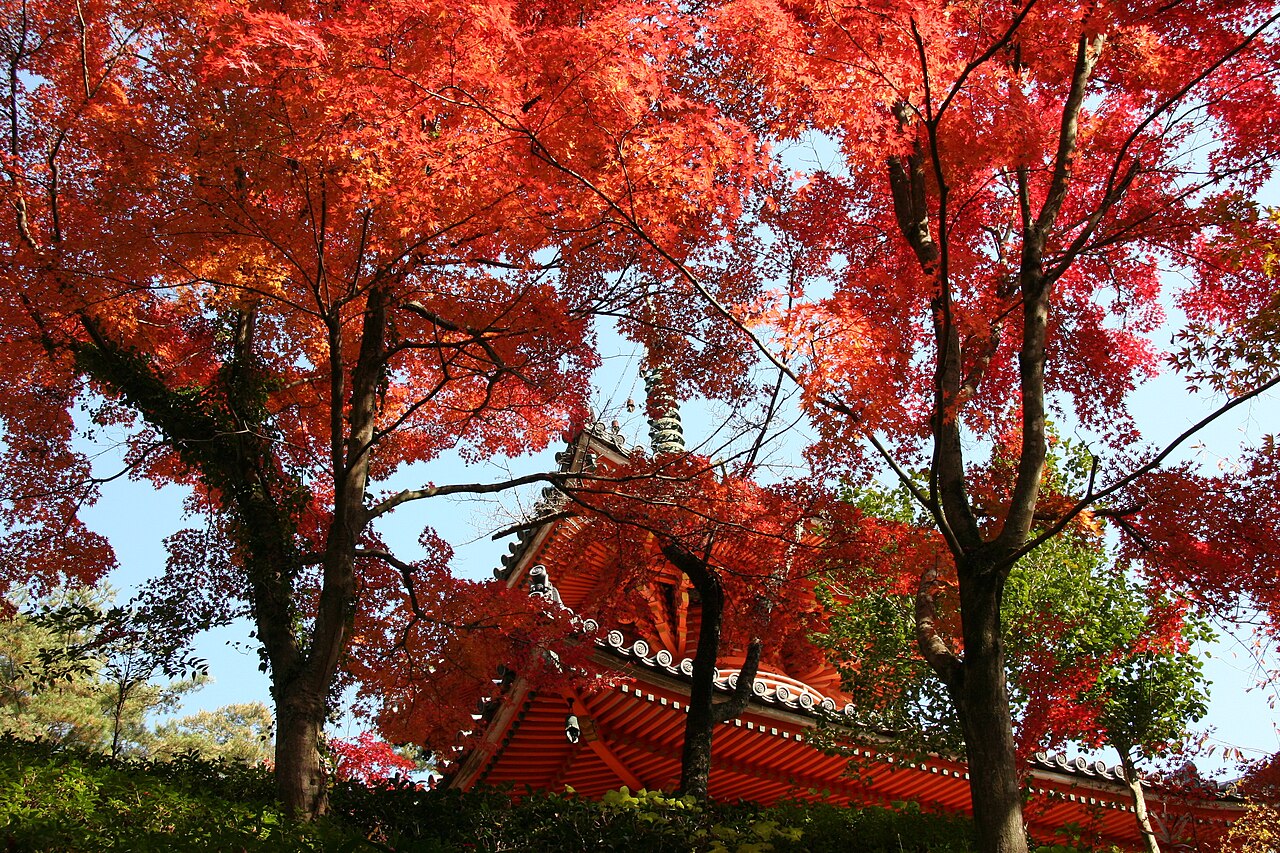
A forested mountain temple of three waterfalls just north of central Hiroshima, famous for blazing autumn maples.
Mitaki-dera is a serene mountain temple hidden in the forested slopes of Mount Mitaki, only a few minutes by train north of central Hiroshima yet a world away from the city bustle. Its name literally means 'three waterfalls temple', for the trio of cascades that tumble through its grounds, and their clear water has long been prized: it is drawn each year to brew the tea offered at Hiroshima's Peace Memorial Ceremony on 6 August, giving this tranquil spot a poignant tie to the city below.
The temple was founded in 809, during the early Heian period, and is dedicated to Kannon, the bodhisattva of compassion; locals affectionately know it as 'Mitaki Kannon'. Rather than a single grand hall, Mitaki-dera is a scattering of weathered wooden buildings, statues and shrines threaded along mossy stone paths that wind uphill through dense woodland. The effect is intimate and contemplative, a place to walk slowly and listen to running water rather than to tick off monuments.
Its architectural jewel is a graceful vermilion two-storey pagoda (tahoto). Originally built in 1526, it was relocated here from Wakayama Prefecture in 1951 as a memorial to those who died in the atomic bombing, and it stands beautifully against the surrounding maples. Throughout the grounds you will pass hundreds of small stone Buddhas and Jizo figures, many draped with red bibs, and quiet halls where incense drifts on the damp forest air. The three waterfalls give the walk its rhythm, and a small tea house near the pagoda serves matcha whisked with the sacred spring water.
Mitaki-dera is above all an autumn destination. From mid to late November the temple's many Japanese maples turn brilliant shades of crimson, scarlet and gold, and the combination of red leaves, red pagoda and grey stone draws photographers from across the region. It is regularly named among the finest maple-viewing spots in western Japan, yet remains far less crowded than the marquee sites of Kyoto. Fresh green momiji make early summer lovely too, and the shaded valley stays cool on hot days.
Because the temple climbs the hillside, expect stone steps, uneven paths and a gentle but steady ascent from the entrance, so comfortable shoes are worth wearing; the reward is a genuinely restful atmosphere and lovely filtered views back toward the city. There is no admission charge, which makes it an easy, rewarding half-day escape or a peaceful counterpoint to a morning spent at the Peace Memorial Park.
Getting there is straightforward and Rail-Pass friendly: from Hiroshima Station take the JR Kabe Line just two stops to Mitaki Station, then walk about fifteen minutes uphill following the signs to the temple gate. Allow around an hour to wander the grounds at an unhurried pace, longer in autumn when you will want to linger over the colour and perhaps a bowl of tea.
A local's tip
Visit in the second half of November, when the maples peak, and stop at the little tea house near the two-storey pagoda for a bowl of matcha; the water is drawn from one of the temple's three sacred waterfalls and is used to brew tea for Hiroshima's peace ceremony each August.
Best time to visit
Mid to late November for autumn leaves
Getting there
Take the JR Kabe Line two stops from Hiroshima Station to Mitaki Station (about 6 minutes, Rail-Pass covered), then walk roughly 15 minutes uphill to the temple gate. The grounds themselves rise through forest on stone paths.
Good to know
- Restrooms
- Tea house
Plan the whole trip offline
Mitaki-dera Temple is one of many places in the Real Japan app — with turn-by-turn directions, nearby spots and full offline maps you can use with no signal.