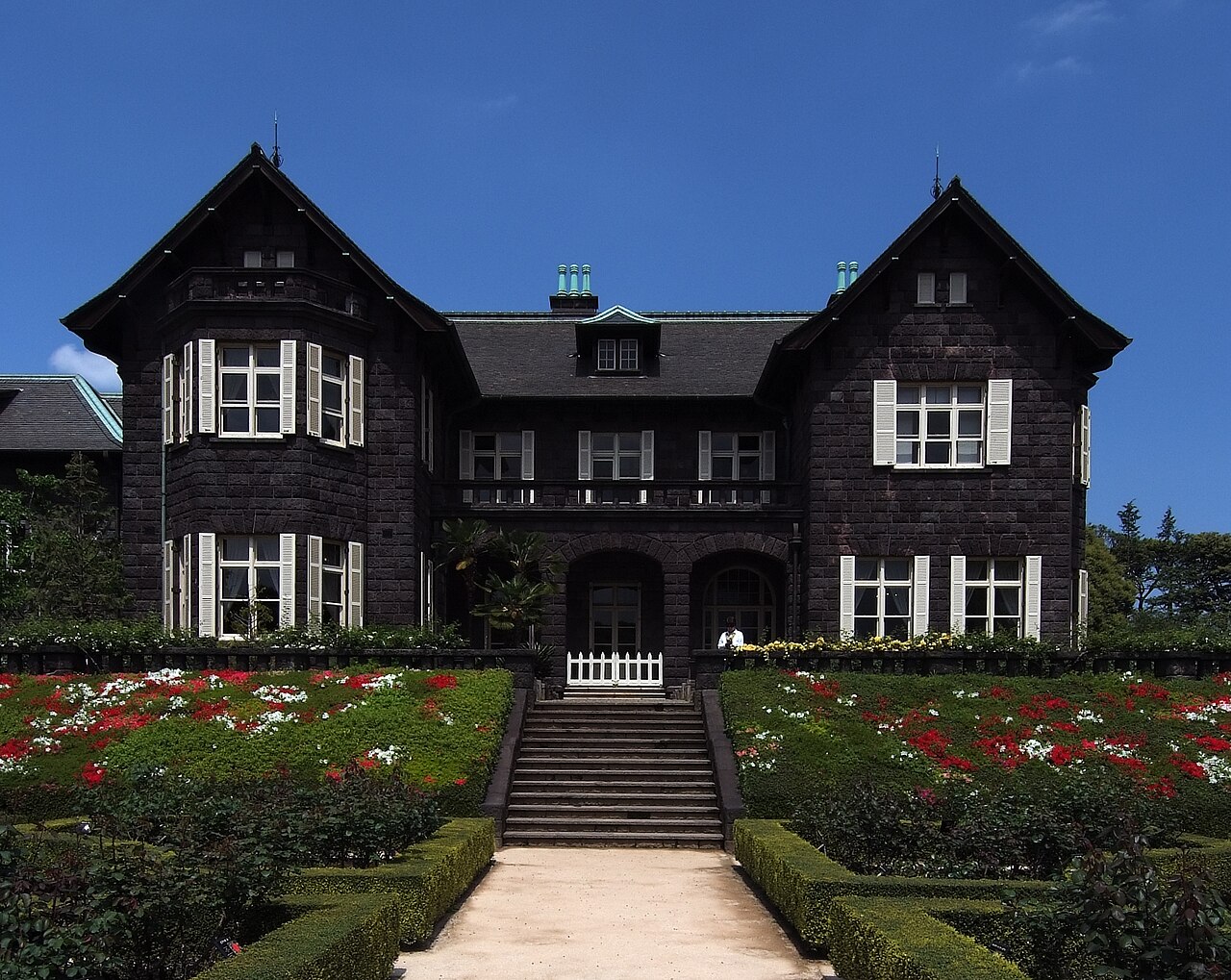
A rare East-meets-West garden pairing a stone European mansion and rose terraces with a classic Japanese pond garden.
Kyu-Furukawa Gardens is one of Tokyo's most unusual and photogenic green spaces, a garden of two distinct halves that embody the cultural collision of early twentieth-century Japan. On the upper terrace stands a handsome grey-stone Western mansion surrounded by geometric beds of roses; below and behind it, hidden by a slope of trees, lies a completely traditional Japanese strolling garden with a heart-shaped pond. Walking from one to the other feels like stepping between two countries in the space of a few minutes.
The estate was developed by Baron Furukawa Toranosuke, head of a powerful mining and industrial conglomerate. The Western mansion and its formal rose garden were designed by the celebrated British architect Josiah Conder—the same architect responsible for many of Meiji Tokyo's landmark Western buildings—and completed in 1917. The Japanese garden below was laid out by Ogawa Jihei VII, known as Ueji, one of the most influential garden masters of the modern era, and finished in 1919. The pairing of a leading foreign architect with a master Japanese gardener on a single site is what makes Kyu-Furukawa so distinctive.
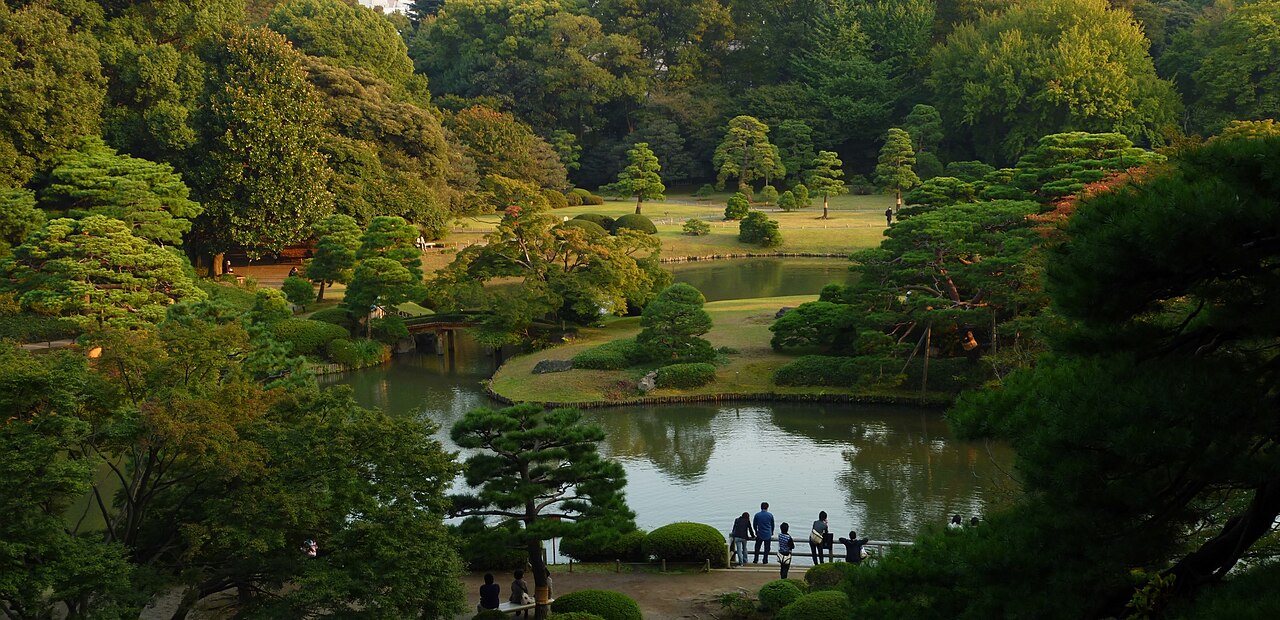
The rose garden is the star for many visitors. Arranged in tidy Italian- and French-influenced parterres on the terrace before the mansion, it bursts into colour and scent twice a year, in mid-May and again in mid-October, when the beds hold roughly a hundred varieties. The stone mansion behind, with its ivy and mullioned windows, gives the scene an unmistakably European air. Descend the wooded slope, however, and the mood changes entirely: the Japanese garden centres on a pond shaped like the kanji character for "heart," with a dry waterfall, stone lanterns, a teahouse, and carefully placed rocks and pruned pines, all screened from the city by dense trees.
The visiting experience is calm and compact, easily enjoyed in an hour, and the contrast between the two styles keeps it constantly interesting. Autumn brings fine maple colour to the Japanese section, while the roses define spring and autumn on the terrace above. The mansion interior can be viewed on separate guided tours booked in advance. Paths in the Japanese garden involve some slopes and steps, so the upper Western section is the more accessible, but the whole garden is small enough to appreciate even from the terrace.
Admission is just 150 yen, another of Tokyo's great garden bargains. The best time to visit is unquestionably the spring or autumn rose season, ideally on a weekday morning before the photographers arrive. To reach it, take the JR Keihin-Tohoku Line to Kami-Nakazato or the Namboku Line to Nishigahara and walk about seven minutes. Because Rikugi-en lies only a short walk south near Komagome, the two pair beautifully into a single, richly varied garden itinerary in Tokyo's quiet northern neighbourhoods.
A local's tip
Time your visit for the spring or autumn rose season and stand on the terrace below the stone mansion looking down over the geometric rose beds to the Japanese pond beyond—it is the one spot where the garden's Western and Japanese halves line up in a single frame.
Best time to visit
Mid-May and mid-October for the rose garden in full bloom
Getting there
From Kami-Nakazato Station (JR Keihin-Tohoku Line) it is about a 7-minute walk, or roughly the same from Nishigahara Station on the Tokyo Metro Namboku Line. Komagome Station is also within a 12-minute walk.
Good to know
- Restrooms
- Rest house
- Wheelchair
- Rose garden
Plan the whole trip offline
Kyu-Furukawa Gardens is one of many places in the Real Japan app — with turn-by-turn directions, nearby spots and full offline maps you can use with no signal.