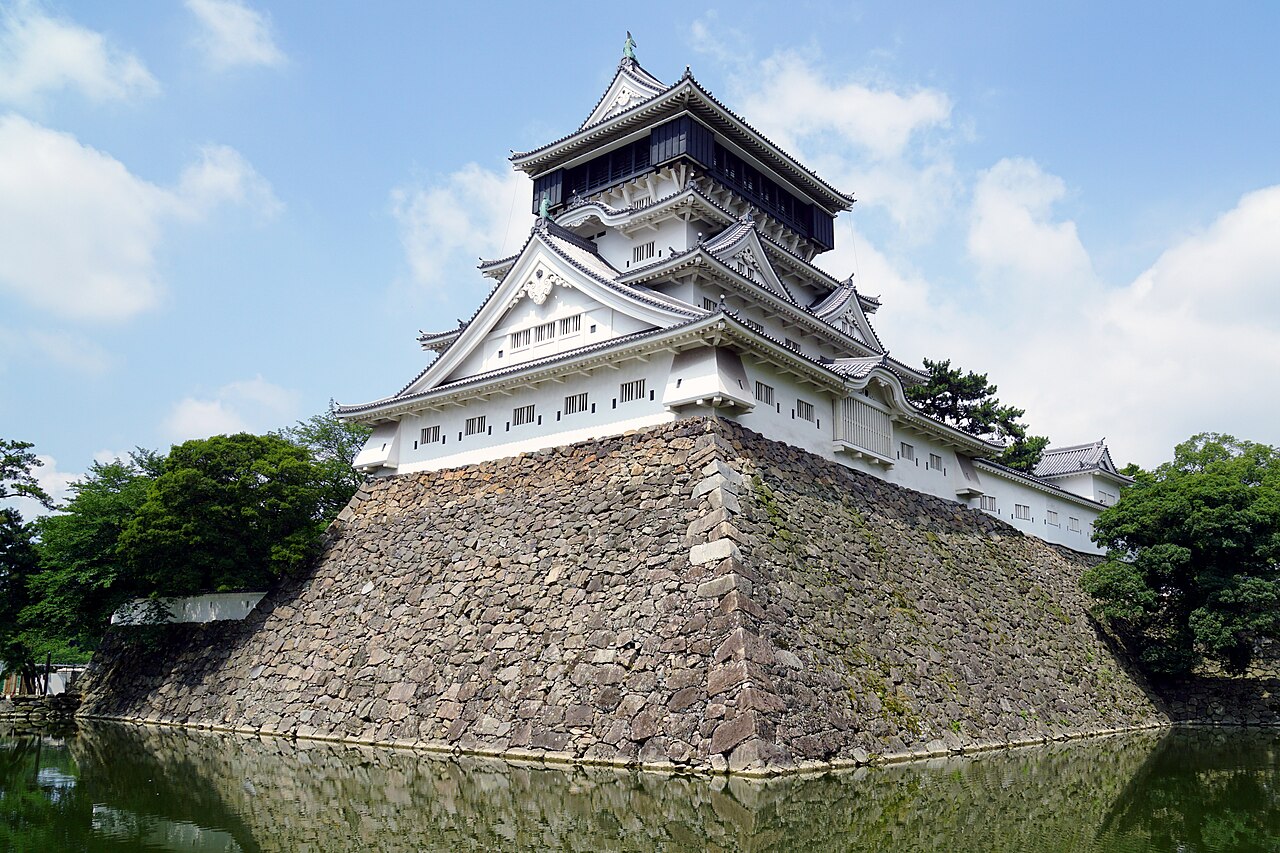
Kitakyushu's rebuilt hilltop keep, a striking gateway castle first raised by warlord Hosokawa Tadaoki in 1602.
Kokura Castle rises above the Murasaki River in the heart of Kitakyushu, a bold black-and-white keep that has become the symbol of Japan's northern Kyushu gateway. The original fortress was built between 1602 and 1608 by Hosokawa Tadaoki, a distinguished general who fought at the Battle of Sekigahara, and it later passed to the Ogasawara clan, who governed the surrounding domain for more than two centuries.
The castle is unusual among Japanese keeps for its karazukuri design, in which the top floor is wider than the one below it, giving the tower a distinctive flared silhouette with no decorative gables. The original keep burned down in 1837 and was finally lost for good during the turbulence of the 1860s, but the current five-storey reconstruction, completed in 1959, faithfully echoes that historic outline. Inside, modern exhibits trace the life of the castle town, with dioramas, samurai armour, and an interactive floor where children can try on helmets and heft replica swords.
What makes a visit rewarding is the setting as much as the tower. The castle stands within Katsuyama Park, whose broad lawns and stone ramparts fill with cherry blossom in late March and early April, drawing crowds for hanami picnics beneath the walls. Adjacent to the keep, the Kokura Castle Garden recreates a feudal lord's residence and strolling garden, complete with a tea house where you can pause over matcha and a seasonal sweet while gazing across raked gravel and clipped pines.
There is genuine history layered into the site. Miyamoto Musashi, Japan's most famous swordsman, is connected to this domain through his adopted son Iori, who served the Ogasawara lords, and the castle grounds nod to that legacy. The nearby Yasaka Shrine, within the old outer bailey, hosts the lively Kokura Gion Daiko drum festival each July, a UNESCO-recognised tradition of thunderous taiko that has echoed here for four hundred years.
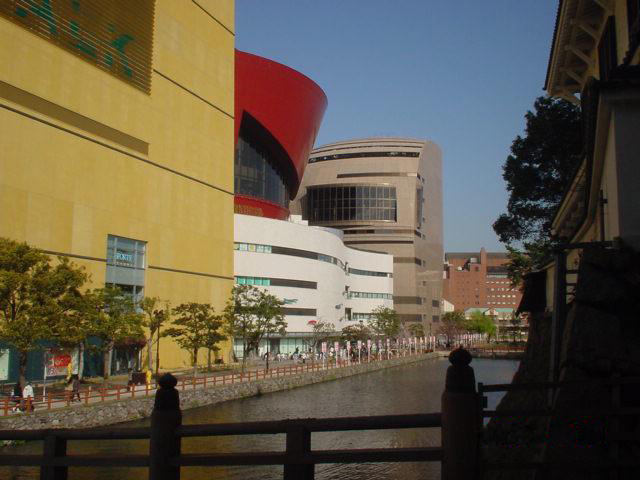
From the top floor, windows open onto a sweeping view over the Riverwalk Kitakyushu complex, the river, and the city stretching toward the Kanmon Strait that separates Kyushu from Honshu. It is an easy, satisfying stop for travellers passing through on the Shinkansen, requiring only an hour or two yet offering a real sense of the region's warrior past.
The best time to visit is spring, when the moat and ramparts are wreathed in blossom, or a clear autumn afternoon when the maples in the garden turn and the light softens the keep's dark timbers. To get here, walk about fifteen minutes south from JR Kokura Station, a major Shinkansen stop covered by the Japan Rail Pass, or take the short monorail hop to Heiwa-dori. Combined with the castle garden and the Matsumoto Seicho Memorial Museum next door, it makes a relaxed half-day in the middle of Kitakyushu.
A local's tip
Buy the combination ticket that adds the neighbouring Kokura Castle Garden (Teien) and Matsumoto Seicho Memorial Museum for far better value than the keep alone.
Best time to visit
Spring for cherry blossoms; clear afternoons for keep views
Getting there
A 15-minute walk south from JR Kokura Station, or a short ride on the Kitakyushu Monorail to Heiwa-dori. The castle sits in Katsuyama Park beside the Murasaki River in central Kitakyushu.
Good to know
- Wi-Fi
- Gift shop
- Restrooms
- Wheelchair access
Plan the whole trip offline
Kokura Castle is one of many places in the Real Japan app — with turn-by-turn directions, nearby spots and full offline maps you can use with no signal.