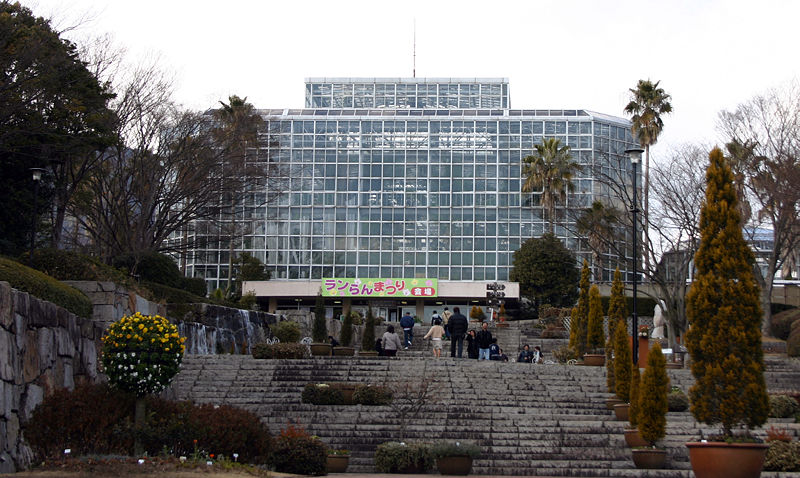
A hillside botanical garden above the Seto Inland Sea with Japan's largest greenhouse dome and thousands of plant species.
Spread across a sunny hillside in the western suburbs of Hiroshima, overlooking the islands of the Seto Inland Sea, the Hiroshima Botanical Garden is a green and gently educational retreat that makes a fine half-day escape from the city centre. Opened in 1976, it covers a generous eighteen hectares and cultivates well over ten thousand plant species and varieties, arranged across themed outdoor beds, wooded slopes and a series of large greenhouses. For families, garden lovers and anyone wanting a quiet day among growing things, it is one of the most relaxing spots in the prefecture.
The garden's centrepiece is its great greenhouse, one of the largest in Japan, whose soaring dome shelters a lush tropical and subtropical world of orchids, palms, cycads and towering rainforest trees. A star attraction is the giant Amazonian water lily, Victoria amazonica, whose enormous circular pads can support a surprising weight and whose flowers open only at night, changing colour from white to pink over two evenings. On selected summer nights the garden stays open late so visitors can witness this rare and dramatic bloom, one of the botanical highlights of the Japanese calendar.
Outdoors, the collections change with the seasons in a continuous procession of colour. Spring brings drifts of cherry blossom, tulips, azaleas and a celebrated peony and Japanese iris display; early summer adds roses and hydrangeas; and even the cooler months offer camellias, plum blossom and winter-flowering shrubs. A dedicated Japanese rose garden, a cactus and succulent house, a bonsai display and specialist beds for medicinal and useful plants give the garden real depth for enthusiasts, while broad lawns and shaded paths make it easy and pleasant for casual strollers and children.
Because the garden climbs a hillside, its upper reaches open onto fine views over Hiroshima Bay and the scattered green islands beyond, a reminder that you are never far from the sea in this part of Japan. Benches, a restaurant and a gift shop selling seeds and plants make it easy to spend a leisurely couple of hours, and the gentle gradients and paved main paths keep most of the garden accessible to all. Regular seasonal events, plant sales and hands-on workshops give it a lively, community feel, especially at weekends.
The garden lies a short distance from central Hiroshima in the Saeki ward. The usual approach is to take a JR Sanyo Line train to Itsukaichi Station and then a local bus bound for the botanical garden, a ride of around twenty minutes that climbs into the hills to the entrance. Admission is a modest 510 yen and the garden is open every day except Thursdays, from morning until late afternoon, with those special extended summer evenings for the water lily. Come in spring for the greatest floral variety, or on a warm summer night for the once-a-year spectacle of the giant lily unfurling in the humid air of the great glasshouse.
A local's tip
Time a summer visit for the rare night openings when the enormous Victoria amazonica water lily blooms after dark in the tropical greenhouse.
Best time to visit
Spring for flowers; summer evenings for the giant water lily
Getting there
Take the JR Sanyo Line to Itsukaichi Station, then a local bus bound for the botanical garden (Shokubutsu-koen) for about 20 minutes to the entrance.
Good to know
- Gift shop
- Restrooms
- Greenhouse
- Restaurant
Plan the whole trip offline
Hiroshima Botanical Garden is one of many places in the Real Japan app — with turn-by-turn directions, nearby spots and full offline maps you can use with no signal.