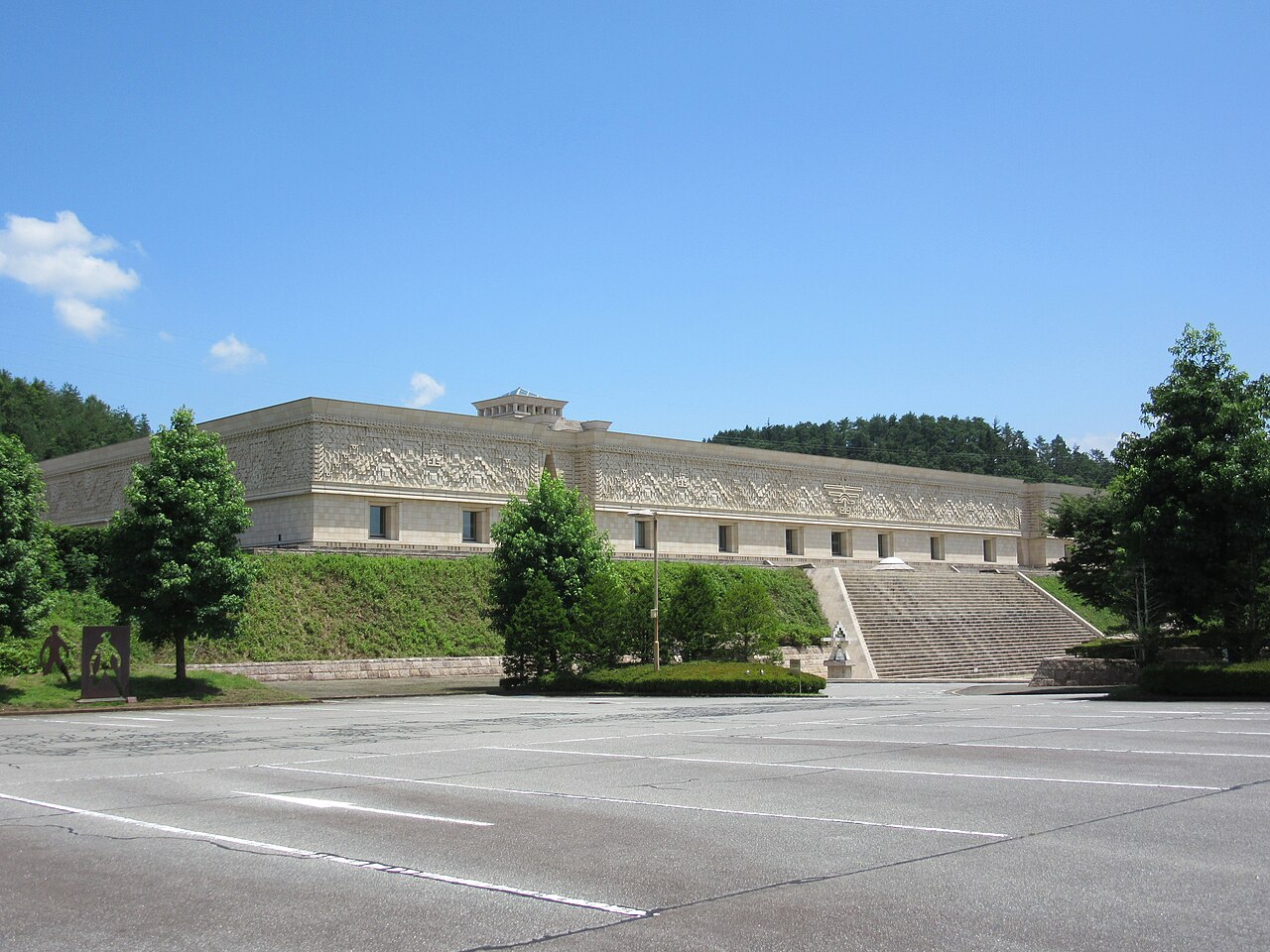
A monumental pyramid-shaped museum blending Japanese art, world antiquities and European paintings.
The Hikaru Museum is one of Takayama's more unexpected cultural landmarks, a vast and unusual building on the hills southwest of the city that houses an eclectic collection spanning Japanese art, world antiquities and European masterpieces. Completed in 1999, its most arresting feature is the architecture itself: the sprawling stone structure was inspired by the great Maya pyramid complexes of Tikal in Guatemala, and its monumental, stepped exterior rising from the mountain greenery makes an immediate and dramatic impression, quite unlike anything else in Hida.
Inside, the museum's collection is broad in scope if selective in depth. One of its strengths is Japanese art, with paintings, screens, ceramics and other works that reward visitors interested in the country's artistic traditions. A separate gallery holds a small but notable collection of European painting, including works attributed to major names such as Renoir, Van Gogh and Monet, allowing an unexpected encounter with Western art in a mountain setting. Elsewhere the museum displays a scattering of artefacts from ancient civilisations around the world, echoing the archaeological theme of its pyramid design, along with fossils and natural history exhibits.
The overall experience is as much about atmosphere and architecture as about any single object. The interiors are spacious and grand, with soaring halls and long galleries, and part of the pleasure is simply moving through such a bold, idiosyncratic building. Because the collection ranges so widely, visitors tend to find their own highlights, whether that is a favourite European canvas, a delicate piece of Japanese porcelain or an ancient relic. A cafe and museum shop round out the visit, and the elevated location offers views over the surrounding countryside.
The Hikaru Museum makes a good choice for travellers who have already seen Takayama's core historical sights and are looking for something more offbeat, or for art lovers who welcome an air-conditioned, weatherproof indoor destination. Families may enjoy the archaeological and natural history elements and the sheer novelty of the pyramid design. Allow around ninety minutes to explore at a relaxed pace.
A few practical points are worth noting. The museum lies about three kilometres southwest of Takayama Station, too far to walk comfortably, so a taxi or local bus is the sensible way to arrive, taking roughly ten minutes. It is generally open from late February to mid-December and closed on Wednesdays, and it also closes during the depths of winter, so it is one Takayama attraction where checking the seasonal schedule in advance genuinely matters. Admission is around 900 yen, with combination tickets sometimes available alongside the Hida Takayama Museum of Art.
Open from 10:00 to 17:00 on the days it operates, with parking, restrooms and a cafe on site, the Hikaru Museum offers a curious and memorable blend of art, archaeology and architecture. It will not suit every itinerary, but for the curious traveller it provides a genuinely distinctive stop and a striking building unlike anything else you will encounter in the Japan Alps.
A local's tip
The building itself is the star: it was modelled on the Maya pyramids of Tikal in Guatemala, so allow time to walk around the monumental exterior before heading inside.
Best time to visit
Late February to mid-December; closed in deep winter
Getting there
About 3 km southwest of Takayama Station; reachable by taxi or local bus in roughly 10 minutes, as it is too far to walk comfortably.
Good to know
- Cafe
- Parking
- Restrooms
- Museum shop
Plan the whole trip offline
Hikaru Museum is one of many places in the Real Japan app — with turn-by-turn directions, nearby spots and full offline maps you can use with no signal.