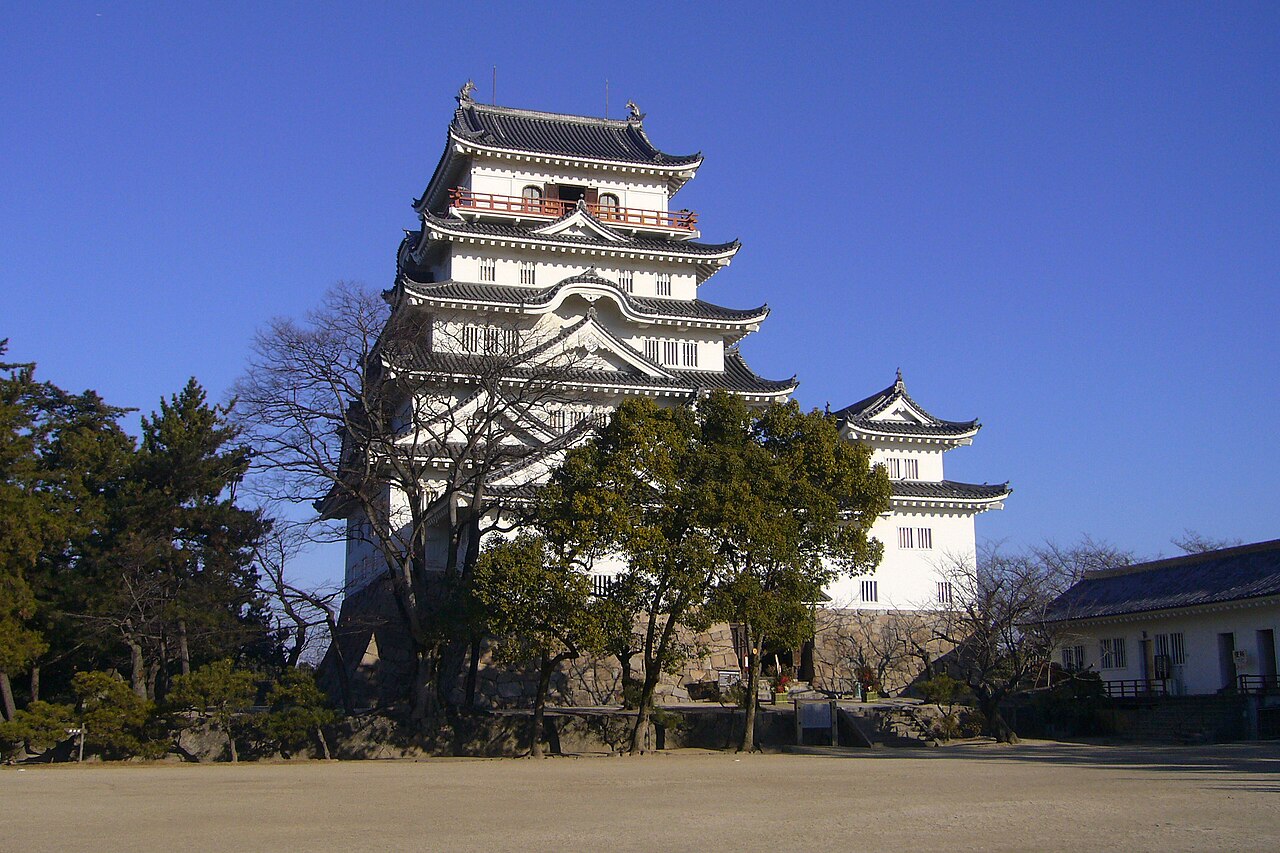
An Edo-period castle rebuilt beside its Shinkansen station, notable for the restored iron plating on its keep.
Fukuyama Castle rises on a low hill immediately behind the Shinkansen station of Fukuyama, in the eastern corner of Hiroshima Prefecture, and it is one of the most conveniently reached castles in all of Japan. It was built in 1622 by Mizuno Katsunari, a cousin of the shogun Tokugawa Ieyasu, who was granted the region as a reward and set about creating a brand-new castle town to guard the western approaches to the shogun's domains. Constructed at the very end of Japan's great castle-building age, it was a large and sophisticated fortress, and some of its structures were reputedly moved here from Fushimi Castle near Kyoto, including a turret and a gate that survive to this day and are designated Important Cultural Properties.
For more than two centuries the castle was the seat of the Mizuno and later the Abe clans and the heart of a prosperous domain. Much of it survived into the modern era, and its original five-storey keep was designated a National Treasure. That keep, however, was destroyed in an air raid in August 1945 during the final weeks of the Second World War, the same summer that saw the atomic bombing of Hiroshima city to the west. The present keep is a ferro-concrete reconstruction completed in 1966, rebuilt to the outward form of the lost original.
A major renovation completed in 2022, marking four centuries since the castle's founding, gave the keep a distinctive and historically grounded new feature. Records showed that the original north face had been clad in protective black iron plates, an unusual defensive measure because that side lacked natural protection, and the restoration recreated this striking dark iron sheathing. The result is one of the only castle keeps in Japan to display such armour, and walking around to the north face to see it is the highlight of a visit. Inside, the keep functions as a local history museum, with displays on the Mizuno and Abe clans and on the castle town, and the top floor offers views over the city and the Inland Sea coastal plain.
The surrounding hilltop park preserves the original stone walls, moat traces, and the two genuine surviving structures, along with a shrine and a small art museum nearby. In spring the grounds are a popular cherry-blossom spot, the pink canopy set against the pale keep, and autumn brings maple colour to the slopes.
What sets Fukuyama apart from most castles is sheer accessibility: it stands barely a hundred metres from the north exit of Fukuyama Station, a Shinkansen stop fully covered by the Japan Rail Pass, so it can be visited in an hour as a stop between Hiroshima and Okayama without ever taking a bus or taxi. The keep museum charges a modest fee and closes on Mondays, while the park itself is free and open. The hilltop involves some steps, so the keep is not fully wheelchair accessible, but the views and the ironclad keep reward the short climb.
A local's tip
Walk around to the north face of the keep to see the recreated black iron cladding, a rare defensive feature restored in the 2022 renovation and unique among Japanese castles.
Best time to visit
Spring for cherry blossom on the castle hill
Getting there
Fukuyama Castle sits directly behind the north exit of Fukuyama Station, a five-minute walk uphill; Fukuyama is a Shinkansen stop on the Sanyo line.
Good to know
- Wi-Fi
- Gift Shop
- Restrooms
Plan the whole trip offline
Fukuyama Castle is one of many places in the Real Japan app — with turn-by-turn directions, nearby spots and full offline maps you can use with no signal.