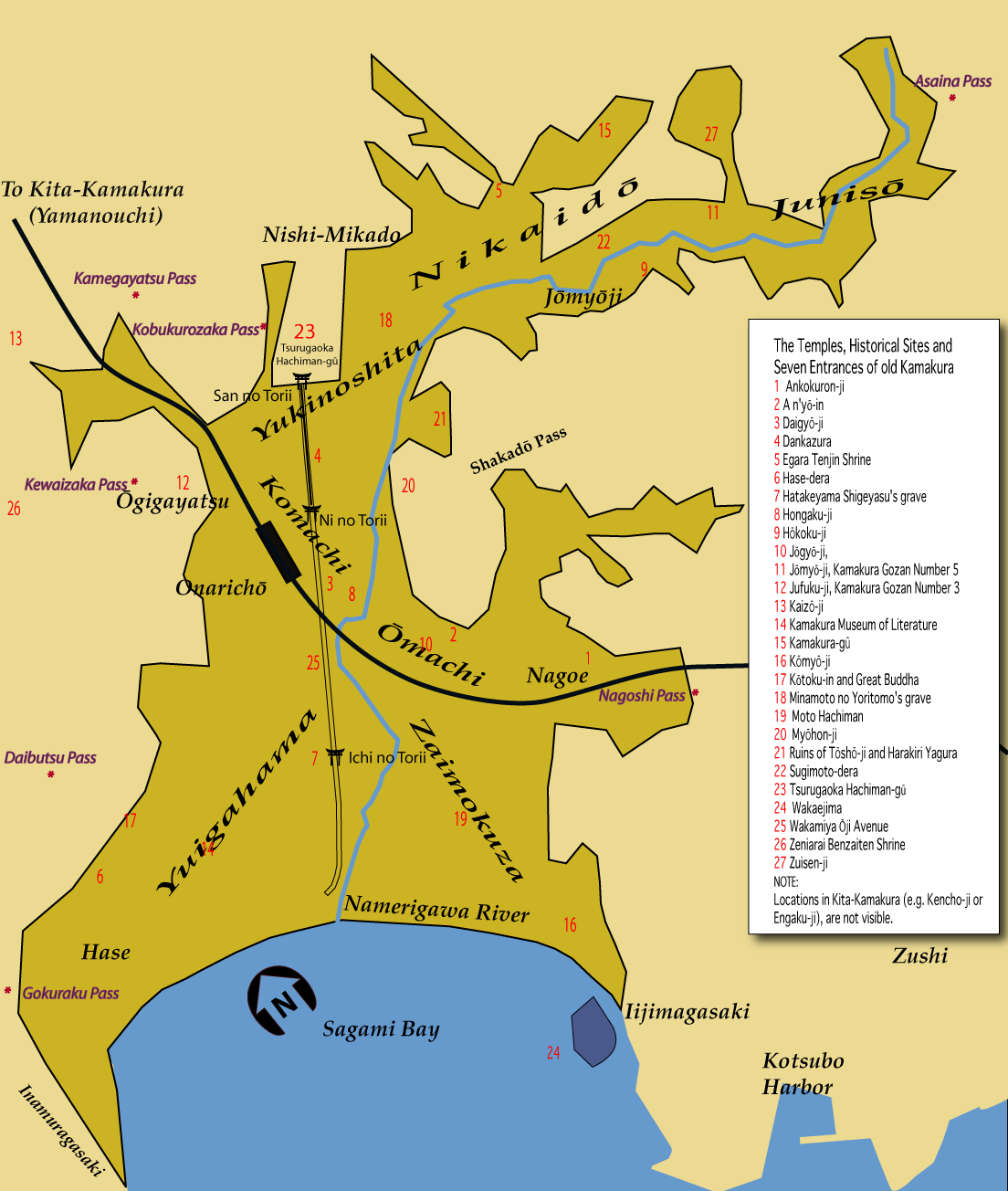
The grand ceremonial avenue laid out by Minamoto Yoritomo in 1182, its raised cherry-lined path leading straight to Kamakura's great shrine.
Wakamiya Oji is the ceremonial spine of Kamakura, a broad, arrow-straight avenue running from near the seashore up to the towering torii and steps of Tsurugaoka Hachimangu, the city's great shrine. Far from being an ordinary road, it is a deliberate piece of medieval urban planning, laid out in 1182 on the orders of Minamoto no Yoritomo himself, the founder of the shogunate, as a sacred processional way linking the shrine to the sea. To walk it is to trace the axis around which the first samurai capital was organised.
The avenue is famous above all for the Dankazura, a raised pedestrian path running down its centre, elevated above the roadway and lined with cherry and azalea. Tradition holds that Yoritomo had this causeway built as a prayer for the safe delivery of a child by his wife, Hojo Masako, who was pregnant at the time; the raised path was an offering to the gods for a healthy birth. Whatever its precise origins, it became one of the defining features of the city, and it survives — restored and replanted over the centuries — as one of Kamakura's most beloved landmarks.
The design contains a clever secret. The Dankazura does not run at a constant width: it narrows subtly as it approaches Tsurugaoka Hachimangu. This is a deliberate use of forced perspective, making the avenue appear longer and the shrine at its head appear larger and more imposing than the true distance would suggest — a sophisticated visual trick employed some eight centuries ago to enhance the grandeur of the sacred approach. Three great torii gates once punctuated the avenue's length, marking the stages of the pilgrim's progress toward the shrine.
The avenue is at its most spectacular in early April, when the rows of cherry trees along the Dankazura burst into bloom and form a pale pink tunnel arching over the raised path. Crowds gather to stroll beneath the blossoms toward the vermilion shrine, and it becomes one of the finest hanami settings in the Kanto region. At other times of year the walk is pleasant and lively, lined increasingly with cafes, boutiques, and traditional shops as the city has grown around its ancient main street, while a parallel bustle of visitors flows along nearby Komachi-dori.
Experiencing Wakamiya Oji costs nothing and could not be easier: the avenue begins just outside Kamakura Station and delivers you straight to the foot of the great shrine, a walk of only a few minutes at an easy pace. The raised Dankazura path is reached by short steps at intervals, but the main roadside pavements are level and fully accessible for those who prefer to avoid them.
Come in cherry-blossom season for the full effect, but at any time the avenue offers the best possible introduction to Kamakura — a living piece of the medieval city plan that carries you, exactly as it carried pilgrims and warriors eight hundred years ago, from the everyday town up to the sacred heart of the samurai capital at Tsurugaoka Hachimangu.
A local's tip
Notice how the raised central path narrows as it nears the shrine — a deliberate perspective trick that makes the approach look longer and the shrine grander than it really is.
Best time to visit
Early April, when the cherry trees of the Dankazura form a blossom tunnel
Getting there
The avenue begins near Kamakura Station's east exit and runs straight to Tsurugaoka Hachimangu; the raised Dankazura path is in the centre of the avenue.
Good to know
- Cafes
- Shops
- Restrooms
Plan the whole trip offline
Wakamiya Oji and Dankazura is one of many places in the Real Japan app — with turn-by-turn directions, nearby spots and full offline maps you can use with no signal.