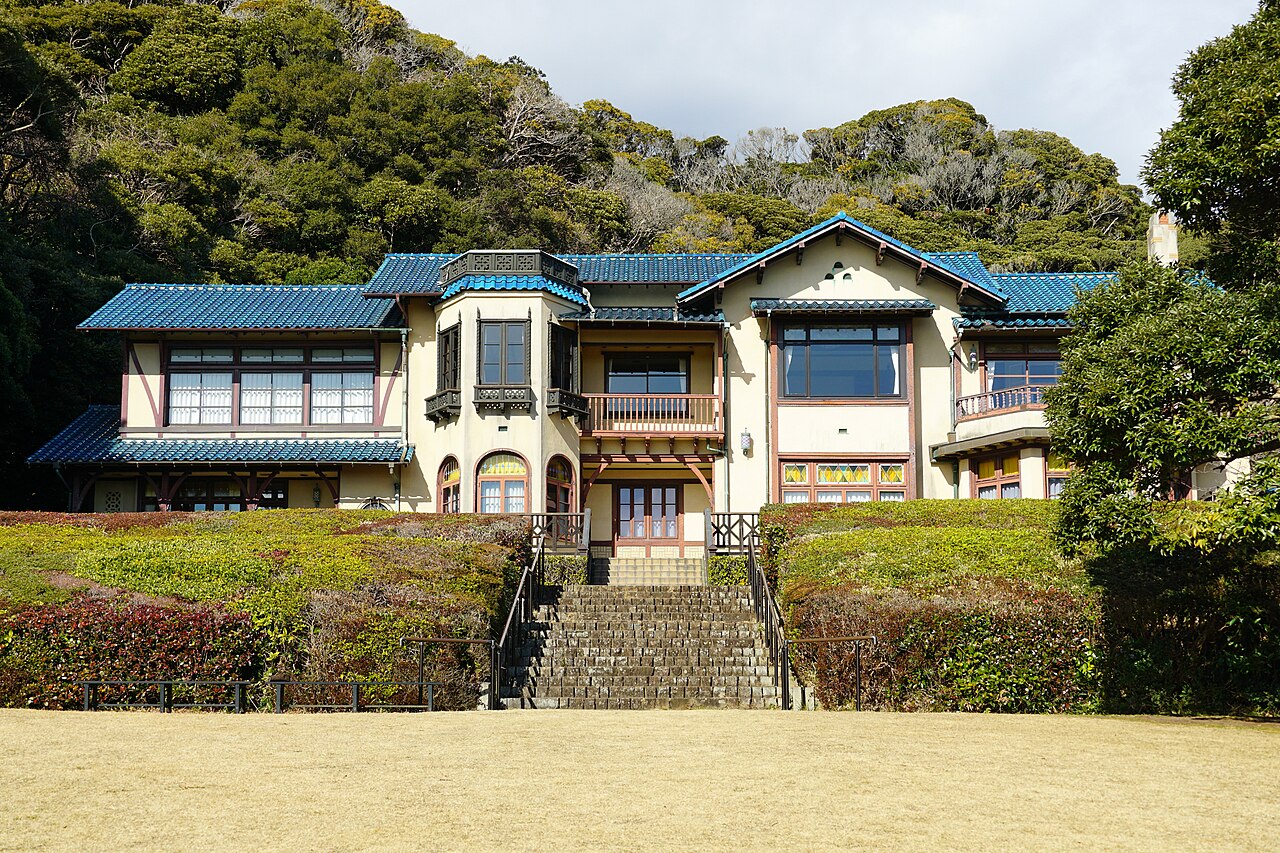
A former marquis's seaside villa turned literary museum, with a famous rose garden overlooking Sagami Bay.
The Kamakura Museum of Literature - Kamakura Bungakukan - occupies one of the most romantic buildings in the city: a grand Western-Japanese hybrid villa built in 1936 for the Maeda family, former daimyo lords of the Kaga domain. Set into a wooded hillside above the Hase district, the mansion looks out across terraced lawns to the glittering line of Sagami Bay, and its elegant blend of half-timbered gables, tiled roofs and Art Deco detailing has made it a beloved landmark. Novelist Yukio Mishima was so taken with it that he used it as the model for the Marquis Matsugae's estate in his final tetralogy, The Sea of Fertility.
Since 1985 the villa has served as a museum devoted to Kamakura's extraordinary literary heritage. The city was, for much of the twentieth century, a favored retreat for Japan's writers - a place where the sea air, temples and quiet lanes drew a remarkable community of novelists and poets. The permanent and rotating exhibitions honor figures such as Natsume Soseki, Ryunosuke Akutagawa, Yasunari Kawabata, Osamu Dazai and Mishima himself, many of whom lived, worked or set stories in and around Kamakura. Manuscripts in the writers' own hands, first editions, letters, photographs and personal effects bring these literary lives close, and the museum regularly mounts themed shows exploring a single author or movement.
For visitors who do not read Japanese, the exhibits themselves can be hard to fully appreciate, since the material is text-heavy and translation is limited. But the building and its garden more than justify the trip. The terraced rose garden, laid out on the slope below the villa, holds nearly two hundred varieties and blooms twice a year - a spectacular flush in mid-to-late spring and a second, softer showing in autumn. Standing among the roses with the villa behind you and the ocean shimmering ahead is one of the quiet pleasures of Kamakura, the kind of view that explains why so many writers chose to live here.
The experience is gentle and unhurried. You wander the ground-floor rooms of the mansion, admire the period woodwork and stained glass, step out onto the lawn, and take in the sea. An hour is ample. The setting is at its best in the rose seasons, so aim for May or October if you can, and go on a clear day to get the full sweep of the bay.
To reach it, ride the little Enoden tram from Kamakura Station toward Hase or Yuigahama and walk uphill for a few minutes into the residential lanes that climb the hillside - a pleasant approach past old houses and garden walls. Admission is inexpensive and varies with the current exhibition. Even if the literature is beyond your reading, the Museum of Literature rewards anyone who loves historic architecture, sea views and gardens, and it pairs naturally with a visit to nearby Hase-dera and the Great Buddha.
A local's tip
Time your visit to the spring or autumn rose season - the terraced garden framing Sagami Bay is the real showpiece, arguably more than the exhibits.
Best time to visit
May and October for the rose garden in bloom
Getting there
Take the Enoden from Kamakura Station to Yuigahama, then walk about 7 minutes uphill toward the hills behind Hase.
Good to know
- Garden
- Restrooms
Plan the whole trip offline
Kamakura Museum of Literature is one of many places in the Real Japan app — with turn-by-turn directions, nearby spots and full offline maps you can use with no signal.