One of Kamakura's five great Zen temples, founded in 1200 on the site of Minamoto Yoritomo's father's residence.
Jufuku-ji is among the oldest and most historically significant Zen temples in Kamakura, ranked third of the Kamakura Gozan — the five great Zen temples that anchored the religious life of the medieval warrior capital. It was founded in 1200 by Hojo Masako, the formidable widow of Minamoto no Yoritomo, the warrior who established the Kamakura shogunate and thereby Japan's first samurai government. The temple was built on ground of deep significance to the Minamoto: this was the site where Yoritomo's father, Minamoto no Yoshitomo, had once had his residence, so the temple bound the new Zen faith directly to the family that founded the shogunate.
Masako invited the pioneering monk Eisai, who had brought the Rinzai school of Zen and the custom of tea drinking from China, to serve as founding priest, making Jufuku-ji one of the cradles of Zen Buddhism in eastern Japan. In an age when the samurai were drawn to Zen's discipline and directness, temples like this shaped the culture of the ruling class.
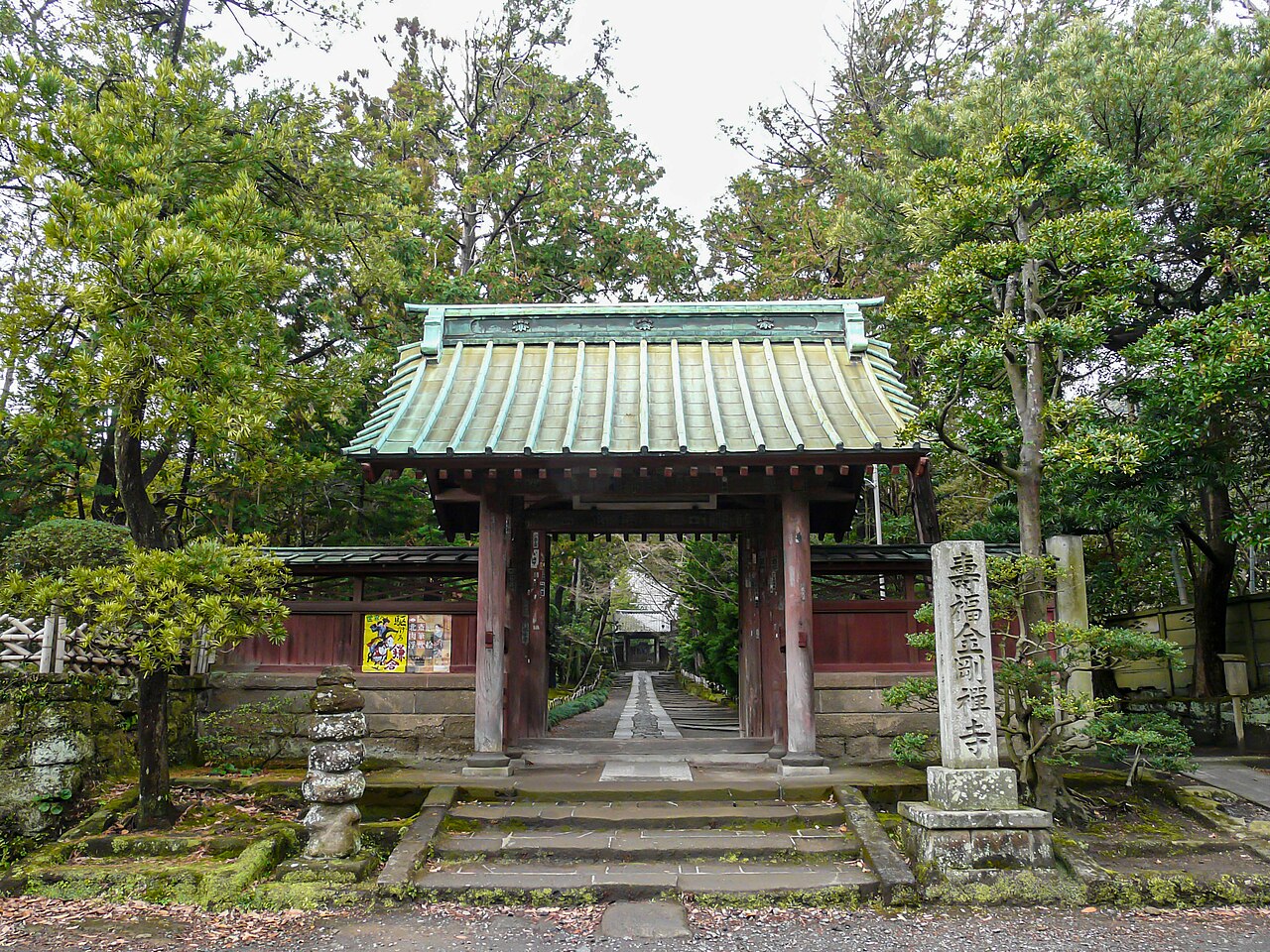
Today Jufuku-ji is quietly beautiful and, unusually, largely closed to the public — you cannot enter the inner precinct or the main hall. Yet the approach alone is one of the most photographed scenes in Kamakura: a long, straight stone path flanked by ancient trees and moss, leading through a simple gate toward the hidden temple buildings. The restraint is part of the appeal; where other temples bustle with visitors, Jufuku-ji keeps its serenity precisely because it asks to be admired from a respectful distance.
The great reward for visitors lies to the side and rear, where a path leads to an old cemetery set against the cliff. Here, carved into the rock, are yagura — the cave-tombs typical of medieval Kamakura, where the hilly terrain made flat burial ground scarce. Two of these caves are traditionally said to hold the remains of Hojo Masako herself and of her son Minamoto no Sanetomo, the third shogun, who was assassinated in 1219. Standing before these weathered stone tombs among the trees, you are as close as anywhere in the city to the founding drama of samurai Japan.
A visit is short, free, and contemplative. The approach path is level and easy, though the cemetery involves uneven ground and some steps. There are no facilities and no crowds — just the hush of an old temple that has kept its dignity for eight centuries. Photographers come for the moss-lined path, especially after rain when the greens deepen, and in spring and autumn the surrounding trees add colour.
Jufuku-ji sits about ten minutes on foot from Kamakura Station, on the road toward Kita-Kamakura, making it an easy first stop on a walk that can take in the Zen temples of the northern valley. It rarely appears on rushed itineraries, which is exactly why those who seek it out find one of Kamakura's most authentically old and peaceful corners.
A local's tip
Walk past the closed main gate and follow the side path to the atmospheric cliffside cemetery, where the yagura cave-tombs said to hold Hojo Masako and her son Sanetomo lie among the trees.
Best time to visit
Any time; the mossy approach is loveliest after rain
Getting there
A 10-minute walk from Kamakura Station's west (Enoden) exit, heading toward Kita-Kamakura.
Plan the whole trip offline
Jufuku-ji is one of many places in the Real Japan app — with turn-by-turn directions, nearby spots and full offline maps you can use with no signal.