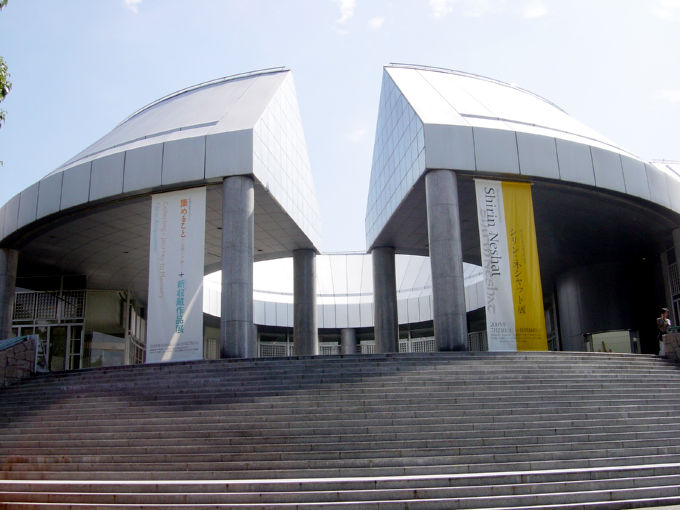
Japan's first public contemporary art museum, a Kisho Kurokawa landmark atop leafy Hijiyama Park.
Perched on the wooded summit of Hijiyama Park, the Hiroshima City Museum of Contemporary Art was the first public museum in Japan dedicated to contemporary art when it opened in 1989. It is as much an architectural destination as an art one, designed by Kisho Kurokawa, a leading figure of Japan's Metabolist movement. Kurokawa wrapped the galleries around a circular plaza and clad the building in stone and aluminium, weaving traditional Japanese forms such as the storehouse and the gate together with sleek modern geometry. The approach through the trees, up to the round plaza with its sculptural archway, primes you for the work inside.
The collection focuses on art made since 1945, with two clear strands. One is international and canonical, including Andy Warhol's Marilyn, Frank Stella, Donald Judd and a monumental Henry Moore sculpture that anchors the grounds. The other, and the reason the museum matters, is art that responds to Hiroshima itself: works grappling with the atomic bombing, memory, the body and peace, by both Japanese and overseas artists. This gives the museum a moral seriousness that sets it apart from a general modern-art collection; contemporary art here is not decoration but a way of continuing to think about what the city has lived through. The programme of temporary exhibitions is adventurous and changes regularly, so there is usually something provocative on show.
The setting doubles the appeal. Hijiyama Park is a green hill rising above the Minami ward, laced with walking paths and dotted with outdoor sculptures, and it is one of Hiroshima's most loved cherry-blossom spots. In early April the approach is a tunnel of pink; in autumn the maples colour the trails. From the ridge you get sweeping views over the city and, on clear days, toward the Seto Inland Sea. It makes the museum an easy place to combine culture with a relaxed walk, a picnic or a family afternoon.
The museum reopened in 2023 after a careful renovation that refreshed the galleries and public spaces while respecting Kurokawa's original vision. Facilities include a cafe, a design-focused shop and full accessibility, with lifts serving the levels despite the hilltop site. Admission to the collection is inexpensive, around 370 yen, with separate pricing for special exhibitions.
Getting there is part of the experience. Take the Hiroden tram to Hijiyama-shita and walk up through the park for about ten minutes, or use the free shuttle that runs on certain days. IC cards work on every tram in the city, and from Hiroshima Station it is only a short ride. Time your visit for cherry-blossom season if you can, tour the galleries, then linger on the summit for the view. For travellers who want a different, more forward-looking side of Hiroshima, one that faces the future rather than only the past, this hilltop museum is the ideal antidote.
A local's tip
Hijiyama Park is one of Hiroshima's best cherry-blossom spots, so visit in early April and combine the galleries with hanami and city views from the summit.
Best time to visit
Spring for the hilltop cherry blossoms
Getting there
Take the Hiroden tram to Hijiyama-shita, then walk about 10 minutes up through Hijiyama Park; a free shuttle bus also runs from the tram stop on some days. The hilltop setting means a gentle uphill approach.
Good to know
- Cafe
- Shop
- Restrooms
- Wheelchair
Plan the whole trip offline
Hiroshima City Museum of Contemporary Art is one of many places in the Real Japan app — with turn-by-turn directions, nearby spots and full offline maps you can use with no signal.