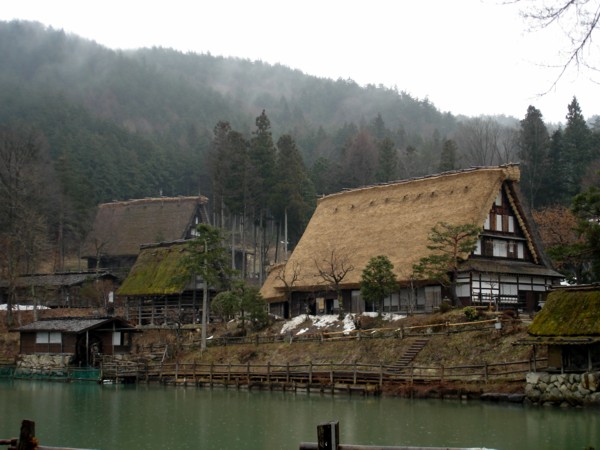
An open-air museum of relocated thatched farmhouses recreating a traditional Hida mountain village.
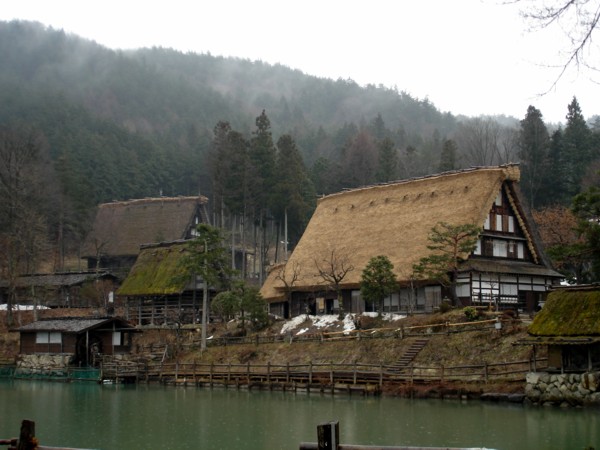
Hida Folk Village, known locally as Hida no Sato, is an open-air museum on the wooded hills southwest of central Takayama, where more than thirty authentic historic buildings have been carefully dismantled from villages across the Hida region and reassembled around a tranquil central pond. Rather than a collection of empty shells, it is a living re-creation of an entire pre-modern mountain community, complete with farmhouses, a village headman's residence, storehouses, a logging hut and workshops.
The architectural stars are the gassho-zukuri farmhouses, their steep thatched roofs pitched like two hands pressed together in prayer, a design evolved to shed the region's famously heavy snowfall. Some of the relocated houses are more than 300 years old, and their soot-blackened beams, sunken hearths and silk-worm lofts tell the story of how families lived, farmed and endured the long alpine winters. Interpretive displays and preserved furnishings show everything from rice cultivation and sake brewing to the raising of silkworms in the upper floors.
What sets Hida no Sato apart is that artisans still work on site. Depending on the season you can watch woodcarvers, weavers, dyers and lacquer craftspeople at their trades, buy their handmade goods, and even try hands-on activities such as making a sarubobo doll, the region's faceless red good-luck charm. This working dimension turns a museum stroll into an immersive lesson in Hida craftsmanship, a tradition that stretches back to the master carpenters who were once sent to build temples in the imperial capital in lieu of paying taxes.
The experience shifts dramatically with the seasons. In spring and summer the ponds and surrounding forest are lush and green; autumn drapes the roofs in fiery maple colour; and winter is the most magical of all, when snow piles thick on the thatch and the village is lit up on select evenings, its glowing houses mirrored in the frozen pond. A giant four-metre maneki-neko beckoning cat near the entrance adds a whimsical touch that delights children.
Allow around two hours to walk the loop at a relaxed pace, more if you join a workshop. Paths are gentle but there are some slopes and steps, so sensible shoes help, especially in snow. There are restrooms, a gift shop and rest areas, and the elevated setting gives fine views back over Takayama toward the Japan Alps.
Getting there is easy: the Sarubobo sightseeing bus runs from Takayama Station to the Hida no Sato stop in about ten minutes, and a combined bus-and-admission ticket costs 930 yen versus the 700-yen entry alone. Energetic visitors can walk up in around thirty minutes. Open daily from 08:30 to 17:00, it pairs naturally with the nearby Hida Takayama Museum of Art for a half-day away from the old town crowds, and rewards anyone curious about how ordinary people actually lived in one of Japan's snowiest inland regions.
A local's tip
Visit in winter when the village is illuminated at night and the thatched roofs are buried in snow; the reflection of the gassho houses in the central pond is the classic shot.
Best time to visit
Winter for snow-laden roofs; autumn for foliage
Getting there
From Takayama Station take the Sarubobo Bus (about 10 minutes) toward Hida no Sato, or a combined bus-and-entry ticket for 930 yen. On foot it is roughly a 30-minute uphill walk west of the station.
Good to know
- Gift shop
- Restrooms
- Craft workshops
Plan the whole trip offline
Hida Folk Village (Hida no Sato) is one of many places in the Real Japan app — with turn-by-turn directions, nearby spots and full offline maps you can use with no signal.